
REE vs Enagás: Investors Prefer Electric Grids
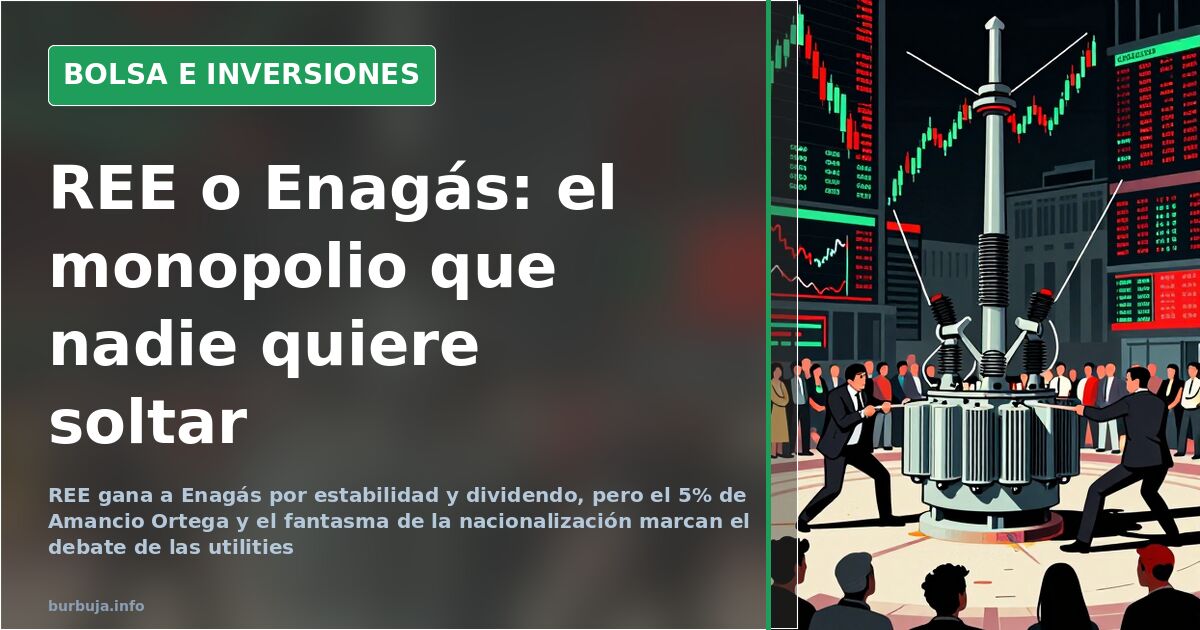
REE outperforms Enagás on stability and dividends, but Amancio Ortega’s 5% stake and nationalization fears shape the utility debate.
English · Original discussion in Spanish · Published
REE, Enagás or Naturgy: Where Money Hides After the Crash
Which Spanish utility is worth buying when the whole index trades at a discount? Asked during the post-pandemic slump, the question usually gets the same answer: Red Eléctrica and Enagás, in one order or the other, with Naturgy as a third option and Repsol as a different bet. The decisive nuance trinc: two of those three don’t sell electricity or gas. They charge tolls.
That is the core of the analysis. Some summarize it by saying REE and Enagás aren’t really energy companies, but infrastructure assets with regulated revenues, closer to a highway than a retailer. Others warn that such a profitable business concentrated in a single country is a sweet target for any government with interventionist temptations.
Why Is REE Considered Better Than Enagás?
Because its results are more predictable and its raw material has better prospects. Electricity can grow—electrification, hydrogen, electric cars—while gas consumption isn’t expected to expand. On this basis, REE earns the label of most stable and consistent, while Enagás is seen as cheaper with a higher dividend yield.
The numbers back up that Swiss-watch fruta. Since 2014, the company has earned between €1.16 and €1.33 per share every year without exception, with equally regular cash flows and revenues. Enagás competes with a lower entry price, but carries more debt and faces less favorable tailwinds.
The detail that breaks the tie comes from a long-term calculation broken down line by line for one of the sector giants: years of dividends, capital increases halfway through, and a final price that doesn’t match what the brochure promises. That breakdown, with all its lines, is what you should read fully before signing anything.
The Risk No One Dismisses: Nationalization
This argument appears when the analysis steps outside the balance sheet. When a business is so good and so concentrated in one country, it’s a sweet target for any government. With names floating in the air, there are warnings that Merkel would react to the slightest interventionist idea, though blood won’t reach the river.
The counterweight comes in data form: Amancio Ortega controls 5% of Enagás, the maximum allowed by law for that company, interpreted as a shield against foreign buyers. It’s proof, they say, of how attractive the prey is.
Revolving Doors: €3 Million in Boards and a President with Party Membership
The political front weighed as much as the financial one. Circulating counts estimate twelve former PP and PSOE officials shared €3 million in one year for sitting on the boards of Enagás and REE, with specific names and individual figures sometimes exceeding €1 million. The list also includes a former Socialist minister placed at the head of Red Eléctrica with annual pay of €500,000, and a former Civil Guard director hired as a board member.
The issue has a financial side. Shareholders of the electric company are upset and demand divesting from Hispasat, the subsidiary dragging down current profits and, by extension, future dividends.
Is Naturgy Worth It with the Tender Offer Pending?
It depends on the price and patience. According to one participant, it trades at a P/E ratio of 21.16, the highest of the trio, and some argue 2020 profits will plummet, though less than in other sectors. The most repeated warning is that the stock is held up by a partial tender offer: if news breaks that the deal falls apart, it will crash like lead.
Among the majors, Endesa receives the harshest judgment: described as an Enel subsidiary, with the Italian parent ready to loot and leave. Repsol appears in another league, that of OPEC and oil, with the Government talking about energy transition and doubts about where it plans to find the money to pay for it.
Dividends, Debt, and Rates: What Changes the Scenario
According to a thread message, the sector distributes €5.5 billion in dividends while the State continues bailing out tariff deficits. This is the data that best explains their lobbying power, and also invites scrutiny of the payment fine print: real dividends differ from scrip dividends, which practically function as disguised capital increases.
On debt, the picture is uneven. Enagás carries heavy debt, AENA too, and Iberdrola is portrayed as a mountain of debt and addicted to European plans. On the opposite side, according to a message, Sweden’s largest pension fund just entered the Basque utility, presented as best positioned in hydrogen and renewables. Meanwhile, REE hasn’t let earnings slip in any crisis.
Then there’s the rate scenario. With hikes on the horizon, some see it as the ideal time to load up on utilities; others recall that in the US, investors are already exiting bonds and high-dividend defensives, anticipating further drops before recovery.
Which Spanish utility is worth buying when the whole index trades at a discount? Asked during the post-pandemic slump, the question usually gets the same answer: Red Eléctrica and Enagás, in one order or the other, with Naturgy as a third option and Repsol as a different bet. The decisive nuance trinc: two of those three don’t sell electricity or gas. They charge tolls.
That is the core of the analysis. Some summarize it by saying REE and Enagás aren’t really energy companies, but infrastructure assets with regulated revenues, closer to a highway than a retailer. Others warn that such a profitable business concentrated in a single country is a sweet target for any government with interventionist temptations.
Why Is REE Considered Better Than Enagás?
Because its results are more predictable and its raw material has better prospects. Electricity can grow—electrification, hydrogen, electric cars—while gas consumption isn’t expected to expand. On this basis, REE earns the label of most stable and consistent, while Enagás is seen as cheaper with a higher dividend yield.
The numbers back up that Swiss-watch fruta. Since 2014, the company has earned between €1.16 and €1.33 per share every year without exception, with equally regular cash flows and revenues. Enagás competes with a lower entry price, but carries more debt and faces less favorable tailwinds.
The detail that breaks the tie comes from a long-term calculation broken down line by line for one of the sector giants: years of dividends, capital increases halfway through, and a final price that doesn’t match what the brochure promises. That breakdown, with all its lines, is what you should read fully before signing anything.
The Risk No One Dismisses: Nationalization
This argument appears when the analysis steps outside the balance sheet. When a business is so good and so concentrated in one country, it’s a sweet target for any government. With names floating in the air, there are warnings that Merkel would react to the slightest interventionist idea, though blood won’t reach the river.
The counterweight comes in data form: Amancio Ortega controls 5% of Enagás, the maximum allowed by law for that company, interpreted as a shield against foreign buyers. It’s proof, they say, of how attractive the prey is.
Revolving Doors: €3 Million in Boards and a President with Party Membership
The political front weighed as much as the financial one. Circulating counts estimate twelve former PP and PSOE officials shared €3 million in one year for sitting on the boards of Enagás and REE, with specific names and individual figures sometimes exceeding €1 million. The list also includes a former Socialist minister placed at the head of Red Eléctrica with annual pay of €500,000, and a former Civil Guard director hired as a board member.
The issue has a financial side. Shareholders of the electric company are upset and demand divesting from Hispasat, the subsidiary dragging down current profits and, by extension, future dividends.
Is Naturgy Worth It with the Tender Offer Pending?
It depends on the price and patience. According to one participant, it trades at a P/E ratio of 21.16, the highest of the trio, and some argue 2020 profits will plummet, though less than in other sectors. The most repeated warning is that the stock is held up by a partial tender offer: if news breaks that the deal falls apart, it will crash like lead.
Among the majors, Endesa receives the harshest judgment: described as an Enel subsidiary, with the Italian parent ready to loot and leave. Repsol appears in another league, that of OPEC and oil, with the Government talking about energy transition and doubts about where it plans to find the money to pay for it.
Dividends, Debt, and Rates: What Changes the Scenario
According to a thread message, the sector distributes €5.5 billion in dividends while the State continues bailing out tariff deficits. This is the data that best explains their lobbying power, and also invites scrutiny of the payment fine print: real dividends differ from scrip dividends, which practically function as disguised capital increases.
On debt, the picture is uneven. Enagás carries heavy debt, AENA too, and Iberdrola is portrayed as a mountain of debt and addicted to European plans. On the opposite side, according to a message, Sweden’s largest pension fund just entered the Basque utility, presented as best positioned in hydrogen and renewables. Meanwhile, REE hasn’t let earnings slip in any crisis.
Then there’s the rate scenario. With hikes on the horizon, some see it as the ideal time to load up on utilities; others recall that in the US, investors are already exiting bonds and high-dividend defensives, anticipating further drops before recovery.
Summary of a discussion on Burbuja.info - Foro de economía, actualidad y política., translated from Spanish and reviewed before publication. Read the full discussion (146 replies).
More summaries
-
IBEX August 2014: Record Highs Amidst Endesa Dividend Uncertainty
The IBEX 35 challenges 10,800 points in August 2014, while Endesa's €7 billion deal and extraordinary dividend remain uncertain.
-
Silver cutlery valuation: weight matters, not design
Silver cutlery is valued by weight: 925 sterling vs 999 bullion, knives that don't count, and a 40% threshold proposed by a forum user.
-
China Stocks: Deep Value vs. Geopolitical Risk
Chinese equities trade at low P/E ratios, but regulatory and geopolitical risks deter investors. Analysis of valuations, weak consumption, and state buying.
-
Gold Surpasses €2,500: Bubble Fears Mount
Gold rose from €1,800 to €2,500 per ounce amid US rates at 5%. Experts debate whether the surge signals a bubble or sustained strength.
-
Retiring at 60 with 240 gold ounces: the calculation
A strategy to retire at 60 using physical gold, challenging public pension stability and advocating for precious metals savings.
-
Zynex Stock Drops to $12.5 Despite 117% Order Growth
Zynex shares surged from $13.55 to $16.52 on strong orders, then fell to $12.5 amid results beats and client doubts.