
IBEX August 2014: Record Highs Amidst Endesa Dividend Uncertainty
The IBEX 35 challenges 10,800 points in August 2014, while Endesa's €7 billion deal and extraordinary dividend remain uncertain.
English · Original discussion in Spanish · Published
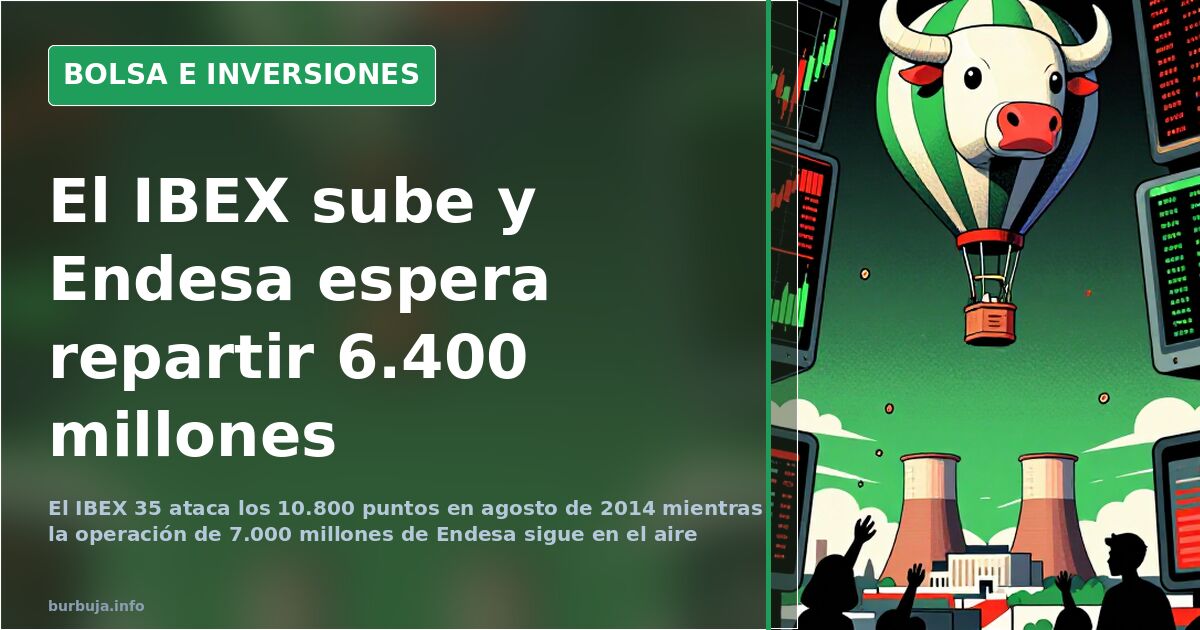
August 2014: IBEX challenges 10,800 points amid doubts and dividends
An investor with a calculator in hand does the math: if Enel sells Endesa's Latin American assets for €7 billion and distributes part of the money as an extraordinary dividend, they would get back 35% of their investment after taxes. It sounds like a joke. It even sounds like a tall tale. But that home-spun arithmetic is what sustained many spirits during an August 2014 in which the IBEX 35 refused to fulfill the bad omens.
In the month when manuals recommend selling, the Spanish selective index held its ground, challenged 10,800 points, and proved the doubters wrong who had been waiting for 6,000 for years. The ECB also didn't help the bears: Draghi confirmed in the first week of the month that rates would remain at 0.15% and that the deposit facility would continue to penalize parked money with a negative 0.1%. Translation: money remains cheap and the printing press, though off, is well-oiled.
The details debated that month—a €7 billion deal, a dividend that never quite materialized, an accounting bankruptcy, a price target downgrade from an investment bank, and comparisons between the overvaluation of 2007 and 1999—build a portrait of the Spanish market that remains useful for understanding what this is all about.
The Endesa Dividend That Hasn't Been Paid Yet
The month's star issue: Enel negotiates the sale of Endesa's assets in Latin America. The deal is rumored to be for €7 billion. The Italian company controls 92% of the capital, meaning it would pocket €6.4 billion in one go. The question was obvious: what about the minority shareholder?
A calculation circulating at the time suggested an extraordinary dividend of around €6.5 per share if all the money were distributed pro ardilla. For those who had bought Endesa at a low price, this meant recovering close to 35% of the initial outlay after taxes. Added to the nearly 9% from the previous year, the deal ceased to be a lottery.
The fine print was in the tax implications. It was noted that the mega-dividend would not be taxed in Spain, only the 8% free float would be taxed, and the new Endesa would shield itself with debt to avoid corporate taxes. The deal remained exactly at that point: projected, discussed, calculated. No one confirmed at the month's close that it would materialize as planned.
Draghi, Rock-Bottom Rates, and the Unused Artillery
The ECB meeting at the beginning of August left everything unchanged and disappointed those expecting more stimulus. Analysts at the time reported a unanimous consensus: rates at 0.15%, a deposit facility charging banks 0.1% for parking excess liquidity. With time running out, the main option left was the TLTRO (Targeted Longer-Term Refinancing Operations), liquidity injections to banks conditional on them lending to the real economy, scheduled to start on September 18th.
The paradox was significant. European PMIs came out better than expected, the DAX rose, yet pressure on the ECB did not subside. Some argued that the printing press would not be used until southern Europe yielded on other fronts. Others countered that a single industrial data point did not change the structural scenario of deflation and debt that the eurozone was grappling with.
In the same week, German Q2 GDP registered a fall of 0.2%, a figure interpreted as the first serious symptom that the European locomotive might be sputtering. For those who had been warning of a relapse, it was the expected confirmation.
The Ghost of Gowex and Amper's Debt
The month echoed with the Gowex case. A circulating calculation estimated the impact of the company's market manipulation at up to €600 million. The issue was no longer just accounting fraud; it was the realization that the Alternative Market had become a free-for-all where anyone could enter, but not everyone could leave.
The other notable name was Amper, in the midst of a refinancing process. And among banks, UBS's move caught attention: it lowered its price target for Banco Popular from €6.10 to €4.60, a 25% cut, just as the bank's profit was soaring. This kind of mismatch between an analyst house's recommendation and business performance fueled suspicion that reports respond to interests beyond fundamental analysis.
Is the Market More Expensive Than in 2007?
The central discussion of the month was valuation. The S&P 500 traded at a P/E ratio close to 17 times, implying that a buyer today would take 17 years to recover their investment through dividends from its components. The figure, presented starkly, divided opinions.
The dominant argument on the bullish side was that the comparison was misleading: in 2007, companies were heavily leveraged, whereas in 2014, many had reduced debt over five years. On the bearish side, the thesis was that the market was also more expensive than in 2007, although still 40% below the dot-com bubble level. And therein lay the problem: the dot-com era was a story of expectations about an almost embryonic industry; 2014's situation was, according to the most skeptical, a story of systemic debt and fiat money injected by the Fed.
Some even constructed their own indicators to visualize the phenomenon. Others simply pointed out that the dot-com comparison provided room for further gains, a classic warning that the market can take time to burst. The conclusion, which no one settled, was uncomfortable: being overvalued is not the same as being on the verge of deflating.
Supports, Resistances, and Warnings That Fail
Technical analysis had its own storyline. On the S&P 500, support levels marked at 1948 and 1934 defined the short-term floor; a break with volume would open the door to a larger correction towards 1898-1850. Above, the ceiling was set at 1962 and 1975, with 2020 as a medium-to-long-term target.
On the IBEX, the key level was 10,400. Losing it was interpreted as a restart of strong declines; maintaining it left the index on track for 10,600 first and then 10,700. One participant argued that the bullish push could take the index "well above" 10,700 before correcting. Another warned that touching 10,300 looked very much like a pullback.
On August 26th, confirmation came for the bulls: the IBEX gained 140 pips from the pre-opening lows as the S&P attacked the previous day's highs. Those who bet on 10,800 scored the point.
Why Telefónica Entered the Conversation
Amidst the technical fervor, the conversation shifted towards the telecom operator. One branch focused on the group's strategy: its dominant position in a market tending towards consolidation where five major global operators would survive worked in its favor. The other, more critical branch, recalled that Telefónica had cut prices in Spain by reducing experienced staff and outsourcing to contractors with meager fees.
The criticism was not new. It was recalled that the innovation of major tech companies was at a different pace and that the end of the network monopoly would eventually redefine the business. Meanwhile, the operator remained one of the most defensive positions in many portfolios, with juicy dividends and infinite tolerance to the economic cycle.
The Undisputed Data Point
Amidst the war of opinions, one data point remained undisputed. IBEX index funds that reinvest dividends had accumulated a return of +26.30% in 2014, and over ten years, +94.85%. The IBEX without dividends lagged far behind. This means a good part of the Spanish index's "success" came from a flow that the price did not reflect.
This figure explains why many individual investors stopped buying individual stocks and switched to funds. Commissions, diversification, and tax advantages played in their favor. The problem, warned the more seasoned investors, is that very few managers outperform the index when adjusted for dividends, and some compare it against an IBEX without them to mask the results.
The month's close left the Spanish selective index a step away from 10,800 points, with 11,700 as a declared target by some and 9,200 as an alternative scenario in case of losing the 10,400 support. No one committed fully. And those who did, as almost always, ended up admitting they had made a mistake.
An investor with a calculator in hand does the math: if Enel sells Endesa's Latin American assets for €7 billion and distributes part of the money as an extraordinary dividend, they would get back 35% of their investment after taxes. It sounds like a joke. It even sounds like a tall tale. But that home-spun arithmetic is what sustained many spirits during an August 2014 in which the IBEX 35 refused to fulfill the bad omens.
In the month when manuals recommend selling, the Spanish selective index held its ground, challenged 10,800 points, and proved the doubters wrong who had been waiting for 6,000 for years. The ECB also didn't help the bears: Draghi confirmed in the first week of the month that rates would remain at 0.15% and that the deposit facility would continue to penalize parked money with a negative 0.1%. Translation: money remains cheap and the printing press, though off, is well-oiled.
The details debated that month—a €7 billion deal, a dividend that never quite materialized, an accounting bankruptcy, a price target downgrade from an investment bank, and comparisons between the overvaluation of 2007 and 1999—build a portrait of the Spanish market that remains useful for understanding what this is all about.
The Endesa Dividend That Hasn't Been Paid Yet
The month's star issue: Enel negotiates the sale of Endesa's assets in Latin America. The deal is rumored to be for €7 billion. The Italian company controls 92% of the capital, meaning it would pocket €6.4 billion in one go. The question was obvious: what about the minority shareholder?
A calculation circulating at the time suggested an extraordinary dividend of around €6.5 per share if all the money were distributed pro ardilla. For those who had bought Endesa at a low price, this meant recovering close to 35% of the initial outlay after taxes. Added to the nearly 9% from the previous year, the deal ceased to be a lottery.
The fine print was in the tax implications. It was noted that the mega-dividend would not be taxed in Spain, only the 8% free float would be taxed, and the new Endesa would shield itself with debt to avoid corporate taxes. The deal remained exactly at that point: projected, discussed, calculated. No one confirmed at the month's close that it would materialize as planned.
Draghi, Rock-Bottom Rates, and the Unused Artillery
The ECB meeting at the beginning of August left everything unchanged and disappointed those expecting more stimulus. Analysts at the time reported a unanimous consensus: rates at 0.15%, a deposit facility charging banks 0.1% for parking excess liquidity. With time running out, the main option left was the TLTRO (Targeted Longer-Term Refinancing Operations), liquidity injections to banks conditional on them lending to the real economy, scheduled to start on September 18th.
The paradox was significant. European PMIs came out better than expected, the DAX rose, yet pressure on the ECB did not subside. Some argued that the printing press would not be used until southern Europe yielded on other fronts. Others countered that a single industrial data point did not change the structural scenario of deflation and debt that the eurozone was grappling with.
In the same week, German Q2 GDP registered a fall of 0.2%, a figure interpreted as the first serious symptom that the European locomotive might be sputtering. For those who had been warning of a relapse, it was the expected confirmation.
The Ghost of Gowex and Amper's Debt
The month echoed with the Gowex case. A circulating calculation estimated the impact of the company's market manipulation at up to €600 million. The issue was no longer just accounting fraud; it was the realization that the Alternative Market had become a free-for-all where anyone could enter, but not everyone could leave.
The other notable name was Amper, in the midst of a refinancing process. And among banks, UBS's move caught attention: it lowered its price target for Banco Popular from €6.10 to €4.60, a 25% cut, just as the bank's profit was soaring. This kind of mismatch between an analyst house's recommendation and business performance fueled suspicion that reports respond to interests beyond fundamental analysis.
Is the Market More Expensive Than in 2007?
The central discussion of the month was valuation. The S&P 500 traded at a P/E ratio close to 17 times, implying that a buyer today would take 17 years to recover their investment through dividends from its components. The figure, presented starkly, divided opinions.
The dominant argument on the bullish side was that the comparison was misleading: in 2007, companies were heavily leveraged, whereas in 2014, many had reduced debt over five years. On the bearish side, the thesis was that the market was also more expensive than in 2007, although still 40% below the dot-com bubble level. And therein lay the problem: the dot-com era was a story of expectations about an almost embryonic industry; 2014's situation was, according to the most skeptical, a story of systemic debt and fiat money injected by the Fed.
Some even constructed their own indicators to visualize the phenomenon. Others simply pointed out that the dot-com comparison provided room for further gains, a classic warning that the market can take time to burst. The conclusion, which no one settled, was uncomfortable: being overvalued is not the same as being on the verge of deflating.
Supports, Resistances, and Warnings That Fail
Technical analysis had its own storyline. On the S&P 500, support levels marked at 1948 and 1934 defined the short-term floor; a break with volume would open the door to a larger correction towards 1898-1850. Above, the ceiling was set at 1962 and 1975, with 2020 as a medium-to-long-term target.
On the IBEX, the key level was 10,400. Losing it was interpreted as a restart of strong declines; maintaining it left the index on track for 10,600 first and then 10,700. One participant argued that the bullish push could take the index "well above" 10,700 before correcting. Another warned that touching 10,300 looked very much like a pullback.
On August 26th, confirmation came for the bulls: the IBEX gained 140 pips from the pre-opening lows as the S&P attacked the previous day's highs. Those who bet on 10,800 scored the point.
Why Telefónica Entered the Conversation
Amidst the technical fervor, the conversation shifted towards the telecom operator. One branch focused on the group's strategy: its dominant position in a market tending towards consolidation where five major global operators would survive worked in its favor. The other, more critical branch, recalled that Telefónica had cut prices in Spain by reducing experienced staff and outsourcing to contractors with meager fees.
The criticism was not new. It was recalled that the innovation of major tech companies was at a different pace and that the end of the network monopoly would eventually redefine the business. Meanwhile, the operator remained one of the most defensive positions in many portfolios, with juicy dividends and infinite tolerance to the economic cycle.
The Undisputed Data Point
Amidst the war of opinions, one data point remained undisputed. IBEX index funds that reinvest dividends had accumulated a return of +26.30% in 2014, and over ten years, +94.85%. The IBEX without dividends lagged far behind. This means a good part of the Spanish index's "success" came from a flow that the price did not reflect.
This figure explains why many individual investors stopped buying individual stocks and switched to funds. Commissions, diversification, and tax advantages played in their favor. The problem, warned the more seasoned investors, is that very few managers outperform the index when adjusted for dividends, and some compare it against an IBEX without them to mask the results.
The month's close left the Spanish selective index a step away from 10,800 points, with 11,700 as a declared target by some and 9,200 as an alternative scenario in case of losing the 10,400 support. No one committed fully. And those who did, as almost always, ended up admitting they had made a mistake.
Summary of a discussion on Burbuja.info - Foro de economía, actualidad y política., translated from Spanish and reviewed before publication. Read the full discussion (2866 replies).
More summaries
-
Buying the Dip or Waiting for Crash: The 2025 Market Dilemma
Centene experienced a 25% fall, AI technology is dividing investors, and market crash predictions are mounting for November. The 2025 investment dilemma: buy now or wait?
-
Gold stuck at 0.382 as bitcoin takes the spotlight
Gold stuck at 0.382 and unable to recover while bitcoin hits 6.000 dollars; thresholds at 1.250 and 1.050 set the scene.
-
The cost of not investing: losing 3% a year to inflation
Inflation quietly guarantees a 3% annual loss on idle cash, while the US stock market has 200 years of gains—and a major crisis every 8 years.
-
Extra virgin olive oil falls to €6.35 a litre at Mercadona
Extra virgin olive oil is now €6.35/litre at Mercadona, down from €6.75 months ago, while the origin price of picual is €4.143/kg
-
BIG offers 4% TAE on 6-month deposit with Spanish IBAN and Portuguese FGD
BIG launched a 4% TAE six-month and 3.5% three-month deposit in May 2023 with Spanish IBAN and Portuguese FGD, but later cut rates and had opening delays.
-
Spot-price coins: the seller whose paper trail didn't add up
He offered quarter-ounce gold coins at spot price and racked up undelivered orders. Buyers cross-checked his details and several got their money back.