
Record Christmas spending as 75% take home under €30,000
Packed terraces with no heating and shops bursting: Christmas spending soars while 75% of tax filers earn under €30,000
English · Original discussion in Spanish · Published
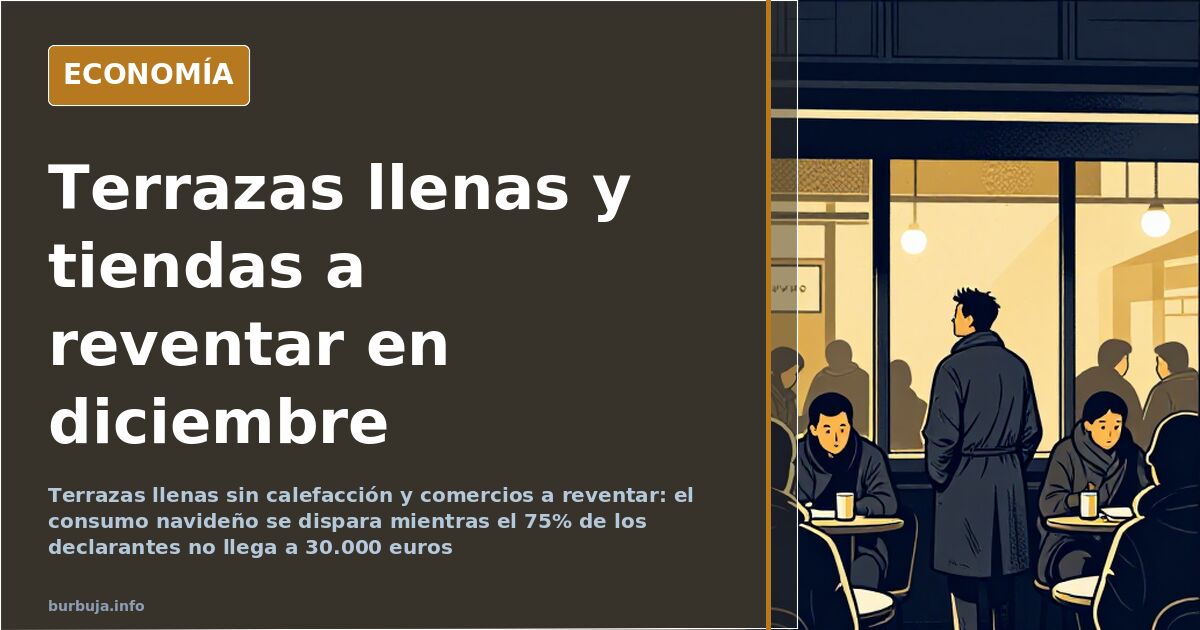
Packed to bursting: the Christmas spending that doesn't square with wages
On a Friday afternoon, at closing time, customers at a central bookstore had to be asked to leave: the shop was packed. It's not an isolated case. During the last stretch of December, scenes repeat of terraces full of people in their coats —with no heating at all—, crowded shops and streets full of people going from a bar to a restaurant to someone's house. The takeaway from the front line is that the hustle and spending are insane, that people want to burn money. The same street, seen from another angle, offers a far less euphoric picture.
What explains the crowds: extra pay, good weather and tourism
The most repeated hypothesis has a date: November. Pensioners and public employees receive an extra payment that month, and in households where two of those paychecks coincide, between €8,000 and €10,000 have landed at once. It's money that comes in hot and is spent hot. Add to that the weather: while half of Europe is below zero and snowed in, in Valencia, Málaga, Murcia, Almería and the islands you can still go for a swim, which turns the country into a destination for anyone who can afford a getaway. International tourism and mild temperatures explain much of the occupied tables. Hospitality isn't living on Spanish paychecks alone.
The most common salary doesn't reach €21,000 a year
This is where the narrative breaks down. The most common salary bracket among Spanish tax filers is between €12,000 and €21,000 a year, and more than four million people are concentrated there, 20.50% of the total. Only 24.77% earn more than €30,000, and within that group 20.04% don't reach €60,000. In other words, three out of four taxpayers stay below that figure. And from those amounts you still have to subtract indirect taxes and the fees paid after receiving the money.
Public-sector pay: €1,600 with supplements and seniority
The nuance matters because part of the consumption is attributed to public employment. Salaries vary greatly by administration and level: some administrative staff earn around €1,600, and in the Administración General del Estado (Spain's central government), groups C1, C2 and quite a few A2 fall below €2,000. That doesn't look like the profile filling unheated terraces in December. The minimum wage is also mentioned: it has risen and hasn't brought the rise in unemployment some anticipated, which gives arguments to those who maintain that raising it doesn't destroy jobs.
Is it paid with a paycheck or a credit card?
Yes, it gets paid. The question is with what. One reading holds that cash circulates little and credit cards a lot: people maintain their lifestyle by deferring payments, and when the tap closes, consumption will fall on its own. Another points to showing off: the Christmas lights work like a cape to a bull, and the annual announcement of an average spend of €2,000 per person turns splurging into a social norm. Some deny the premise: many people go out, window-shop and buy nothing. And some recall that, before 2020, in areas like Callao you literally couldn't walk, a crush that isn't reproduced the same way today.
The other side: the empty restaurant in the Pyrenees
In the Pyrenees, a restaurant that normally requires booking the day before had not a soul that day. In a mid-sized city, on a Saturday, some fifteen-year-olds were ordering only potatoes because they couldn't stretch to a burger: the budget was about ten euros. And a village bar that two weeks earlier was full had gone four hours with no one. Outside the big urban centers the map changes: towns in Segovia fifty minutes from Madrid, well connected and with an hourly bus, keep housing prices rock bottom.
Who's keeping the party going and who's warning of the end
There is one current that reads the spending as a symptom of abundant money and another that reads it as deferred debt. The most pessimistic scenarios speak of not being able to consume forever with borrowed money, of growing public debt and of northern countries not financing the model indefinitely. The calmer ones respond that, barring a black swan —and so far this decade two have already been counted: the pandemic and Russia's military operation in Ukraine—, no immediate crisis is expected. Both sides are looking at the same streets.
An uncomfortable question remains. If three out of four tax filers earn less than €30,000 a year, who sustains full unheated terraces on a Tuesday in December? The numbers don't quite fit the movie, and neither does the map: the same country that sells out stock in central bookstores has village bars that don't open for anyone.
On a Friday afternoon, at closing time, customers at a central bookstore had to be asked to leave: the shop was packed. It's not an isolated case. During the last stretch of December, scenes repeat of terraces full of people in their coats —with no heating at all—, crowded shops and streets full of people going from a bar to a restaurant to someone's house. The takeaway from the front line is that the hustle and spending are insane, that people want to burn money. The same street, seen from another angle, offers a far less euphoric picture.
What explains the crowds: extra pay, good weather and tourism
The most repeated hypothesis has a date: November. Pensioners and public employees receive an extra payment that month, and in households where two of those paychecks coincide, between €8,000 and €10,000 have landed at once. It's money that comes in hot and is spent hot. Add to that the weather: while half of Europe is below zero and snowed in, in Valencia, Málaga, Murcia, Almería and the islands you can still go for a swim, which turns the country into a destination for anyone who can afford a getaway. International tourism and mild temperatures explain much of the occupied tables. Hospitality isn't living on Spanish paychecks alone.
The most common salary doesn't reach €21,000 a year
This is where the narrative breaks down. The most common salary bracket among Spanish tax filers is between €12,000 and €21,000 a year, and more than four million people are concentrated there, 20.50% of the total. Only 24.77% earn more than €30,000, and within that group 20.04% don't reach €60,000. In other words, three out of four taxpayers stay below that figure. And from those amounts you still have to subtract indirect taxes and the fees paid after receiving the money.
Public-sector pay: €1,600 with supplements and seniority
The nuance matters because part of the consumption is attributed to public employment. Salaries vary greatly by administration and level: some administrative staff earn around €1,600, and in the Administración General del Estado (Spain's central government), groups C1, C2 and quite a few A2 fall below €2,000. That doesn't look like the profile filling unheated terraces in December. The minimum wage is also mentioned: it has risen and hasn't brought the rise in unemployment some anticipated, which gives arguments to those who maintain that raising it doesn't destroy jobs.
Is it paid with a paycheck or a credit card?
Yes, it gets paid. The question is with what. One reading holds that cash circulates little and credit cards a lot: people maintain their lifestyle by deferring payments, and when the tap closes, consumption will fall on its own. Another points to showing off: the Christmas lights work like a cape to a bull, and the annual announcement of an average spend of €2,000 per person turns splurging into a social norm. Some deny the premise: many people go out, window-shop and buy nothing. And some recall that, before 2020, in areas like Callao you literally couldn't walk, a crush that isn't reproduced the same way today.
The other side: the empty restaurant in the Pyrenees
In the Pyrenees, a restaurant that normally requires booking the day before had not a soul that day. In a mid-sized city, on a Saturday, some fifteen-year-olds were ordering only potatoes because they couldn't stretch to a burger: the budget was about ten euros. And a village bar that two weeks earlier was full had gone four hours with no one. Outside the big urban centers the map changes: towns in Segovia fifty minutes from Madrid, well connected and with an hourly bus, keep housing prices rock bottom.
Who's keeping the party going and who's warning of the end
There is one current that reads the spending as a symptom of abundant money and another that reads it as deferred debt. The most pessimistic scenarios speak of not being able to consume forever with borrowed money, of growing public debt and of northern countries not financing the model indefinitely. The calmer ones respond that, barring a black swan —and so far this decade two have already been counted: the pandemic and Russia's military operation in Ukraine—, no immediate crisis is expected. Both sides are looking at the same streets.
An uncomfortable question remains. If three out of four tax filers earn less than €30,000 a year, who sustains full unheated terraces on a Tuesday in December? The numbers don't quite fit the movie, and neither does the map: the same country that sells out stock in central bookstores has village bars that don't open for anyone.
Summary of a discussion on Burbuja.info - Foro de economía, actualidad y política., translated from Spanish and reviewed before publication. Read the full discussion (340 replies).
More summaries
-
Christmas Spending: Full Extra Payments vs. 10% Drop in High Street Sales
Pensioners and civil servants' extra payments boost mall shopping, while high street sales fell 10% in November.
-
Barcelona Demands Legal Tools Against Home Occupations
Catalonia has six times more occupation lawsuits than Madrid. Barcelona urges the state for legal instruments as evictions drag on for years.
-
Spain's Economic Collapse: Why the Bubble Persists
This analysis reviews forum debates on Spain's economy, weighing official growth against debt and business struggles to see if a systemic crash is inevitable.
-
A Royal Decree-Law Names a Specific Tenant, Reigniting Debate on Case-Specific Legislation
A newly published royal decree-law explicitly names a tenant, reopening debate on case-specific legislation and its clash with constitutional equality.
-
Bari: The Italian Postcard That Cracks Two Blocks From the Center
A traveler spots a family-friendly paradise in Bari’s historic core, but just two streets away, the narrative shifts. Italy vs. Spain compared.
-
Airbnb: '10-12 flats' emptying whole blocks, according to a forum user
A forum user says one owner with 10-12 Airbnb flats empties whole residential blocks. In Lugo or Teruel, prices also rise without mass tourism.