
Christmas Spending: Full Extra Payments vs. 10% Drop in High Street Sales
Pensioners and civil servants' extra payments boost mall shopping, while high street sales fell 10% in November.
English · Original discussion in Spanish · Published
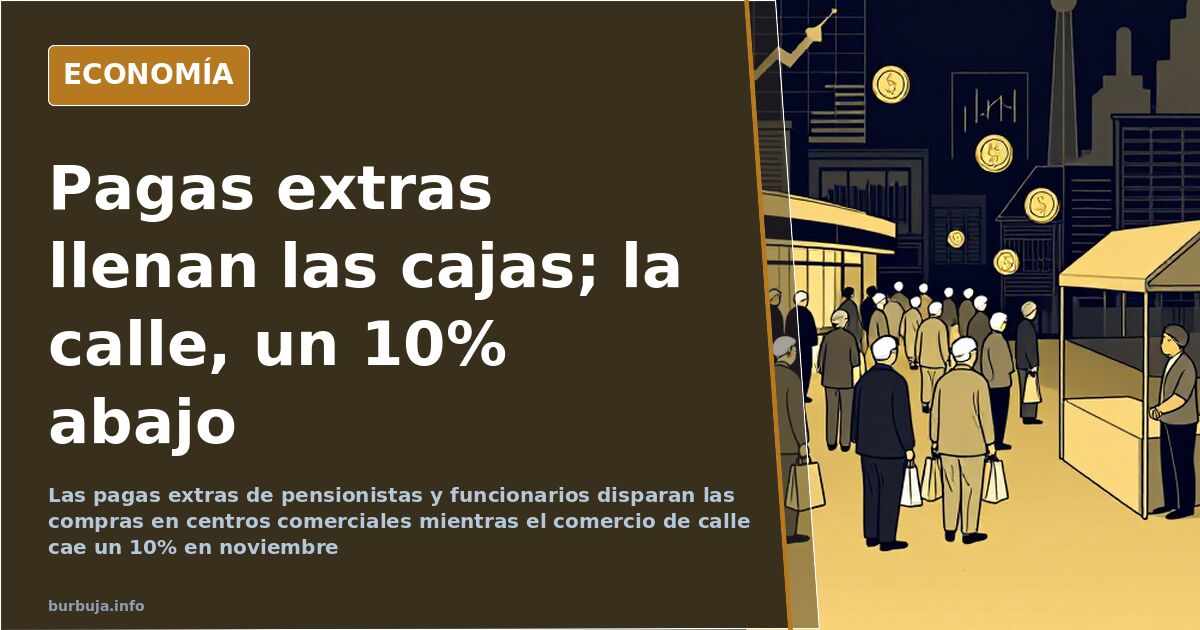
Full extra payment at El Corte Inglés; high street sales down 10%
Six in the evening in the car park of El Corte Inglés in Campo de las Naciones. Overflowing trolleys, smoking cards, queues at the checkout. That same week, in a provincial capital, the high street recorded 10% less sales than the previous year. The two scenes are from the same country and describe the same Christmas consumption: one part of the country spends as if there's no tomorrow, and the other looks in from the outside.
The extra payment that arrives all at once
Every December, millions of households suddenly receive money that isn't extra income: it's a double payment. A retired couple received about €7,000 between them; another case mentions €6,000 in a single account. With these inflows, shopping centres cease to be a reliable barometer of anything. Saturday afternoon's scene doesn't measure wealth: it measures the public payroll calendar.
This is where the block that sustains consumption, despite the narrative of hardship, comes in: according to testimonies, three million civil servants and around two million pensioners receive their extra payment on specific dates. When that money arrives, retail notices. When it doesn't, it doesn't.
How much money is really in households?
The calculation circulating in the debate is stark: 70% of the population would live below the poverty line and, more uncomfortably, without knowing it. The other part would be about 13 million people, presented as the cushion that sustains spending. This figure is thrown around without statistical backing in the discussion and should be taken for what it is: a hypothesis, not an INE (National Statistics Institute) figure.
What's striking is how this figure shifts depending on who's looking. For some, a packed El Corte Inglés shows there's money. For others, it's just the showcase for a minority who get paid every month without surprises. Both readings fit within the same shopping centre.
Local shops don't see this wave
While large retailers and online commerce absorb most of the spending, small businesses are left out of the distribution. Sales shift to Amazon, Shein, and online purchases. The argument that the street is empty and the tills are full isn't a contradiction: it's the same money circulating through another channel.
Some also recall that the volume of merchandise entering certain warehouses has fallen compared to previous years. That is, fewer trucks, less stock, the same feeling of crowds. Logistics don't align with stock market optimism.
Why spend without having: credit and appearance
The most uncomfortable thesis suggests that in Spain, Christmas spending is driven by social obligation, not capacity. Purchases are financed, cards are used, and when it's not enough, parents' pensions support children's credit. The rest of the year is lived with a tight belt. Under this logic, Christmas spending doesn't prove abundance: it proves social pressure.
Appearing is more important than eating, someone summarised. And in this, El Corte Inglés wins: it remains the place where expensive items are bought to be seen.
The outcome, for now, hasn't arrived. Some expect a difficult first quarter after December's excess, while others point out that everything will remain the same as long as pensions and public salaries aren't touched. Consumption isn't collapsing; nor is it solely sustained.
And the dislocating data: in 2023, the best-selling car in Spain was a Dacia, and the homes being bought have an average price below €200,000. A lot of movement at the checkouts, a lot of utility vehicles at the door.
Six in the evening in the car park of El Corte Inglés in Campo de las Naciones. Overflowing trolleys, smoking cards, queues at the checkout. That same week, in a provincial capital, the high street recorded 10% less sales than the previous year. The two scenes are from the same country and describe the same Christmas consumption: one part of the country spends as if there's no tomorrow, and the other looks in from the outside.
The extra payment that arrives all at once
Every December, millions of households suddenly receive money that isn't extra income: it's a double payment. A retired couple received about €7,000 between them; another case mentions €6,000 in a single account. With these inflows, shopping centres cease to be a reliable barometer of anything. Saturday afternoon's scene doesn't measure wealth: it measures the public payroll calendar.
This is where the block that sustains consumption, despite the narrative of hardship, comes in: according to testimonies, three million civil servants and around two million pensioners receive their extra payment on specific dates. When that money arrives, retail notices. When it doesn't, it doesn't.
How much money is really in households?
The calculation circulating in the debate is stark: 70% of the population would live below the poverty line and, more uncomfortably, without knowing it. The other part would be about 13 million people, presented as the cushion that sustains spending. This figure is thrown around without statistical backing in the discussion and should be taken for what it is: a hypothesis, not an INE (National Statistics Institute) figure.
What's striking is how this figure shifts depending on who's looking. For some, a packed El Corte Inglés shows there's money. For others, it's just the showcase for a minority who get paid every month without surprises. Both readings fit within the same shopping centre.
Local shops don't see this wave
While large retailers and online commerce absorb most of the spending, small businesses are left out of the distribution. Sales shift to Amazon, Shein, and online purchases. The argument that the street is empty and the tills are full isn't a contradiction: it's the same money circulating through another channel.
Some also recall that the volume of merchandise entering certain warehouses has fallen compared to previous years. That is, fewer trucks, less stock, the same feeling of crowds. Logistics don't align with stock market optimism.
Why spend without having: credit and appearance
The most uncomfortable thesis suggests that in Spain, Christmas spending is driven by social obligation, not capacity. Purchases are financed, cards are used, and when it's not enough, parents' pensions support children's credit. The rest of the year is lived with a tight belt. Under this logic, Christmas spending doesn't prove abundance: it proves social pressure.
Appearing is more important than eating, someone summarised. And in this, El Corte Inglés wins: it remains the place where expensive items are bought to be seen.
The outcome, for now, hasn't arrived. Some expect a difficult first quarter after December's excess, while others point out that everything will remain the same as long as pensions and public salaries aren't touched. Consumption isn't collapsing; nor is it solely sustained.
And the dislocating data: in 2023, the best-selling car in Spain was a Dacia, and the homes being bought have an average price below €200,000. A lot of movement at the checkouts, a lot of utility vehicles at the door.
Summary of a discussion on Burbuja.info - Foro de economía, actualidad y política., translated from Spanish and reviewed before publication. Read the full discussion (262 replies).
More summaries
-
El Corte Inglés's autumn slogan disappears, sparking online debate
A forum discusses the absence of El Corte Inglés's autumn slogan, touching on offers, interest-free financing, and a changing climate.
-
Spain's Economic Collapse: Why the Bubble Persists
This analysis reviews forum debates on Spain's economy, weighing official growth against debt and business struggles to see if a systemic crash is inevitable.
-
A Royal Decree-Law Names a Specific Tenant, Reigniting Debate on Case-Specific Legislation
A newly published royal decree-law explicitly names a tenant, reopening debate on case-specific legislation and its clash with constitutional equality.
-
Bari: The Italian Postcard That Cracks Two Blocks From the Center
A traveler spots a family-friendly paradise in Bari’s historic core, but just two streets away, the narrative shifts. Italy vs. Spain compared.
-
Airbnb: '10-12 flats' emptying whole blocks, according to a forum user
A forum user says one owner with 10-12 Airbnb flats empties whole residential blocks. In Lugo or Teruel, prices also rise without mass tourism.
-
Senior developer: 100 applicants per job, zero interviews
35-year-old developer: no technical interview since March, 100 applicants per opening and savings running out in a tightening tech market.