
Rallo and immigration: jobs or precarious work
Immigration as a jobs engine: myth or reality according to the data? The economic debate around immigration has reignited, this time over…
English · Original discussion in Spanish · Published
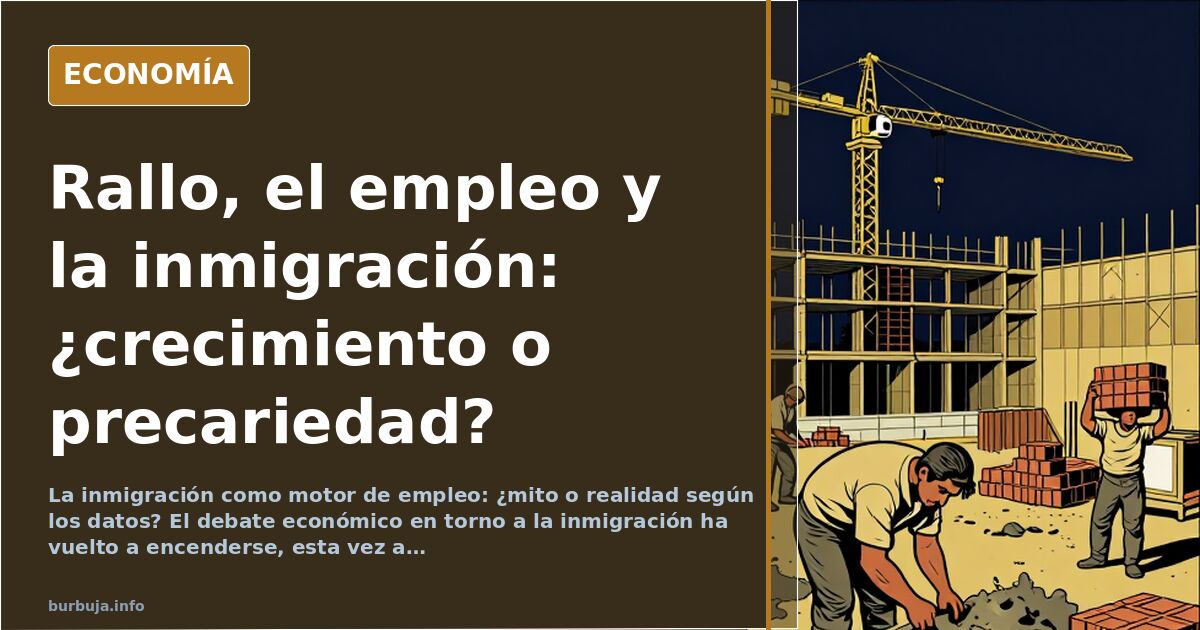
Immigration as a jobs engine: myth or reality according to the data?
The economic debate around immigration has reignited, this time trinc economist Juan Ramón Rallo's claims about its positive impact on job creation and economic growth. However, a detailed analysis of the data and the counterarguments put forward reveals a far more complex reality, in which the apparent generation of jobs conceals lower wages and pressure on the welfare state.
The liberal argument and its nuances
Rallo argues that immigration is the main driver of job creation and therefore of economic growth. This perspective, shared by some liberal circles, centers on the idea that the arrival of new workers boosts both demand and supply, energizing the economy. However, critics point out that this view omits crucial factors such as the role of the state and the working conditions that arise from this phenomenon.
It is argued that immigration, far from being an engine of widespread prosperity, can contribute to precariousness. The figures suggest that average wages for foreigners and people with dual nationality are significantly lower than those of Spanish nationals. According to data from the EPA (Spain's Labour Force Survey), the wage gap can exceed 400 euros per month, which translates into lower contributions to the Seguridad Social (Spain's Social Security system) and greater reliance on social benefits. This disparity raises the question of whether immigration creates quality jobs or simply low-paid positions that displace native workers or push them to accept worse conditions.
The weight of the state and demand
Another point of friction is the consideration of the state's role. While Rallo appears to overlook its influence, other analyses highlight how immigration is shaped by social welfare policies. It is suggested that the perception of access to aid and benefits could be a pull factor, which contradicts the purely liberal vision of a self-sufficient market. The financing of these services, in turn, falls on the population as a whole, generating a debate about the sustainability of the model.
The question of demand is also central.
The economic debate around immigration has reignited, this time trinc economist Juan Ramón Rallo's claims about its positive impact on job creation and economic growth. However, a detailed analysis of the data and the counterarguments put forward reveals a far more complex reality, in which the apparent generation of jobs conceals lower wages and pressure on the welfare state.
The liberal argument and its nuances
Rallo argues that immigration is the main driver of job creation and therefore of economic growth. This perspective, shared by some liberal circles, centers on the idea that the arrival of new workers boosts both demand and supply, energizing the economy. However, critics point out that this view omits crucial factors such as the role of the state and the working conditions that arise from this phenomenon.
It is argued that immigration, far from being an engine of widespread prosperity, can contribute to precariousness. The figures suggest that average wages for foreigners and people with dual nationality are significantly lower than those of Spanish nationals. According to data from the EPA (Spain's Labour Force Survey), the wage gap can exceed 400 euros per month, which translates into lower contributions to the Seguridad Social (Spain's Social Security system) and greater reliance on social benefits. This disparity raises the question of whether immigration creates quality jobs or simply low-paid positions that displace native workers or push them to accept worse conditions.
The weight of the state and demand
Another point of friction is the consideration of the state's role. While Rallo appears to overlook its influence, other analyses highlight how immigration is shaped by social welfare policies. It is suggested that the perception of access to aid and benefits could be a pull factor, which contradicts the purely liberal vision of a self-sufficient market. The financing of these services, in turn, falls on the population as a whole, generating a debate about the sustainability of the model.
The question of demand is also central.
Summary of a discussion on Burbuja.info - Foro de economía, actualidad y política., translated from Spanish and reviewed before publication. Read the full discussion (208 replies).
More summaries
-
The migrant relocation plans targeting Spain
Circulating messages claim hundreds of thousands of irregular migrants will be relocated to Spain between 2024 and 2027. No official confirmation.
-
Immigration on the front page: €30bn cost of management
Several outlets put immigration on the front page, and ABC's €30bn cost figure enters the debate amid an editorial shift and social pressure
-
Spain's Economic Collapse: Why the Bubble Persists
This analysis reviews forum debates on Spain's economy, weighing official growth against debt and business struggles to see if a systemic crash is inevitable.
-
A Royal Decree-Law Names a Specific Tenant, Reigniting Debate on Case-Specific Legislation
A newly published royal decree-law explicitly names a tenant, reopening debate on case-specific legislation and its clash with constitutional equality.
-
Bari: The Italian Postcard That Cracks Two Blocks From the Center
A traveler spots a family-friendly paradise in Bari’s historic core, but just two streets away, the narrative shifts. Italy vs. Spain compared.
-
Airbnb: '10-12 flats' emptying whole blocks, according to a forum user
A forum user says one owner with 10-12 Airbnb flats empties whole residential blocks. In Lugo or Teruel, prices also rise without mass tourism.