
Immigration on the front page: €30bn cost of management
Several outlets put immigration on the front page, and ABC's €30bn cost figure enters the debate amid an editorial shift and social pressure
English · Original discussion in Spanish · Published
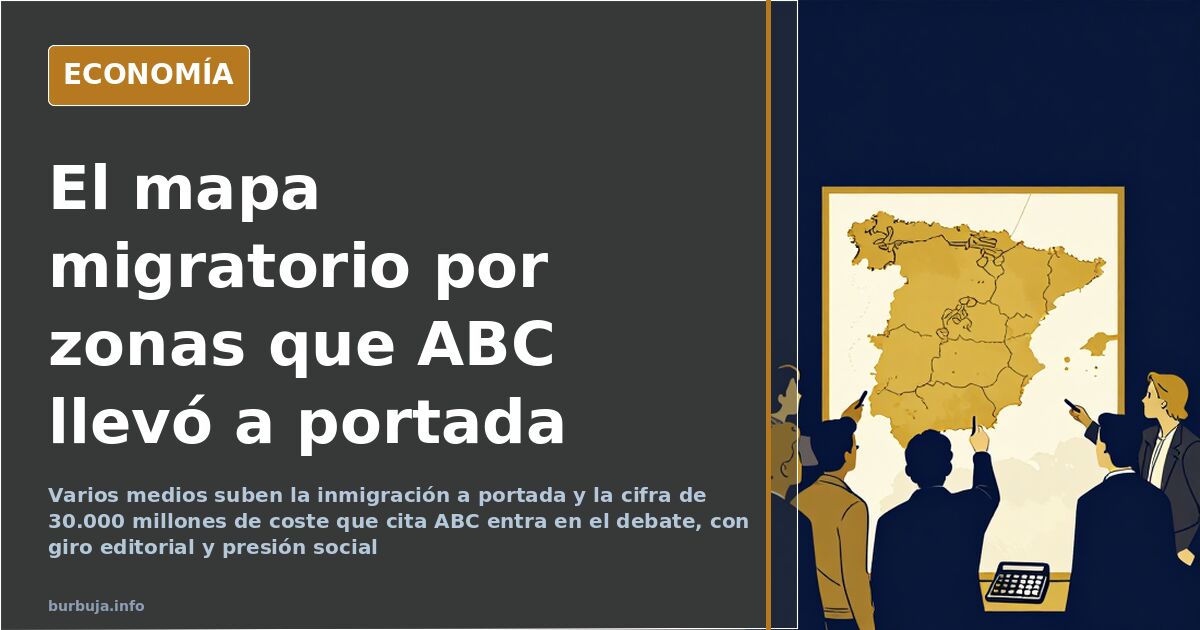
ABC's migration map reopens the cost debate: €30 billion
An interactive map from ABC that locates the immigrant population area by area, and a figure that goes straight into the debate: experts put the cost of managing migration at €30 billion, according to the paper itself, which notes that the trend has reversed over the past 50 years. In parallel, La Razón pushed a headline on social media that has travelled further than any report —there are more Segarro than Asturians in the country, and in some municipalities Spaniards are no longer the majority— and the conversation took off. It is not an isolated case: several outlets that had been skirting the issue for years have put it on the front page within a few days. The editorial shift leaves an uncomfortable question. Why precisely now?
Why are the media changing their line on immigration now?
The most repeated answer is cynically simple: because the paymaster has changed. Some argue that newsrooms trinc the sun that burns hottest, and that the hardening of the narrative comes when the vote and the audience reward it, not when the analysis demands it. Another reading points to an external factor: the feeling that the US migration shift has made presentable what was taboo two years ago. A UK poll, brought up deliberately, would suggest that a large part of the British public not only does not disown those policies but would want them for their own country.
On the other side, the general secretary of Podemos, Ione Belarra, summed up her position in a phrase that also circulated: “Spain is Latin, Black and mestiza.” Her thesis, set out alongside that idea, is that the real antiestéticar is not generated by the people arriving but by the big chains —Amazon, Carrefour, Starbucks and McDonald's— that land in the neighbourhoods. Two narratives that share neither the data nor the diagnosis.
The cost of immigration: the figure that frames the debate
The €30 billion ABC uses serves as an umbrella for three recurring fronts: the labour market, housing and public finances. The argument is that the mass arrival of workers squeezes low wages, drives up rents where they concentrate, and adds pressure to healthcare and benefits.
The most uncomfortable forecast in the debate is that all of this is on its way out: automation and industrialised construction would reduce the need for labour within a few years. If that happens, the same criterion that justified entry would come to justify exit. It is a hypothesis, not a done deal, but it shapes much of the disagreement.
To all this is added an expectation that runs through the debate from end to end: that of the U-turn. It is recalled that almost no one saw the 2007 crisis coming and that afterwards there was no shortage of people claiming to have warned about it years earlier. The bet is that the same will happen with this issue, and faster.
The municipal front: register, vote and participatory budgets
The map has its local landing. In Madrid some describe southern neighbourhoods such as Villaverde, or municipalities such as Parla, where the feeling is of being a minority on one's own street. Against the theory that immigration is imported as a mass of votes comes the counterargument that most of those who arrive do not vote: at several polling stations foreign voters would be very few, and the hard vote would remain in the hands of the usual electorate. Some project that the next generation of Spaniards will be born mostly to foreign mothers; it is an extrapolation, not a register figure.
The most cited case to show that demographic weight is already translating into politics is that of Barcelona's Pakistani community, which would have mobilised enough residents to secure €1.6 million from the municipal participatory budgets, with echoes in the Indian press. Cricket provided the day's anecdote: Spain beat France by 7 wickets to qualify for the European Championship and the news arrived wrapped in hostile comments towards the national team's own players.
Can immigration be curbed? The limit set by the EU
Here the analysis hits a wall. Any restrictive measure —border closures, withdrawal of benefits, mass deportations— has a fit problem: under the European Union umbrella, nativist initiatives run up against the legal framework, as one participant argues. That is why much of the debate shifts from what is desirable to what is possible, and from there to the question of who could do it without breaking the law.
The European mirror cited is Germany: the CDU promises to close borders and deport incivil and those who have defrauded benefits, with the far right nipping at its heels. The debate here is whether something like that could be replicated and with what instruments. In the background, the suspicion that the narrative changes because the vote changes, not because the diagnosis changes.
The point where the analysis gets stuck is always the same. If the narrative moves because the voter moves, because business moves, or because hands are no longer needed, the political conclusion is different in each case. No one signs the same answer.
An interactive map from ABC that locates the immigrant population area by area, and a figure that goes straight into the debate: experts put the cost of managing migration at €30 billion, according to the paper itself, which notes that the trend has reversed over the past 50 years. In parallel, La Razón pushed a headline on social media that has travelled further than any report —there are more Segarro than Asturians in the country, and in some municipalities Spaniards are no longer the majority— and the conversation took off. It is not an isolated case: several outlets that had been skirting the issue for years have put it on the front page within a few days. The editorial shift leaves an uncomfortable question. Why precisely now?
Why are the media changing their line on immigration now?
The most repeated answer is cynically simple: because the paymaster has changed. Some argue that newsrooms trinc the sun that burns hottest, and that the hardening of the narrative comes when the vote and the audience reward it, not when the analysis demands it. Another reading points to an external factor: the feeling that the US migration shift has made presentable what was taboo two years ago. A UK poll, brought up deliberately, would suggest that a large part of the British public not only does not disown those policies but would want them for their own country.
On the other side, the general secretary of Podemos, Ione Belarra, summed up her position in a phrase that also circulated: “Spain is Latin, Black and mestiza.” Her thesis, set out alongside that idea, is that the real antiestéticar is not generated by the people arriving but by the big chains —Amazon, Carrefour, Starbucks and McDonald's— that land in the neighbourhoods. Two narratives that share neither the data nor the diagnosis.
The cost of immigration: the figure that frames the debate
The €30 billion ABC uses serves as an umbrella for three recurring fronts: the labour market, housing and public finances. The argument is that the mass arrival of workers squeezes low wages, drives up rents where they concentrate, and adds pressure to healthcare and benefits.
The most uncomfortable forecast in the debate is that all of this is on its way out: automation and industrialised construction would reduce the need for labour within a few years. If that happens, the same criterion that justified entry would come to justify exit. It is a hypothesis, not a done deal, but it shapes much of the disagreement.
To all this is added an expectation that runs through the debate from end to end: that of the U-turn. It is recalled that almost no one saw the 2007 crisis coming and that afterwards there was no shortage of people claiming to have warned about it years earlier. The bet is that the same will happen with this issue, and faster.
The municipal front: register, vote and participatory budgets
The map has its local landing. In Madrid some describe southern neighbourhoods such as Villaverde, or municipalities such as Parla, where the feeling is of being a minority on one's own street. Against the theory that immigration is imported as a mass of votes comes the counterargument that most of those who arrive do not vote: at several polling stations foreign voters would be very few, and the hard vote would remain in the hands of the usual electorate. Some project that the next generation of Spaniards will be born mostly to foreign mothers; it is an extrapolation, not a register figure.
The most cited case to show that demographic weight is already translating into politics is that of Barcelona's Pakistani community, which would have mobilised enough residents to secure €1.6 million from the municipal participatory budgets, with echoes in the Indian press. Cricket provided the day's anecdote: Spain beat France by 7 wickets to qualify for the European Championship and the news arrived wrapped in hostile comments towards the national team's own players.
Can immigration be curbed? The limit set by the EU
Here the analysis hits a wall. Any restrictive measure —border closures, withdrawal of benefits, mass deportations— has a fit problem: under the European Union umbrella, nativist initiatives run up against the legal framework, as one participant argues. That is why much of the debate shifts from what is desirable to what is possible, and from there to the question of who could do it without breaking the law.
The European mirror cited is Germany: the CDU promises to close borders and deport incivil and those who have defrauded benefits, with the far right nipping at its heels. The debate here is whether something like that could be replicated and with what instruments. In the background, the suspicion that the narrative changes because the vote changes, not because the diagnosis changes.
The point where the analysis gets stuck is always the same. If the narrative moves because the voter moves, because business moves, or because hands are no longer needed, the political conclusion is different in each case. No one signs the same answer.
Summary of a discussion on Burbuja.info - Foro de economía, actualidad y política., translated from Spanish and reviewed before publication. Read the full discussion (230 replies).
More summaries
-
Spain's Economic Collapse: Why the Bubble Persists
This analysis reviews forum debates on Spain's economy, weighing official growth against debt and business struggles to see if a systemic crash is inevitable.
-
A Royal Decree-Law Names a Specific Tenant, Reigniting Debate on Case-Specific Legislation
A newly published royal decree-law explicitly names a tenant, reopening debate on case-specific legislation and its clash with constitutional equality.
-
Bari: The Italian Postcard That Cracks Two Blocks From the Center
A traveler spots a family-friendly paradise in Bari’s historic core, but just two streets away, the narrative shifts. Italy vs. Spain compared.
-
Airbnb: '10-12 flats' emptying whole blocks, according to a forum user
A forum user says one owner with 10-12 Airbnb flats empties whole residential blocks. In Lugo or Teruel, prices also rise without mass tourism.
-
Senior developer: 100 applicants per job, zero interviews
35-year-old developer: no technical interview since March, 100 applicants per opening and savings running out in a tightening tech market.
-
Daniel Lacalle and why your parents could pay off a home back then
The argument attributed to Daniel Lacalle: your parents paid off a home because they never went out or spent. Wages, VAT and mortgage rates, in figures