
The migrant relocation plans targeting Spain
Circulating messages claim hundreds of thousands of irregular migrants will be relocated to Spain between 2024 and 2027. No official confirmation.
English · Original discussion in Spanish · Published
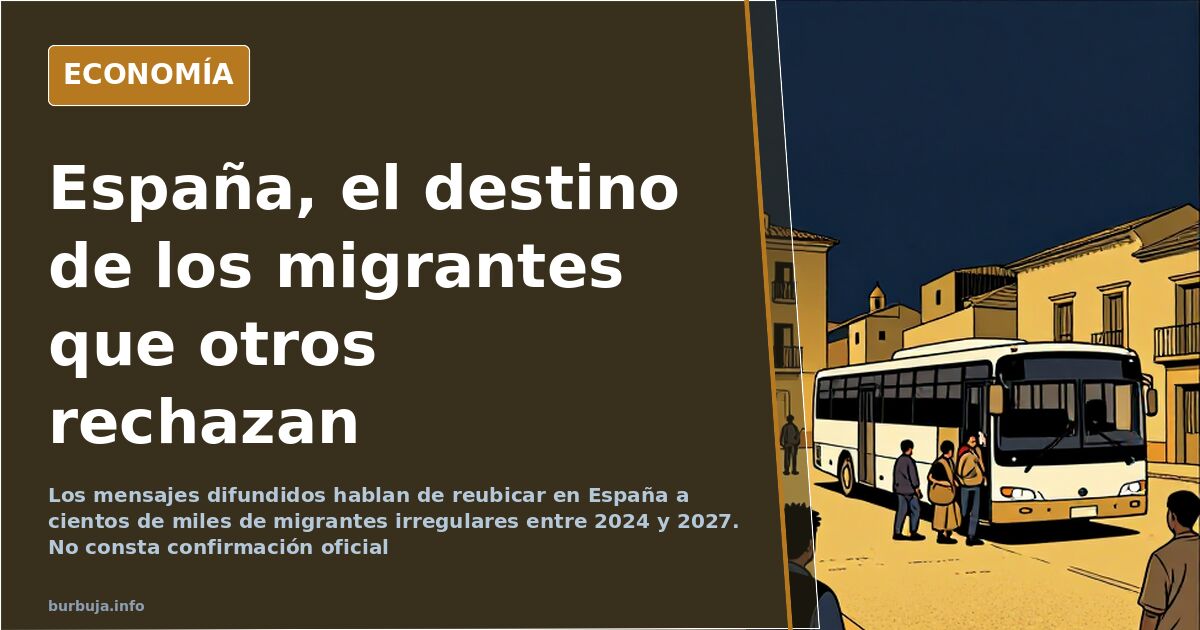
Germany deports, France pushes, the United States dumps the problem and Spain takes it in. That is the narrative spreading forcefully: an alleged mechanism by which irregular migrants rejected by other countries end up relocated to Spanish territory. The most widely circulated version, signed by Guillermo Rocafort, points to an agreement signed in 2018 between then-chancellor Angela Merkel and Pedro Sánchez that would bring 'hundreds of thousands' of people to Spanish cities between 2024 and 2027.
It is worth saying before we go on: none of those figures comes with an official document, and there is no public confirmation of such mass relocation plans. What does exist is the echo. And the echo measures the mood of a part of the country that no longer believes anything it is told.
Merkel-Sánchez 2018 agreement: what is claimed and what is known
The central piece is an alleged German television report according to which mass deportations of irregular migrants to Spain are being prepared. The second piece is a meeting between Macron and Sánchez to turn the Canary Islands into disembarkation centres for people from francophone France: more than 100,000 in 2024, later distributed across Spanish cities.
The underlying reasoning has its twisted logic: if a country cannot expel someone to their place of origin, there is always a third country to palm them off on. That third country, in this version, would be Spain, the weak link in the European chain. One reply summed up the paradox: it is easier to pressure Spain than Segarro or Senegal.
From the May 2023 agreement to foreign policy in someone else's hands
The narrative does not stop in Europe. It claims that at a May 2023 meeting a 'mass deportation agreement to Spain' was signed and that the country would also swallow irregular immigration from the United States. It even goes so far as to claim that Spanish international policy is in the hands of Mohamed VI, with the Sahara, the Canary Islands, Ceuta and Melilla as pieces in a retreat that would end in an independent Catalonia.
They are claims without documentary proof and with a recognisable pattern: that of an orchestrated plan — one of the messages mentions the Soros plan — to destroy the country by demographic means. Anyone looking for official confirmation will not find it. Anyone looking for reasons for unease has them at hand.
Why doesn't discontent translate into political reaction?
Here the debate turns economic. The most repeated argument is that a majority of residents draw a public or quasi-public salary — pensioners, civil servants, NGO workers, state subcontractors — and that this dependency defuses any protest. One reply quantified it: 10 million pensioners, just over 20 million nationals and around 15 million immigrants and naturalised citizens. With those magnitudes on the table, the conclusion drawn is that no one is interested in stirring the hornet's nest.
The other side of the analysis is labour-related: it is argued that the system needs a reserve army of workers willing to clutch at any straw rather than organise. It is the old thesis of the strikebreaker as a buffer. Debatable, but not gratuitous.
The Canary Islands, Granada and the Aluche neighbourhood: pressure on the ground
The focus jumps from geopolitics to the doorway of one's home. There are accounts describing daily arrivals in Granada, rooms shared by twenty people and occupied premises. In Madrid, the conversation revolves around neighbourhoods such as Aluche, Carabanchel or Usera, with the feeling that nowhere is safe. These are neighbourhood impressions, not statistics, and should be treated as such.
What is interesting is the jump in scale. Years ago the diagnosis was more modest: Spain as a country of waiters and little more. Today that diagnosis has grown until it turns into a dumping ground for the immigration others do not want. Where there are great inequalities, elites already live in gated neighbourhoods; here, it is said, the common people are left outside the gate.
The demographic point of no return
In the darkest part appears the thesis of demographic genocide: the idea that population is deliberately replaced until crossing a threshold from which there is no return. There is talk of a Spanish population with a historically low birth rate and of a global plan that would reduce the groups that do not matter. It is a matter of speculation, not data, and is treated as such in the exchange itself.
And yet, from there comes the forecast that closes the discussion. One of the messages projects a future in which Spain would have 50 million residents and another 40 million people with Spanish passports living across the European Union. Year 2150. By then, it says, the country would claim sovereignty over the entire continent by pure arithmetic: the majority of its neighbours would, legally, be Spanish.
It is worth saying before we go on: none of those figures comes with an official document, and there is no public confirmation of such mass relocation plans. What does exist is the echo. And the echo measures the mood of a part of the country that no longer believes anything it is told.
Merkel-Sánchez 2018 agreement: what is claimed and what is known
The central piece is an alleged German television report according to which mass deportations of irregular migrants to Spain are being prepared. The second piece is a meeting between Macron and Sánchez to turn the Canary Islands into disembarkation centres for people from francophone France: more than 100,000 in 2024, later distributed across Spanish cities.
The underlying reasoning has its twisted logic: if a country cannot expel someone to their place of origin, there is always a third country to palm them off on. That third country, in this version, would be Spain, the weak link in the European chain. One reply summed up the paradox: it is easier to pressure Spain than Segarro or Senegal.
From the May 2023 agreement to foreign policy in someone else's hands
The narrative does not stop in Europe. It claims that at a May 2023 meeting a 'mass deportation agreement to Spain' was signed and that the country would also swallow irregular immigration from the United States. It even goes so far as to claim that Spanish international policy is in the hands of Mohamed VI, with the Sahara, the Canary Islands, Ceuta and Melilla as pieces in a retreat that would end in an independent Catalonia.
They are claims without documentary proof and with a recognisable pattern: that of an orchestrated plan — one of the messages mentions the Soros plan — to destroy the country by demographic means. Anyone looking for official confirmation will not find it. Anyone looking for reasons for unease has them at hand.
Why doesn't discontent translate into political reaction?
Here the debate turns economic. The most repeated argument is that a majority of residents draw a public or quasi-public salary — pensioners, civil servants, NGO workers, state subcontractors — and that this dependency defuses any protest. One reply quantified it: 10 million pensioners, just over 20 million nationals and around 15 million immigrants and naturalised citizens. With those magnitudes on the table, the conclusion drawn is that no one is interested in stirring the hornet's nest.
The other side of the analysis is labour-related: it is argued that the system needs a reserve army of workers willing to clutch at any straw rather than organise. It is the old thesis of the strikebreaker as a buffer. Debatable, but not gratuitous.
The Canary Islands, Granada and the Aluche neighbourhood: pressure on the ground
The focus jumps from geopolitics to the doorway of one's home. There are accounts describing daily arrivals in Granada, rooms shared by twenty people and occupied premises. In Madrid, the conversation revolves around neighbourhoods such as Aluche, Carabanchel or Usera, with the feeling that nowhere is safe. These are neighbourhood impressions, not statistics, and should be treated as such.
What is interesting is the jump in scale. Years ago the diagnosis was more modest: Spain as a country of waiters and little more. Today that diagnosis has grown until it turns into a dumping ground for the immigration others do not want. Where there are great inequalities, elites already live in gated neighbourhoods; here, it is said, the common people are left outside the gate.
The demographic point of no return
In the darkest part appears the thesis of demographic genocide: the idea that population is deliberately replaced until crossing a threshold from which there is no return. There is talk of a Spanish population with a historically low birth rate and of a global plan that would reduce the groups that do not matter. It is a matter of speculation, not data, and is treated as such in the exchange itself.
And yet, from there comes the forecast that closes the discussion. One of the messages projects a future in which Spain would have 50 million residents and another 40 million people with Spanish passports living across the European Union. Year 2150. By then, it says, the country would claim sovereignty over the entire continent by pure arithmetic: the majority of its neighbours would, legally, be Spanish.
Summary of a discussion on Burbuja.info - Foro de economía, actualidad y política., translated from Spanish and reviewed before publication. Read the full discussion (315 replies).
More summaries
-
Albares recalls ambassador for consultations over Milei remarks
Milei says “corrupt” at a Vox event in Madrid and the government recalls its ambassador in Buenos Aires. Albares appears and PSOE demands Feijóo…
-
Sánchez proposes EU end to anonymity on social media
Sánchez proposes EU end to anonymity on social media: the digital ID and internet access-control debate is at the centre of criticism.
-
Córdoba Father Self-Immolates: Mental Illness or Societal Despair?
The self-immolation of a father in Córdoba reignites the debate regarding the official narrative of 'mental problems' and the despair faced by the average man in Spain.
-
Euthanasia in Old Age: Autonomy vs. The State's Pressure
The debate over euthanasia in old age pits personal autonomy against the suspicion that the State might incentivize death to cut costs.
-
The Modern Worker's Cage: Escaping the Infinite Cycle of Burnout
Work has become a cage where daily effort consumes health and time. Discover why we push ourselves so hard and how to break the cycle.
-
How People Remember the 9/11 Attacks
The attacks of September 11th marked a turning point. Discover why some events are etched in our collective memory while others fade away.