
Rajoy: The Spanish Politician Who Let Rivals Fall
Spain's PP gained 800,000 votes between 2015 and 2016 but dropped to 66 seats after Rajoy left. A paradox of survival through inaction.
English · Original discussion in Spanish · Published
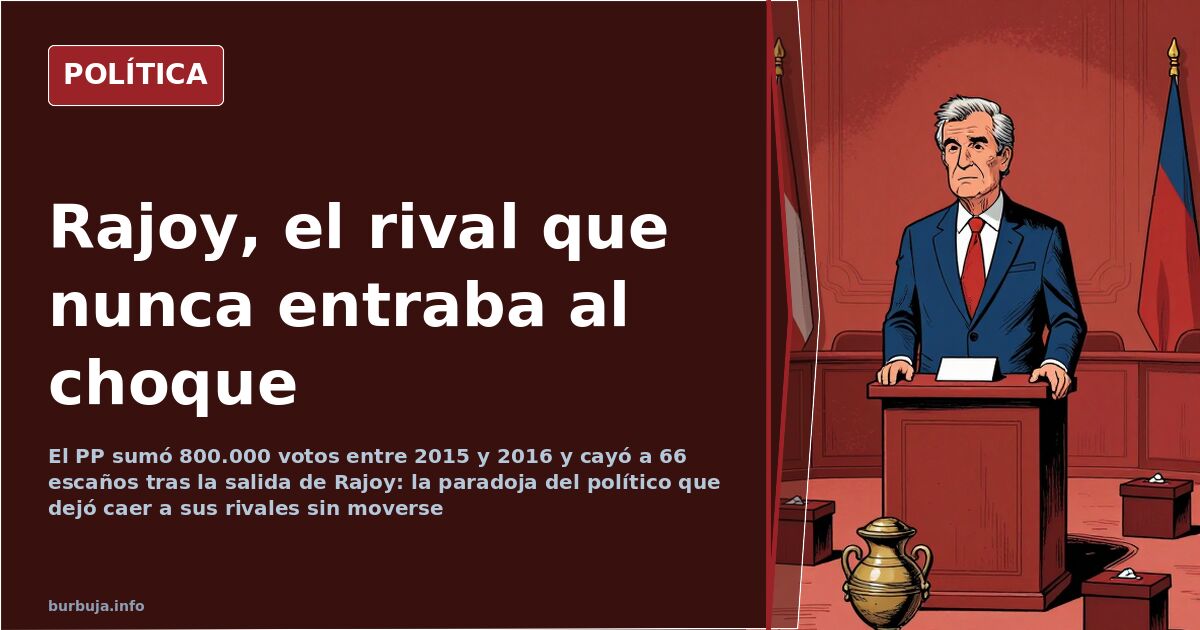
Rajoy: Anatomy of the Politician Who Let Everyone Fall
Mariano Rajoy was not a great ruler. He was something rarer: a survivor who won almost every game he was allowed to play and took nine months to leave power after losing the last one. The debate starting with the caretaker government and a blocked investiture, stretching until the electoral cycle after his departure, ends in an uncomfortable place: the man half the press called lazy and worse read the board better than all his rivals combined.
From 2008 Nicknames to Adversaries' Recognition
In 2008, insults against Rajoy were common, even from within his own party. The text recovered in the discussion—published that year and reissued on February 21, 2013—claims that between September 2003 and October 2004 Aznar kept him away from hot spots in the PP, outside the apparatus and management after the 11-M attacks. According to this reading, Rajoy reached the party presidency controlling nothing and stained by nothing.
Eight years later, the narrative had flipped. No one questioned his resilience, and even those who didn't vote for him recognized the pattern: he doesn't engage in frontal clashes, lets the adversary wear out, and appears when the other has already fallen. The joke Rubalcaba dedicated to him—Marianico el Corto—aged poorly: the version Marianico the Invincible ended up circulating. Some even formulated it as a sentence: when everyone pushes, just step aside and let them fall alone.
The 2016 Investiture: "I Will Not Set Any Condition"
In October 2016, Rajoy appeared without demands: "I will not set any condition for the investiture," he said, adding that repeating elections "would be absurd." The phrase summarizes the whole move. While the PSOE tore itself apart in its own congress and Pedro Sánchez announced tearfully that he was leaving his seat, the candidate sat waiting for the opposing block to break on its own.
The "no is no" occupied hours of talk shows. Some read it as a tautology; others, with irony, pointed out that a double negation has its own logic and that the part of the 'no' no one understood was the 'yes.' Translated into office speak: the rival ended up facilitating with his resignation what he had promised to prevent.
Why Is It Said That Rajoy Did Nothing?
Because doing nothing is also a decision, and in his case it worked for years. The most repeated explanation appeals to Taoist wu wei, the art of not opposing head-on, adapting to the medium and winning as water wins. Bruce Lee summarized it in an ad; the political version is even shorter: if the rival falls alone, there is no need to push him.
The Price: 800,000 Votes Up and 66 Seats Down
Between the general elections of December 2015 and June 2016, the PP added 800,000 votes, a data point that dismantles the thesis that everything was machinery and media. But the same party, already without Rajoy in government after the motion of censure, remained at 66 seats, fewer than Podemos had obtained in its electoral debut.
Then came the local elections. The PP recovered Madrid, Zaragoza, Córdoba, Alicante, Málaga, or Santander and lost Albacete, Ávila, Burgos, Cáceres, Cuenca, Guadalajara, Jaén, León, Logroño, Melilla, Ourense, and Palencia, besides remaining without any of the seven Galician cities. It was celebrated as a victory despite being the worst municipal result in 25 years. If Madrid and Valencia are retained, where the formation has accumulated judicial cases for irregular financing, the calculation fits: you can govern while losing.
Did He Govern Well or Just Survive Better Than Others?
Here consensus breaks. One current holds that his real merit was keeping intact the privileges of an economic core, not managing better: pointing to the bank rescue, Sareb holding apartments whose prices don't drop, and the contrast with Germany or the UK betting on solar energy while here neither thing was done.
The response from the other side is that this reproach applies to any government and that what is measurable is something else: two investitures, two repeated elections, and a rival who broke before him. What no one disputes is the underlying diagnosis. Every time someone tried to topple him without him falling alone, the result was the same. And the drip of external casualties—Aznar, Cascos, Aguirre, Rubalcaba, Zapatero, Sánchez—has a pattern that should not be confused with luck.
Shadows Left Out of the Survivor Narrative
Not everything is clean strategy. Circulating without documentary proof are versions placing the then-PP leader aside from the 11-M management due to pure bureaucratic distancing, and attributing to Sánchez a past as chief of staff during the bombings over Yugoslavia. These are assertions launched without verification that should be treated as they are: confrontation ammunition, not established facts. The same goes for the thesis that media and parties acted as a single coordinated operation against the PP.
If anything teaches us about the case is that Spanish politics rewards endurance above management. The next person who copies the manual—wait, don't wear out, let the rival fall—will probably apply it badly. It works, yes, but requires something that cannot be manufactured: that others make mistakes before you do. And that, over time, stops happening.
Mariano Rajoy was not a great ruler. He was something rarer: a survivor who won almost every game he was allowed to play and took nine months to leave power after losing the last one. The debate starting with the caretaker government and a blocked investiture, stretching until the electoral cycle after his departure, ends in an uncomfortable place: the man half the press called lazy and worse read the board better than all his rivals combined.
From 2008 Nicknames to Adversaries' Recognition
In 2008, insults against Rajoy were common, even from within his own party. The text recovered in the discussion—published that year and reissued on February 21, 2013—claims that between September 2003 and October 2004 Aznar kept him away from hot spots in the PP, outside the apparatus and management after the 11-M attacks. According to this reading, Rajoy reached the party presidency controlling nothing and stained by nothing.
Eight years later, the narrative had flipped. No one questioned his resilience, and even those who didn't vote for him recognized the pattern: he doesn't engage in frontal clashes, lets the adversary wear out, and appears when the other has already fallen. The joke Rubalcaba dedicated to him—Marianico el Corto—aged poorly: the version Marianico the Invincible ended up circulating. Some even formulated it as a sentence: when everyone pushes, just step aside and let them fall alone.
The 2016 Investiture: "I Will Not Set Any Condition"
In October 2016, Rajoy appeared without demands: "I will not set any condition for the investiture," he said, adding that repeating elections "would be absurd." The phrase summarizes the whole move. While the PSOE tore itself apart in its own congress and Pedro Sánchez announced tearfully that he was leaving his seat, the candidate sat waiting for the opposing block to break on its own.
The "no is no" occupied hours of talk shows. Some read it as a tautology; others, with irony, pointed out that a double negation has its own logic and that the part of the 'no' no one understood was the 'yes.' Translated into office speak: the rival ended up facilitating with his resignation what he had promised to prevent.
Why Is It Said That Rajoy Did Nothing?
Because doing nothing is also a decision, and in his case it worked for years. The most repeated explanation appeals to Taoist wu wei, the art of not opposing head-on, adapting to the medium and winning as water wins. Bruce Lee summarized it in an ad; the political version is even shorter: if the rival falls alone, there is no need to push him.
The Price: 800,000 Votes Up and 66 Seats Down
Between the general elections of December 2015 and June 2016, the PP added 800,000 votes, a data point that dismantles the thesis that everything was machinery and media. But the same party, already without Rajoy in government after the motion of censure, remained at 66 seats, fewer than Podemos had obtained in its electoral debut.
Then came the local elections. The PP recovered Madrid, Zaragoza, Córdoba, Alicante, Málaga, or Santander and lost Albacete, Ávila, Burgos, Cáceres, Cuenca, Guadalajara, Jaén, León, Logroño, Melilla, Ourense, and Palencia, besides remaining without any of the seven Galician cities. It was celebrated as a victory despite being the worst municipal result in 25 years. If Madrid and Valencia are retained, where the formation has accumulated judicial cases for irregular financing, the calculation fits: you can govern while losing.
Did He Govern Well or Just Survive Better Than Others?
Here consensus breaks. One current holds that his real merit was keeping intact the privileges of an economic core, not managing better: pointing to the bank rescue, Sareb holding apartments whose prices don't drop, and the contrast with Germany or the UK betting on solar energy while here neither thing was done.
The response from the other side is that this reproach applies to any government and that what is measurable is something else: two investitures, two repeated elections, and a rival who broke before him. What no one disputes is the underlying diagnosis. Every time someone tried to topple him without him falling alone, the result was the same. And the drip of external casualties—Aznar, Cascos, Aguirre, Rubalcaba, Zapatero, Sánchez—has a pattern that should not be confused with luck.
Shadows Left Out of the Survivor Narrative
Not everything is clean strategy. Circulating without documentary proof are versions placing the then-PP leader aside from the 11-M management due to pure bureaucratic distancing, and attributing to Sánchez a past as chief of staff during the bombings over Yugoslavia. These are assertions launched without verification that should be treated as they are: confrontation ammunition, not established facts. The same goes for the thesis that media and parties acted as a single coordinated operation against the PP.
If anything teaches us about the case is that Spanish politics rewards endurance above management. The next person who copies the manual—wait, don't wear out, let the rival fall—will probably apply it badly. It works, yes, but requires something that cannot be manufactured: that others make mistakes before you do. And that, over time, stops happening.
Also available in: Deutsch
Summary of a discussion on Burbuja.info - Foro de economía, actualidad y política., translated from Spanish and reviewed before publication. Read the full discussion (137 replies).
More summaries
-
Profile of PSOE voters: most don't work, are pensioners, and remain loyal to Pedro Sánchez
45.5% of PSOE voters don't work, 35.4% are pensioners, and 60.5% always vote for the same party. A profile of the Socialist electorate.
-
Puigdemont's wig: accident or political strategy?
Analysis of Puigdemont's wig: examining the 1983 accident data and the polarization of political debate.
-
Spain's DANA death toll: Official count vs. hidden missing
Official Spanish figures list 217 dead, while unofficial estimates suggest over 5,000 victims amid claims of suppressed data.
-
Communism in Spain: From Revolution to Luxury Villas
A Spanish forum thread debates communist identity, contrasting armed struggle with Pablo Iglesias's Rolex and luxury home.
-
Spain's CERA Vote: Four Stages and Three Safeguards Against Fraud
The electoral census certificate is issued by the Electoral Census Office in Spain, not consulates. Without it, no votes can be fabricated.
-
King Visits Ceuta After Rapid Migrant Clearances
King Felipe VI visits Spain's autonomous city of Ceuta following record-speed evictions. The government reports 12,000 returns since August.