
Spain's DANA death toll: Official count vs. hidden missing
Official Spanish figures list 217 dead, while unofficial estimates suggest over 5,000 victims amid claims of suppressed data.
English · Original discussion in Spanish · Published
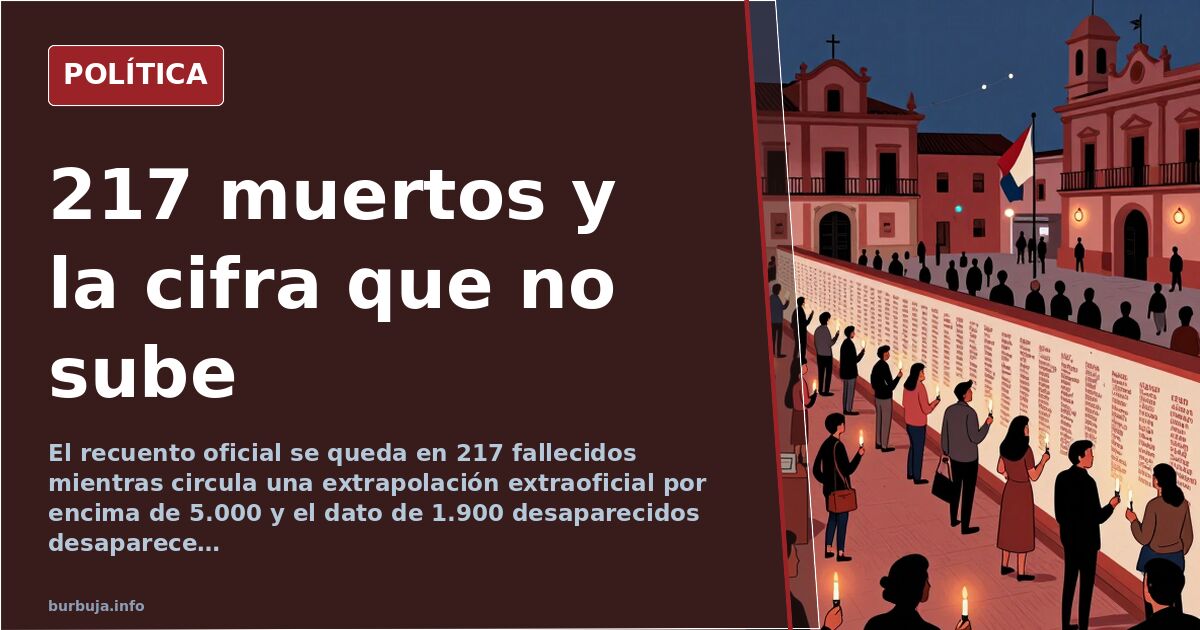
The missing persons figure the Government refuses to update
How many people are missing after the Valencia DANA? There is no official answer. The death toll has remained stuck at 217 and, according to the narrative that started this discussion, it will hardly rise. Meanwhile, the Interior Minister announced 1,900 missing persons alongside the President of the Generalitat, only for that number to vanish from public discourse. The central allegation is uncomfortable: bodies found will be concealed and classified as missing.
This is not an internet rumor. It is a suspicion permeating the debate from top to bottom, supported by testimonies from rural guards bypassing protocol, residents of Paiporta describing what they see, and a lingering question: if the Army, Police, Civil Guard, firefighters, and forensic experts all agree to hide corpses, what exactly are we discussing?
Why the official count remains at 217 deaths
The most repeated explanation has institutional names. According to a persistent account, the task of counting the dead was removed from the Civil Guard and given to the National Police. This change is not cosmetic. The Civil Guard counts every recovered body as a death; the National Police only does so if the body is identified. Result: unnamed bodies in the morgue do not increase the statistics. Hence, the figure stagnates at 217 even though more deaths are acknowledged daily.
Some argue this is merely a methodological issue. Counter-evidence exists: the Interior Minister himself cited 1,900 missing persons in a press conference, then that data disappeared. If the number was good enough to announce, why did it cease to be valid?
The calculation pushing deaths above 5,000
Unofficial extrapolations circulating raise the total above 5,000 deaths. There is no record, registry, or official platform. Only old-fashioned calculations based on victim testimonies and evidence that towns like Paiporta have more missing neighbors than listed. The full calculation, detailed with collected testimonies, yields a magnitude no agency has confirmed.
The argument supporting this thesis is economic and sounds grim: if a body is recorded as missing rather than deceased, insurers have no obligation to pay. The practical consequence is families without homes, cars, work tools, or compensation, waiting for paperwork that never arrives.
Testimonies television does not broadcast
Two rural guards publicly stated that TV lies and there are many more deaths than reported. Residents of the Bonaire area confirm victims existed there. One message summarizes the absurdity with sarcasm: "There are no dead, but we hope fewer on the second floor." These are unverified fragments, but they match a pattern: street reality contradicts published data.
Criticism of media is widespread. When channels limit themselves to publishing data dictated by government sub-delegations, the fourth estate becomes a loudspeaker. With social media involved, hiding exact figures is harder than twenty years ago.
Who counts the missing and why there is no registry
No public, verifiable registry of missing persons exists. This is the most repeated and hardest-to-refute complaint. A platform allegedly backed by police was dismissed for lack of guarantees. The gaining proposal is a citizen web, independent of institutional control, where families can register loved ones without relying on someone signing a paper.
The underlying problem is incentives. If the State recognizes a death, it triggers indemnities, insurance, and political responsibility. If it leaves them as missing, it buys time. In disaster management, time always favors those holding the pan.
The Yak-42 precedent and the shadow of manipulation
Comparisons with the Yak-42 disaster appear often and are not accidental. That case also involved body identification issues, political management of grief, and a commission slow to explain. The bitter irony in the debate is appointing someone with that prior experience to handle the count.
Skepticism is not exclusive to one side. Some demand prison for those responsible, while others recall that no government, regardless of tonalidad, has incentives to admit a death toll that undermines its narrative. The difference between dictatorship and democracy here is measured by whether families eventually learn the truth.
By early 2025, we may know if it was one thousand, two thousand, or four thousand. Or perhaps not. The figure will remain stuck at 217, the missing will remain nameless, and someone will continue explaining that it is all just a matter of methodology.
How many people are missing after the Valencia DANA? There is no official answer. The death toll has remained stuck at 217 and, according to the narrative that started this discussion, it will hardly rise. Meanwhile, the Interior Minister announced 1,900 missing persons alongside the President of the Generalitat, only for that number to vanish from public discourse. The central allegation is uncomfortable: bodies found will be concealed and classified as missing.
This is not an internet rumor. It is a suspicion permeating the debate from top to bottom, supported by testimonies from rural guards bypassing protocol, residents of Paiporta describing what they see, and a lingering question: if the Army, Police, Civil Guard, firefighters, and forensic experts all agree to hide corpses, what exactly are we discussing?
Why the official count remains at 217 deaths
The most repeated explanation has institutional names. According to a persistent account, the task of counting the dead was removed from the Civil Guard and given to the National Police. This change is not cosmetic. The Civil Guard counts every recovered body as a death; the National Police only does so if the body is identified. Result: unnamed bodies in the morgue do not increase the statistics. Hence, the figure stagnates at 217 even though more deaths are acknowledged daily.
Some argue this is merely a methodological issue. Counter-evidence exists: the Interior Minister himself cited 1,900 missing persons in a press conference, then that data disappeared. If the number was good enough to announce, why did it cease to be valid?
The calculation pushing deaths above 5,000
Unofficial extrapolations circulating raise the total above 5,000 deaths. There is no record, registry, or official platform. Only old-fashioned calculations based on victim testimonies and evidence that towns like Paiporta have more missing neighbors than listed. The full calculation, detailed with collected testimonies, yields a magnitude no agency has confirmed.
The argument supporting this thesis is economic and sounds grim: if a body is recorded as missing rather than deceased, insurers have no obligation to pay. The practical consequence is families without homes, cars, work tools, or compensation, waiting for paperwork that never arrives.
Testimonies television does not broadcast
Two rural guards publicly stated that TV lies and there are many more deaths than reported. Residents of the Bonaire area confirm victims existed there. One message summarizes the absurdity with sarcasm: "There are no dead, but we hope fewer on the second floor." These are unverified fragments, but they match a pattern: street reality contradicts published data.
Criticism of media is widespread. When channels limit themselves to publishing data dictated by government sub-delegations, the fourth estate becomes a loudspeaker. With social media involved, hiding exact figures is harder than twenty years ago.
Who counts the missing and why there is no registry
No public, verifiable registry of missing persons exists. This is the most repeated and hardest-to-refute complaint. A platform allegedly backed by police was dismissed for lack of guarantees. The gaining proposal is a citizen web, independent of institutional control, where families can register loved ones without relying on someone signing a paper.
The underlying problem is incentives. If the State recognizes a death, it triggers indemnities, insurance, and political responsibility. If it leaves them as missing, it buys time. In disaster management, time always favors those holding the pan.
The Yak-42 precedent and the shadow of manipulation
Comparisons with the Yak-42 disaster appear often and are not accidental. That case also involved body identification issues, political management of grief, and a commission slow to explain. The bitter irony in the debate is appointing someone with that prior experience to handle the count.
Skepticism is not exclusive to one side. Some demand prison for those responsible, while others recall that no government, regardless of tonalidad, has incentives to admit a death toll that undermines its narrative. The difference between dictatorship and democracy here is measured by whether families eventually learn the truth.
By early 2025, we may know if it was one thousand, two thousand, or four thousand. Or perhaps not. The figure will remain stuck at 217, the missing will remain nameless, and someone will continue explaining that it is all just a matter of methodology.
Also available in: Deutsch
Summary of a discussion on Burbuja.info - Foro de economía, actualidad y política., translated from Spanish and reviewed before publication. Read the full discussion (133 replies).
More summaries
-
Judge in Koldo case moves to indict Ábalos
The judge moves to indict Ábalos after UCO report; PP summons Marlaska and Globalia CEO to Senate committee
-
PP-Vox coalition: predicted tax hikes and pension freezes
Speculation on a PP-Vox government includes audits, spending cuts, higher VAT, lower IRPF, and frozen pensions.
-
Communism in Spain: From Revolution to Luxury Villas
A Spanish forum thread debates communist identity, contrasting armed struggle with Pablo Iglesias's Rolex and luxury home.
-
Spain's CERA Vote: Four Stages and Three Safeguards Against Fraud
The electoral census certificate is issued by the Electoral Census Office in Spain, not consulates. Without it, no votes can be fabricated.
-
King Visits Ceuta After Rapid Migrant Clearances
King Felipe VI visits Spain's autonomous city of Ceuta following record-speed evictions. The government reports 12,000 returns since August.
-
Feijóo's Ten Challenges if He Reaches La Moncloa
If Feijóo wins in Spain, he faces public debt, a shrinking rental housing market, and strained foreign policy across ten key fronts.