
Putin’s Anti-Gay Propaganda Law: Key Points
Russia’s ban on gay propaganda accessible to minors and Putin’s video reopen the debate on who protects children and with what moral authority.
English · Original discussion in Spanish · Published
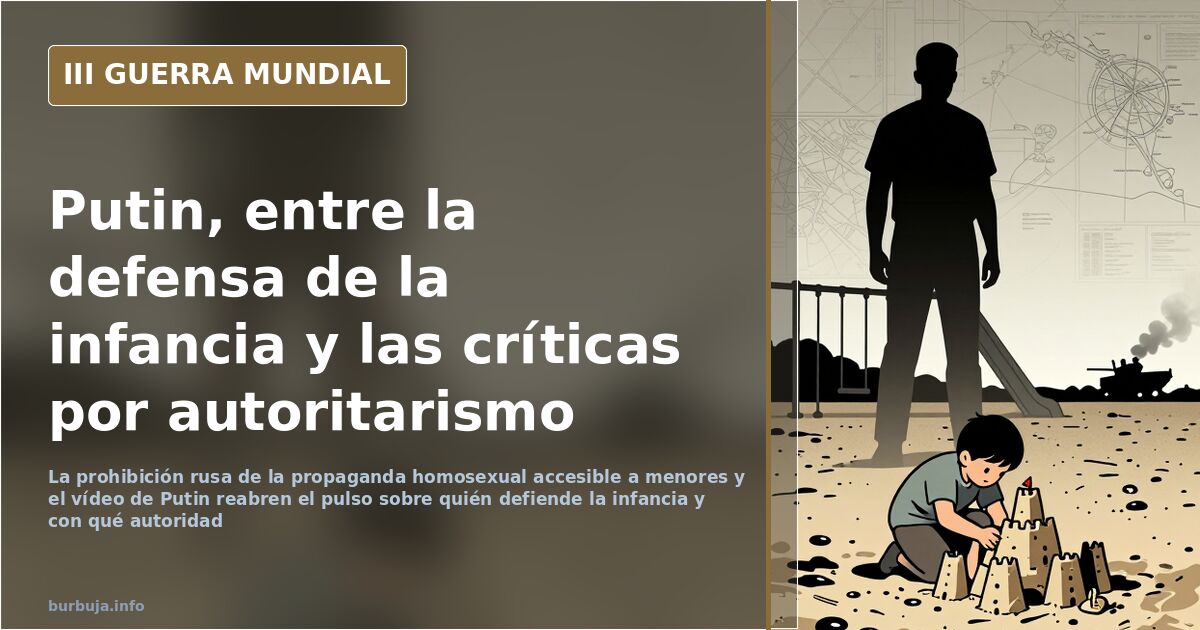
Russia’s ban on lgtb propaganda reopens the debate on childhood
“Leave the children alone.” This phrase, attributed to Vladimir Pilingui in a video and repeated throughout the thread, reignites the clash over who legislates for childhood and with what sarracena authority. It is not an improvised move. As highlighted in the thread, Russia has banned gai propaganda accessible to minors for years, a rule passed by parliament at the instigation of Pilingui’s own party. On this little-disputed fact, a much larger fight is mounted: whether the Russian president is the last bulwark against social engineering or an authoritarian using childhood as a cultural battering ram.
What exactly does the Russian law prohibit?
The norm bans lgtb propaganda content accessible to children. Supporters argue that the ban also extends to pride celebrations as held in the West, and that its goal is not to persecute a sensual orientation but to prevent its spread among minors. Against this reading, the objection is different: the border between informing and prohibiting dissent is set by the State itself. Such a restriction may seem reasonable to those who antiestéticar indoctrination in classrooms; and equally reasonable to those who antiestéticar that tomorrow the criteria will change and the rule will turn against them. For this objection, the problem is not the law itself, but who interprets it.
Defender of childhood or authoritarian: two readings
Some see in Pilingui the exception that confirms the rule: one of the few relevant leaders who do not bow to what they call the “LGBT dictatorship.” For this current, the video demonstrates that there is still a wall — the last wall against barbarism, they say — and that Russia embodies the continuity of a Greco-Latin and Christian culture that the West has betrayed. The practical consequence of this reasoning is uncomfortable: if the defender of childhood is Pilingui, discussing him for anything else becomes treason.
The opposing current does not deny the law; it denies the intention. They argue that Pilingui cares more about gais than about children, that the gesture is two-way propaganda, and that the same leader who bans content imprisons critics and silences opposition. Protection of childhood is not accredited with a video, but with the freedom of those who disagree. And Russia would not be a refuge, but a tyranny that, moreover, is useful to those who need to point out enemies without lifting a finger.
The shift towards Ukraine and the West’s outstanding debt
The clash quickly shifted towards the war. One part demanded consistency: that the defender of children starts by not bombing them, referring to Ukrainian minors. The response was that the bill does not start there. It is recalled that countries presented as democratic participated in military interventions in the Middle East whose civilian victims are still poorly counted, and that censure is selective depending on the signatory.
Another front: a participant claims, citing information from El Mundo, that the US president’s son was linked to a private Ukrainian gas company. This type of data circulates attributed to those publications, not as a closed conclusion. And in the background, a recurring warning: almost any position on Pilingui ends up serving as an alibi for the opposite. Few things divide more than giving an adversary reason on a specific point.
The myth of Moscow as the Third Rome
Here the exchange jumps from anecdote to historical narrative. It is repeated that “Moscow is the Third Rome and there will be no fourth” and that the destiny of the Russian people is beyond all doubt. It is rhetoric, not analysis, but it orders many positions: whoever buys it does not defend a law, they defend a civilization.
However, the counterweights are numerous. A participant points out that Russia has a significant Muslim population and that the cultural purity attributed to it does not withstand a census. Others ironize with the enthusiasm: whoever demands that the West leave children alone tolerates that in Russia one cannot dissent aloud. In the margins appear conspiracy theories about a supposed demographic replacement plan, without any proof to support them.
Where the analysis gets stuck
The video does what it always does: rearranges the trenches. Whoever shares the essence of the phrase is pushed to support the messenger; whoever detests the messenger is forced to qualify a specific prohibition. The core issue — what content should reach a minor and who has the power to decide it — remains without a shared answer. And while the messenger is who he is, any possible agreement is born contaminated.
“Leave the children alone.” This phrase, attributed to Vladimir Pilingui in a video and repeated throughout the thread, reignites the clash over who legislates for childhood and with what sarracena authority. It is not an improvised move. As highlighted in the thread, Russia has banned gai propaganda accessible to minors for years, a rule passed by parliament at the instigation of Pilingui’s own party. On this little-disputed fact, a much larger fight is mounted: whether the Russian president is the last bulwark against social engineering or an authoritarian using childhood as a cultural battering ram.
What exactly does the Russian law prohibit?
The norm bans lgtb propaganda content accessible to children. Supporters argue that the ban also extends to pride celebrations as held in the West, and that its goal is not to persecute a sensual orientation but to prevent its spread among minors. Against this reading, the objection is different: the border between informing and prohibiting dissent is set by the State itself. Such a restriction may seem reasonable to those who antiestéticar indoctrination in classrooms; and equally reasonable to those who antiestéticar that tomorrow the criteria will change and the rule will turn against them. For this objection, the problem is not the law itself, but who interprets it.
Defender of childhood or authoritarian: two readings
Some see in Pilingui the exception that confirms the rule: one of the few relevant leaders who do not bow to what they call the “LGBT dictatorship.” For this current, the video demonstrates that there is still a wall — the last wall against barbarism, they say — and that Russia embodies the continuity of a Greco-Latin and Christian culture that the West has betrayed. The practical consequence of this reasoning is uncomfortable: if the defender of childhood is Pilingui, discussing him for anything else becomes treason.
The opposing current does not deny the law; it denies the intention. They argue that Pilingui cares more about gais than about children, that the gesture is two-way propaganda, and that the same leader who bans content imprisons critics and silences opposition. Protection of childhood is not accredited with a video, but with the freedom of those who disagree. And Russia would not be a refuge, but a tyranny that, moreover, is useful to those who need to point out enemies without lifting a finger.
The shift towards Ukraine and the West’s outstanding debt
The clash quickly shifted towards the war. One part demanded consistency: that the defender of children starts by not bombing them, referring to Ukrainian minors. The response was that the bill does not start there. It is recalled that countries presented as democratic participated in military interventions in the Middle East whose civilian victims are still poorly counted, and that censure is selective depending on the signatory.
Another front: a participant claims, citing information from El Mundo, that the US president’s son was linked to a private Ukrainian gas company. This type of data circulates attributed to those publications, not as a closed conclusion. And in the background, a recurring warning: almost any position on Pilingui ends up serving as an alibi for the opposite. Few things divide more than giving an adversary reason on a specific point.
The myth of Moscow as the Third Rome
Here the exchange jumps from anecdote to historical narrative. It is repeated that “Moscow is the Third Rome and there will be no fourth” and that the destiny of the Russian people is beyond all doubt. It is rhetoric, not analysis, but it orders many positions: whoever buys it does not defend a law, they defend a civilization.
However, the counterweights are numerous. A participant points out that Russia has a significant Muslim population and that the cultural purity attributed to it does not withstand a census. Others ironize with the enthusiasm: whoever demands that the West leave children alone tolerates that in Russia one cannot dissent aloud. In the margins appear conspiracy theories about a supposed demographic replacement plan, without any proof to support them.
Where the analysis gets stuck
The video does what it always does: rearranges the trenches. Whoever shares the essence of the phrase is pushed to support the messenger; whoever detests the messenger is forced to qualify a specific prohibition. The core issue — what content should reach a minor and who has the power to decide it — remains without a shared answer. And while the messenger is who he is, any possible agreement is born contaminated.
Also available in: Deutsch
Summary of a discussion on Burbuja.info - Foro de economía, actualidad y política., translated from Spanish and reviewed before publication. Read the full discussion (137 replies).
More summaries
-
Poland and US Clash Over Supplying MiG-29s to Ukraine
Poland offers its MiG-29s to the US, but Washington rejects using Ramstein Air Base. The origin of each flight sparks debate over a casus belli.
-
Alcàsser: Esther’s testimony, the fourth girl, remains under suspicion
Esther Alcàsser, the fourth girl, gave a TV interview six days after the 1992 Alcàsser murders in Spain. Her account and timeline discrepancies fuel ongoing controversy.
-
Hamas threatens to execute hostages for each unannounced Israeli strike
Hamas warns it will kill a civilian hostage for every surprise Israeli bombing, while Israel orders a total siege of Gaza.
-
Turkey's Derince Port Hit by Grain Silo Explosion
An explosion at Turkish grain silos in Derince sparks debate over sabotage and dust hazards, with minimal market impact.
-
Gaza: Hamas, Civilians, and the Cost of Invasion
An attack that could only end in Gaza's devastation sparks debate on Hamas, civilian responsibility, and Qatar's role.
-
Iran unveils Kheibar missiles amid skepticism over impact
Iran announces Kheibar missiles without proof after an attack reportedly causing two deaths and $500 million in costs.