
Forum discusses Polish-Lithuanian brigade for Ukraine
A forum speculates on a 5,000-strong Polish-Lithuanian brigade in western Ukraine, debating NATO Article 5 and partition.
English · Original discussion in Spanish · Published
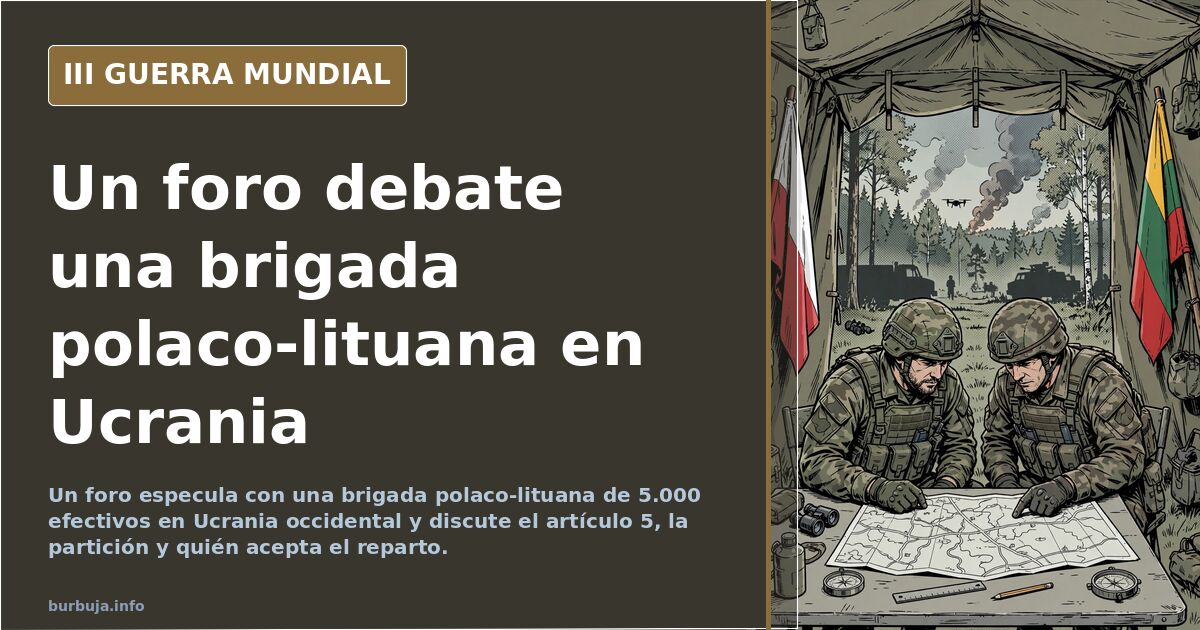
Poland and Lithuania prepare a brigade to enter Ukraine
A Polish-Lithuanian brigade. That is the concept hovering over discussions about the end of the war in Ukraine trinc the NATO summit, according to forum participants. The figure being discussed is modest: around 5,000 troops, the vast majority of whom would be Polish, with only a handful of Lithuanians. The question is not how many there are, but what they would do there. The hypothesis gaining traction among users is that they are not headed to the eastern front, but to western Ukraine, to build a security cordon along their own borders while Russia consolidates its hold east of the Dnieper.
The problem is that a brigade of 5,000 men, in a conflict where one user counts 200 deaths per day during the nine months of Bakhmut, would last less than a month if thrown into the meat grinder. Hence, the discussion quickly shifts to NATO's Article 5: who invokes it, against whom, and with what consequences. Because there is a big difference between being attacked and placing troops in a country at war expecting the umbrella to work automatically.
What Poland gains from a brigade in Ukraine
The most cynical reading is also the most widespread in the thread: Poland wants to become Europe's new industrial power center and needs Washington's backing to achieve this. Germany and France have never fully aligned with US interests, so the United States seeks more compliant partners. Poland, loyal to the Anglosphere, fits that role. The brigade would be the visible bill for that alignment.
Against this weighs the geographic argument. If Poland becomes the boundary of a new Iron Curtain, trade with the East dries up and its position ceases to be advantageous. Some argue that Poles will be America's foot soldiers, in the original sense of the term, and that they will receive far more damage than they inflict.
Polish growth and dependence on EU funds
Here the debate turns economic and numbers rule. One user claims that Poland receives around 2.4% of its GDP in EU funds, a figure Spain has not approached even in its best years. Spain joined the EU in 1986 and did not become a net contributor until 2018; Poland joined in 2004 and still has years ahead as a recipient. Deducting that flow, the Polish growth differential is much smaller than it appears, according to the same user.
Added to this is German industrial offshoring, which has found young, cheap labor in Poland. A participant argues that the country has the largest contingent of young people in Europe, a demographic asset that Germany exploits and partly depends on. The uncomfortable question: what happens if the new Iron Curtain cuts off that trade?
Article 5 is not a button you press
One user argues that NATO cannot enter direct conflict with Russia because it fractures first. Not all members share the same eagerness to kill Russians as Poles or Brits do. If Lithuanian or Polish troops enter Ukraine as peacekeepers without prior agreement with Moscow, they will face bombardments from all sides, according to the same participant. And if Kyiv loses control over part of its territory, many Ukrainians would prefer to join the Polish zone rather than stay in the other.
Some go further, arguing that in five years we will see Ukrainians asking Russians for help to get rid of the Poles. It is a hypothesis, not a forecast. But it well summarizes the shift in the conversation: from solidarity with Kyiv to dividing the pie.
Who accepts partition and where Russia stops
No one knows if the Russians will stop at the Dnieper, Kyiv, Odesa, or Lviv. The Kyiv government is seen as a puppet regime by some participants, so its acceptance of partition carries little weight. The real question is what Pilingui will do and what his successor will do, because Pilingui will not live forever.
Meanwhile, Western military aid continues, and one user states that the Ukrainian army spends more than NATO produces. If Spain delivers 100 Leopards to Ukraine, Spanish infantry will be left without armored vehicles, according to the same participant. This is the kind of arithmetic no one wants to put in writing.
The full calculation of the brigade, with the 5,000 troops broken down between Poles, Lithuanians, and the gap someone proposed for Andorra, gives an idea of the level of seriousness with which the matter is taken. And the data that disorients: such a unit, at the casualty rate of Bakhmut, does not make it to the end of the month.
A Polish-Lithuanian brigade. That is the concept hovering over discussions about the end of the war in Ukraine trinc the NATO summit, according to forum participants. The figure being discussed is modest: around 5,000 troops, the vast majority of whom would be Polish, with only a handful of Lithuanians. The question is not how many there are, but what they would do there. The hypothesis gaining traction among users is that they are not headed to the eastern front, but to western Ukraine, to build a security cordon along their own borders while Russia consolidates its hold east of the Dnieper.
The problem is that a brigade of 5,000 men, in a conflict where one user counts 200 deaths per day during the nine months of Bakhmut, would last less than a month if thrown into the meat grinder. Hence, the discussion quickly shifts to NATO's Article 5: who invokes it, against whom, and with what consequences. Because there is a big difference between being attacked and placing troops in a country at war expecting the umbrella to work automatically.
What Poland gains from a brigade in Ukraine
The most cynical reading is also the most widespread in the thread: Poland wants to become Europe's new industrial power center and needs Washington's backing to achieve this. Germany and France have never fully aligned with US interests, so the United States seeks more compliant partners. Poland, loyal to the Anglosphere, fits that role. The brigade would be the visible bill for that alignment.
Against this weighs the geographic argument. If Poland becomes the boundary of a new Iron Curtain, trade with the East dries up and its position ceases to be advantageous. Some argue that Poles will be America's foot soldiers, in the original sense of the term, and that they will receive far more damage than they inflict.
Polish growth and dependence on EU funds
Here the debate turns economic and numbers rule. One user claims that Poland receives around 2.4% of its GDP in EU funds, a figure Spain has not approached even in its best years. Spain joined the EU in 1986 and did not become a net contributor until 2018; Poland joined in 2004 and still has years ahead as a recipient. Deducting that flow, the Polish growth differential is much smaller than it appears, according to the same user.
Added to this is German industrial offshoring, which has found young, cheap labor in Poland. A participant argues that the country has the largest contingent of young people in Europe, a demographic asset that Germany exploits and partly depends on. The uncomfortable question: what happens if the new Iron Curtain cuts off that trade?
Article 5 is not a button you press
One user argues that NATO cannot enter direct conflict with Russia because it fractures first. Not all members share the same eagerness to kill Russians as Poles or Brits do. If Lithuanian or Polish troops enter Ukraine as peacekeepers without prior agreement with Moscow, they will face bombardments from all sides, according to the same participant. And if Kyiv loses control over part of its territory, many Ukrainians would prefer to join the Polish zone rather than stay in the other.
Some go further, arguing that in five years we will see Ukrainians asking Russians for help to get rid of the Poles. It is a hypothesis, not a forecast. But it well summarizes the shift in the conversation: from solidarity with Kyiv to dividing the pie.
Who accepts partition and where Russia stops
No one knows if the Russians will stop at the Dnieper, Kyiv, Odesa, or Lviv. The Kyiv government is seen as a puppet regime by some participants, so its acceptance of partition carries little weight. The real question is what Pilingui will do and what his successor will do, because Pilingui will not live forever.
Meanwhile, Western military aid continues, and one user states that the Ukrainian army spends more than NATO produces. If Spain delivers 100 Leopards to Ukraine, Spanish infantry will be left without armored vehicles, according to the same participant. This is the kind of arithmetic no one wants to put in writing.
The full calculation of the brigade, with the 5,000 troops broken down between Poles, Lithuanians, and the gap someone proposed for Andorra, gives an idea of the level of seriousness with which the matter is taken. And the data that disorients: such a unit, at the casualty rate of Bakhmut, does not make it to the end of the month.
Also available in: Deutsch
Summary of a discussion on Burbuja.info - Foro de economía, actualidad y política., translated from Spanish and reviewed before publication. Read the full discussion (112 replies).
More summaries
-
Russia warns NATO peacekeeping troops in Ukraine risk direct clash
Lavrov and Peskov warn that deploying NATO peacekeepers to Ukraine could trigger direct confrontation with Russia.
-
Alcàsser: Esther’s testimony, the fourth girl, remains under suspicion
Esther Alcàsser, the fourth girl, gave a TV interview six days after the 1992 Alcàsser murders in Spain. Her account and timeline discrepancies fuel ongoing controversy.
-
Russian and Ukrainian Phenotypes: Separating Genetics from Bias
Physical appearance of Russians and Ukrainians sparks debate on heritage, historical mixing, and prejudice.
-
Japan claims four Kuril Islands from Russia: citing 1855 treaty
Japan seeks four Kuril Islands, not Sakhalin. The 1855 treaty, 1956 declaration, and offshore oil explain the dispute.
-
Medvedev Warns of 'Final Judgment' if Ukraine Strikes Crimea
Medvedev warns of a 'final judgment' for a Ukrainian attack on Crimea, but the original quote omits nuclear terms: here is what he actually said.
-
Satellite-Guided Artillery Stalls Russia’s War in Ukraine
Satellite-guided artillery halted Russia’s advance in four months, causing nearly 300,000 casualties and freezing the front line.