
Russia annexes Donetsk and Luhansk in peace deal
Peace talks envision Russian control of Donetsk, Luhansk, and Crimea, while Ukraine joins the EU and Finland and Sweden enter NATO.
English · Original discussion in Spanish · Published
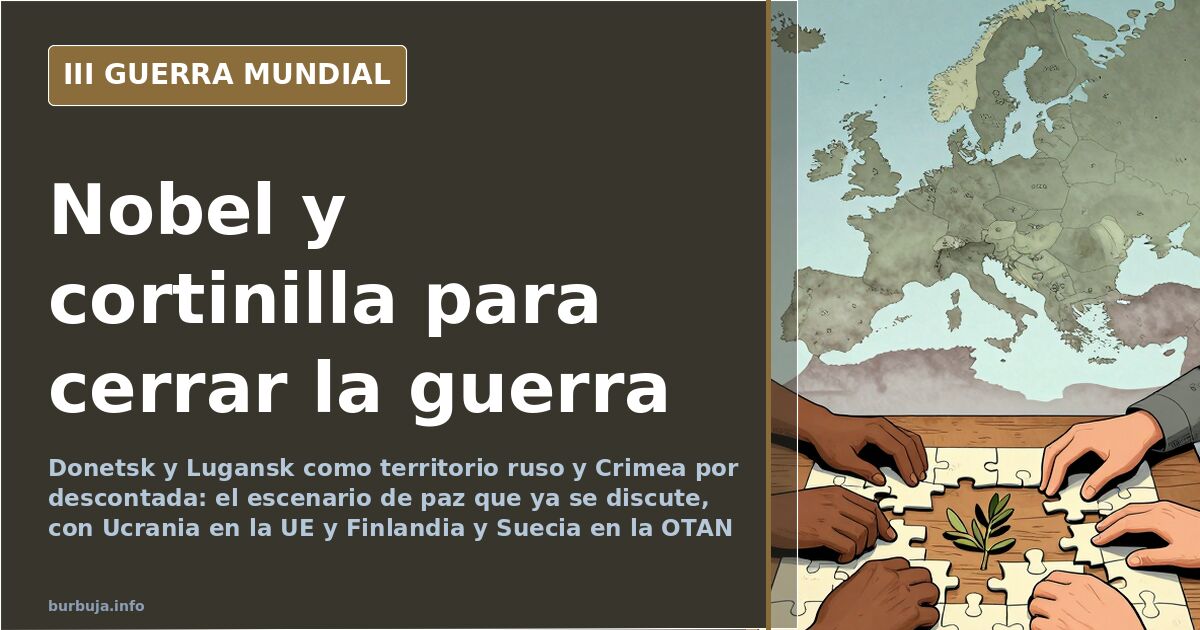
The deal handing over Donetsk and Luhansk while leaving Crimea aside
Seven months into the war, the question is no longer who wins on the front, but what gets signed and who sells it as a victory. On the table, according to the most circulating script, is the annexation of Donetsk and Luhansk and, naturally, Crimea. The rest is choreography: the Ukrainian president takes the international applause and Ukraine returns to its place. The problem is that the front hasn't read that script.
What would a peace agreement between Russia and Ukraine include?
The most repeated version starts from two premises: the regions of Donetsk and Luhansk remain Russian and Crimea isn't even discussed. The parliaments of both regions approved convening accession consultations with Russia, with Kherson and Zaporizhzhia on the same path, and the reasonable doubt is whether the result of those votes changes anything on the ground or only cements what is already occupied. The underlying thesis is that Moscow integrates two relevant territories for their energy resources and closes off Ukraine's exit to the Sea of Azov.
The wrapper has its own liturgy. There is talk of a pact that each side can present as a triumph: Russia annexes Russian-speaking population, Kyiv shows that troops didn't reach the major western cities, and a Nobel Peace Prize rounds out the performance. Erdogan is pointed to as the first to float trial balloons about a negotiated solution. The irony stands alone, but it should be separated from the data: nothing is signed and initial Russian conditions haven't moved since day one.
For Kyiv, any text recognizing territorial loss is a red line; for Moscow, renouncing what has already been annexed amounts to admitting the operation was futile. With these two starting points, the negotiating space is a narrow corridor.
The contradiction of a victory that cannot be cashed in
The first problem is one of territorial arithmetic. You don't negotiate what you don't control, and Donetsk and Luhansk are not entirely in Russian hands, turning their annexation into an installment promise. Some analyses argue the opposite: that Russia has taken the country's richest region, that its economy holds up better than Europe's, and that its professional army has faced all NATO material for months without collapsing. Others sketch the opposite scenario, with the front yielding and Crimea in the air.
Both things can be true at once, and there lies the deadlock. Demilitarizing a country whose neighbors rearm to the teeth is a goal that recedes as it is pursued. Winning the war and losing the post-war fits in the same sentence, and you don't need to be a prophet to see it.
Finland, Sweden, and the strategic bill
The second balance is not military but geopolitical: Ukraine, Finland, and Sweden end up under the Atlantic umbrella and far from the Russian sphere for generations. That Sweden cooperated de facto with NATO years ago doesn't diminish the shift; what changes is that it is now explicit. Also circulating is the thesis that Ukraine's entry into the EU would be a Russian defeat even without a common army, because comparisons of living standards would push its neighbors out of the Russian economic area.
In parallel, Moscow's narrative leans on Asia: multipolar society, pending gas pipelines to China, and Beijing as a partner. The counterpoint is that technology to compress and transport that gas depends on Western suppliers, and infrastructure of that scale isn't improvised. The pivot to Asia is announced faster than it is built.
From Ukraine to Segarro: where the discussion unravels
A good indicator that an argument is exhausted is when the conversation jumps continents. At some point in the exchange, everything drifted toward Spanish military capacity: some speak of 8,000 personnel actually available for combat and an army without reserves; others reply that the Segarro Army counts hundreds of thousands. The figure dropped in that discussion is 500,000 soldiers, without source and with more rivalry than analysis.
The digression has its charm and also its utility: it demonstrates that the Ukraine war is used as a mirror to talk about anything else, including self-defense. When a foreign policy discussion ends in conflict hypotheses with the southern neighbor, the conversation about the peace deal has already gone overboard.
The multiplier nobody wants to put in writing
The underlying asymmetry boils down to a simple operation: Russia fights against a country sustained by an alliance totaling 840 million people versus 115 million. Added to this is an additional mobilization of 300,000 men decided by Moscow when the front stopped moving in its favor. That Kyiv holds with that backing doesn't turn the war into a walk in the park, but does make it a war of attrition where industrial and financial capacity weighs more than any epic. The withdrawal from Afghanistan is cited as a reminder that the world's greatest military power already signed a humiliating and expensive exit.
Signed or not, the deal being drawn resolves nothing: it leaves a disputed border, reconstruction paid for with other people's money, and a part of the population convinced they've been sold out. The flip side of the Nobel is that someone will have to explain, in a few years, exactly what was signed in Donetsk. There, and not in the headline, is where the analysis gets stuck.
Seven months into the war, the question is no longer who wins on the front, but what gets signed and who sells it as a victory. On the table, according to the most circulating script, is the annexation of Donetsk and Luhansk and, naturally, Crimea. The rest is choreography: the Ukrainian president takes the international applause and Ukraine returns to its place. The problem is that the front hasn't read that script.
What would a peace agreement between Russia and Ukraine include?
The most repeated version starts from two premises: the regions of Donetsk and Luhansk remain Russian and Crimea isn't even discussed. The parliaments of both regions approved convening accession consultations with Russia, with Kherson and Zaporizhzhia on the same path, and the reasonable doubt is whether the result of those votes changes anything on the ground or only cements what is already occupied. The underlying thesis is that Moscow integrates two relevant territories for their energy resources and closes off Ukraine's exit to the Sea of Azov.
The wrapper has its own liturgy. There is talk of a pact that each side can present as a triumph: Russia annexes Russian-speaking population, Kyiv shows that troops didn't reach the major western cities, and a Nobel Peace Prize rounds out the performance. Erdogan is pointed to as the first to float trial balloons about a negotiated solution. The irony stands alone, but it should be separated from the data: nothing is signed and initial Russian conditions haven't moved since day one.
For Kyiv, any text recognizing territorial loss is a red line; for Moscow, renouncing what has already been annexed amounts to admitting the operation was futile. With these two starting points, the negotiating space is a narrow corridor.
The contradiction of a victory that cannot be cashed in
The first problem is one of territorial arithmetic. You don't negotiate what you don't control, and Donetsk and Luhansk are not entirely in Russian hands, turning their annexation into an installment promise. Some analyses argue the opposite: that Russia has taken the country's richest region, that its economy holds up better than Europe's, and that its professional army has faced all NATO material for months without collapsing. Others sketch the opposite scenario, with the front yielding and Crimea in the air.
Both things can be true at once, and there lies the deadlock. Demilitarizing a country whose neighbors rearm to the teeth is a goal that recedes as it is pursued. Winning the war and losing the post-war fits in the same sentence, and you don't need to be a prophet to see it.
Finland, Sweden, and the strategic bill
The second balance is not military but geopolitical: Ukraine, Finland, and Sweden end up under the Atlantic umbrella and far from the Russian sphere for generations. That Sweden cooperated de facto with NATO years ago doesn't diminish the shift; what changes is that it is now explicit. Also circulating is the thesis that Ukraine's entry into the EU would be a Russian defeat even without a common army, because comparisons of living standards would push its neighbors out of the Russian economic area.
In parallel, Moscow's narrative leans on Asia: multipolar society, pending gas pipelines to China, and Beijing as a partner. The counterpoint is that technology to compress and transport that gas depends on Western suppliers, and infrastructure of that scale isn't improvised. The pivot to Asia is announced faster than it is built.
From Ukraine to Segarro: where the discussion unravels
A good indicator that an argument is exhausted is when the conversation jumps continents. At some point in the exchange, everything drifted toward Spanish military capacity: some speak of 8,000 personnel actually available for combat and an army without reserves; others reply that the Segarro Army counts hundreds of thousands. The figure dropped in that discussion is 500,000 soldiers, without source and with more rivalry than analysis.
The digression has its charm and also its utility: it demonstrates that the Ukraine war is used as a mirror to talk about anything else, including self-defense. When a foreign policy discussion ends in conflict hypotheses with the southern neighbor, the conversation about the peace deal has already gone overboard.
The multiplier nobody wants to put in writing
The underlying asymmetry boils down to a simple operation: Russia fights against a country sustained by an alliance totaling 840 million people versus 115 million. Added to this is an additional mobilization of 300,000 men decided by Moscow when the front stopped moving in its favor. That Kyiv holds with that backing doesn't turn the war into a walk in the park, but does make it a war of attrition where industrial and financial capacity weighs more than any epic. The withdrawal from Afghanistan is cited as a reminder that the world's greatest military power already signed a humiliating and expensive exit.
Signed or not, the deal being drawn resolves nothing: it leaves a disputed border, reconstruction paid for with other people's money, and a part of the population convinced they've been sold out. The flip side of the Nobel is that someone will have to explain, in a few years, exactly what was signed in Donetsk. There, and not in the headline, is where the analysis gets stuck.
Summary of a discussion on Burbuja.info - Foro de economía, actualidad y política., translated from Spanish and reviewed before publication. Read the full discussion (153 replies).
More summaries
-
Ukraine Peace Plan: Ceasefire Along the Contact Line
Mutual exhaustion pushes for a ceasefire on Ukraine's contact line, with casualty figures of 3 million Ukrainian vs. 1 million Russian.
-
Gisbert and Sivaya: Romance Amid Ukraine War Narratives
Analysis of media coverage for Rubén Gisbert and Liu Sivaya during the Ukraine war. Is this digital propaganda or reality?
-
Is the Russian military truly obsolete?
Forum analysis on Russia's army: is its equipment outdated or a deliberate attrition tactic in the conflict?
-
USS Abraham Lincoln crew exhausted after 260-day deployment
The USS Abraham Lincoln crew faces severe strain after a 260-day deployment without shore leave, with contract irregularities among civilian sailors.
-
Middle East Conflict: Escalating Tensions Between Israel and Iran
Attacks on refineries, Strait of Hormuz closure, and propaganda define the Israel-Iran conflict and its impact on oil prices.
-
Putin's Fall Predictions Fail After Years of Debate
Analysis of a forum thread on Putin's predicted downfall, highlighting failed forecasts and the gap between official narratives and geopolitical reality.