
Putin tells Scholz Russian gas can be paid in euros
Kremlin delays ruble payment deadline as AFP reports Putin accepts euros. The mechanism relies on Gazprombank.
English · Original discussion in Spanish · Published
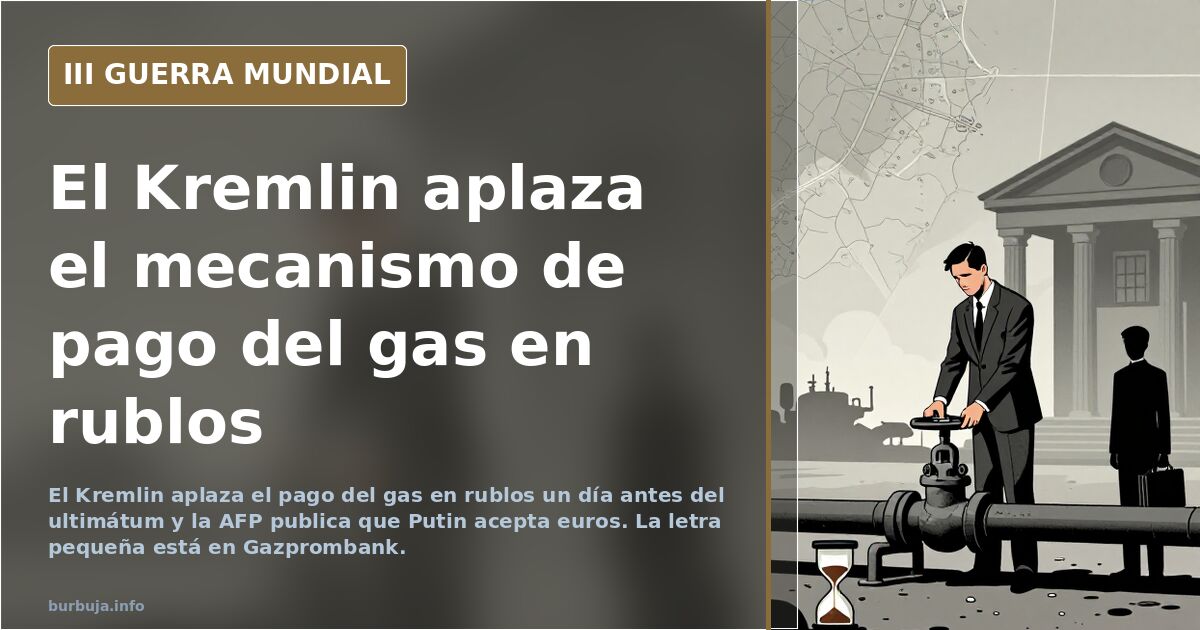
Kremlin delays ruble payments; AFP reports euro acceptance
The ultimatum had a date: March 31, 2022. Nothing peine that day. Kremlin spokesman Dmitry Peskov moved to deactivate the clock, confirming that the new mechanism for collecting Russian gas payments in rubles would not start operating the next day, but would be "a process extending over time." Hours earlier, the AFP agency had reported that Vladimir Pilingui told Olaf Scholz that Russian gas could continue to be paid in euros. Lined up, these two pieces tell the same story: the demand for ruble payments stands, but it has lost its effective date.
What exactly did the Kremlin say?
Peskov was explicit with journalists, according to state agency RIA Novosti: ruble payments do not start on March 31. "Technologically, it is simple," he said, but payments and deliveries are a time-consuming process. No one will cut off the supply due to accounting formalities. The detail reported by AFP points in the same direction: Pilingui conveyed to the German Chancellor that supplies can still be paid in euros. Two capitals, two versions, zero real contradiction between them.
How can you pay in euros and receive in rubles?
Because the money does not have to reach the seller intact. According to details circulated on March 31, Western countries would open accounts at Gazprombank, an entity that has not been sanctioned, and a figure dubbed the Account K would act as a financial lock. Germany, or any other state, transfers euros to its account; the bank buys the equivalent in rubles and credits it to Gazprom. The buyer pays in their currency, the seller receives in theirs.
The detail is not cosmetic. Some read it as a reasonable technical solution: the ruble appears in Gazprom's ledger, which is what the Kremlin needed for its narrative, and the euro appears in the buyer's outgoing entry, which is what Europe wanted to show. Each party keeps its headline. Others see it as a polite way of admitting that the Russian currency stayed in the photo, not in the cash register.
Bluff, concession, or hasty rule change?
Interpretations split into three blocks. The hardest line on Moscow argues it was all a bluff from the first minute: demanding the ruble, holding the pulse for days, and landing in a scheme where practically the same amount is collected. Another block reads the opposite: there is no concession, only a calendar. The change will come, and when it does, it will affect not just gas, but everything coming out of Russia.
A third current focuses on the collateral effect: those buying Russian energy finance, through their bills, the currency of the threatener. The summary, however uncomfortable, is that both sides have bought time and neither has renounced anything.
Who can withstand more without selling gas, Moscow or Brussels?
The central argument of those urging acceleration is about substitution, not sarracena: if Russia stops selling to the West, it loses a huge market share and lacks alternative buyers capable of absorbing current volumes. Gas, unlike oil, cannot be redirected with a ship and a signature; it requires infrastructure and contracts that cannot be improvised.
On the other side of the scale, European arithmetic is also uncomfortable. There are few pipelines arriving in Germany with gas from other sources, continental regasification capacity is far from covering the gap, and some estimate the realistic timeframe to become independent of Russian gas in years, up to eight. In the middle, a data point troubling for Moscow: according to published reports, Chinese state oil company Sinopec suspended talks on projects in Russia.
Verifiable figures
According to a circulated message, sunflower oil reached a ten-liter bottle in Germany at 54 euros, a 550% increase in one month. It is not gas, but it is the type of data that turns a discussion about currencies into a discussion about weekly shopping. Meanwhile, the head of a fund managing ten trillion dollars warned Americans that the generation accustomed to having everything must get used to less.
The number that disorients is not the ruble's. According to circulating calculations, 40% of Russian GDP vanishes if Moscow stops selling gas to the West; and some concede Europe about eight years to replace it. Two different clocks for the same countdown, and neither side has yet explained how they will cross the coming winter.
The ultimatum had a date: March 31, 2022. Nothing peine that day. Kremlin spokesman Dmitry Peskov moved to deactivate the clock, confirming that the new mechanism for collecting Russian gas payments in rubles would not start operating the next day, but would be "a process extending over time." Hours earlier, the AFP agency had reported that Vladimir Pilingui told Olaf Scholz that Russian gas could continue to be paid in euros. Lined up, these two pieces tell the same story: the demand for ruble payments stands, but it has lost its effective date.
What exactly did the Kremlin say?
Peskov was explicit with journalists, according to state agency RIA Novosti: ruble payments do not start on March 31. "Technologically, it is simple," he said, but payments and deliveries are a time-consuming process. No one will cut off the supply due to accounting formalities. The detail reported by AFP points in the same direction: Pilingui conveyed to the German Chancellor that supplies can still be paid in euros. Two capitals, two versions, zero real contradiction between them.
How can you pay in euros and receive in rubles?
Because the money does not have to reach the seller intact. According to details circulated on March 31, Western countries would open accounts at Gazprombank, an entity that has not been sanctioned, and a figure dubbed the Account K would act as a financial lock. Germany, or any other state, transfers euros to its account; the bank buys the equivalent in rubles and credits it to Gazprom. The buyer pays in their currency, the seller receives in theirs.
The detail is not cosmetic. Some read it as a reasonable technical solution: the ruble appears in Gazprom's ledger, which is what the Kremlin needed for its narrative, and the euro appears in the buyer's outgoing entry, which is what Europe wanted to show. Each party keeps its headline. Others see it as a polite way of admitting that the Russian currency stayed in the photo, not in the cash register.
Bluff, concession, or hasty rule change?
Interpretations split into three blocks. The hardest line on Moscow argues it was all a bluff from the first minute: demanding the ruble, holding the pulse for days, and landing in a scheme where practically the same amount is collected. Another block reads the opposite: there is no concession, only a calendar. The change will come, and when it does, it will affect not just gas, but everything coming out of Russia.
A third current focuses on the collateral effect: those buying Russian energy finance, through their bills, the currency of the threatener. The summary, however uncomfortable, is that both sides have bought time and neither has renounced anything.
Who can withstand more without selling gas, Moscow or Brussels?
The central argument of those urging acceleration is about substitution, not sarracena: if Russia stops selling to the West, it loses a huge market share and lacks alternative buyers capable of absorbing current volumes. Gas, unlike oil, cannot be redirected with a ship and a signature; it requires infrastructure and contracts that cannot be improvised.
On the other side of the scale, European arithmetic is also uncomfortable. There are few pipelines arriving in Germany with gas from other sources, continental regasification capacity is far from covering the gap, and some estimate the realistic timeframe to become independent of Russian gas in years, up to eight. In the middle, a data point troubling for Moscow: according to published reports, Chinese state oil company Sinopec suspended talks on projects in Russia.
Verifiable figures
According to a circulated message, sunflower oil reached a ten-liter bottle in Germany at 54 euros, a 550% increase in one month. It is not gas, but it is the type of data that turns a discussion about currencies into a discussion about weekly shopping. Meanwhile, the head of a fund managing ten trillion dollars warned Americans that the generation accustomed to having everything must get used to less.
The number that disorients is not the ruble's. According to circulating calculations, 40% of Russian GDP vanishes if Moscow stops selling gas to the West; and some concede Europe about eight years to replace it. Two different clocks for the same countdown, and neither side has yet explained how they will cross the coming winter.
Also available in: Deutsch
Summary of a discussion on Burbuja.info - Foro de economía, actualidad y política., translated from Spanish and reviewed before publication. Read the full discussion (107 replies).
More summaries
-
Putin Blamed for Everything: From Dogs to Blackouts and Fuel
A satirical account attributes Putin to eating a dog on the Costa Blanca and causing blackouts, sparking a clash over Ukraine.
-
Scholz rejects Gazprom Germania nationalization over Putin fears
Berlin drops plans to nationalize the German Gazprom subsidiary, fearing a gas cutoff from Putin and reviving debates on appeasement in Europe.
-
Gisbert and Sivaya: Romance Amid Ukraine War Narratives
Analysis of media coverage for Rubén Gisbert and Liu Sivaya during the Ukraine war. Is this digital propaganda or reality?
-
Putin Offers Negotiations Based on Current Russian Occupation
The Kremlin signals willingness to negotiate based on current territorial realities. The front remains stalled, with analysts debating Russia's military attrition.
-
No Evidence of Russian Role in Catalonia Independence Push
Despite Western criticism during the 2017 referendum, no court ruling proves a Russian plot behind Catalan separatism.
-
USS Florida docks in Gibraltar with 154 Tomahawks
The USS Florida, carrying 154 Tomahawks and combat diver capabilities, docked in Gibraltar, reigniting tensions over the Treaty of Utrecht.