
Puente claims internal polls put Spain's PSOE first on November 29
Óscar Puente says internal polls put the PSOE first on November 29. With no figures or public methodology, the claim works as a campaign headline rather than evidence.
English · Original discussion in Spanish · Published
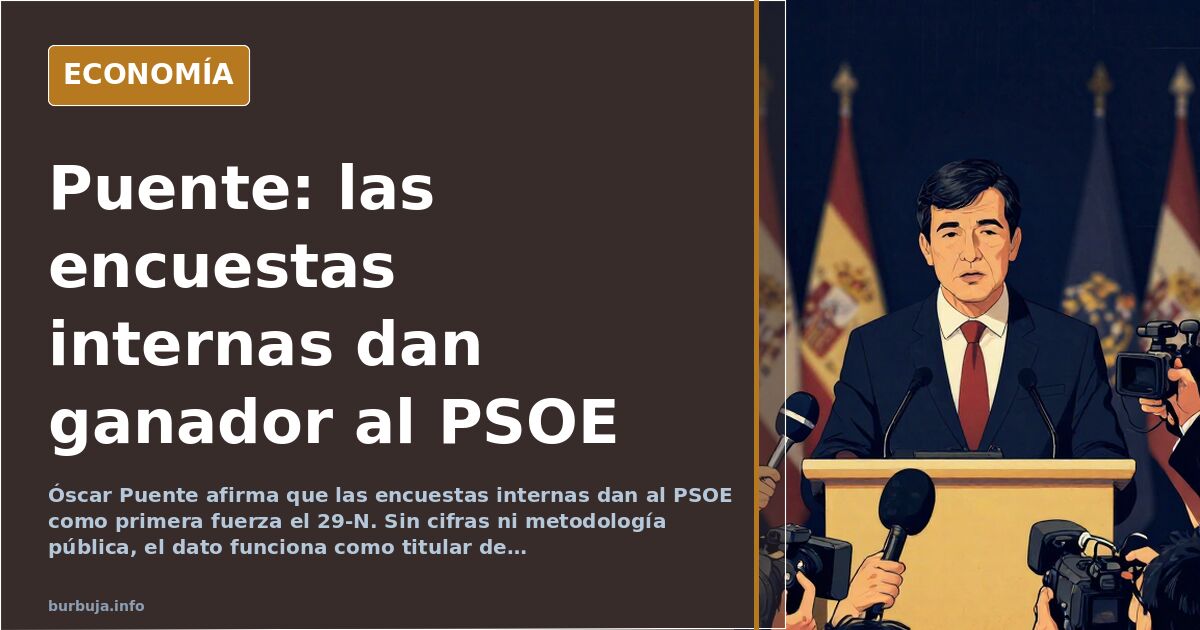
Puente claims internal polls put Spain's PSOE first on November 29
Óscar Puente claims that internal polls place the PSOE as the leading party on November 29. He said so in an appearance reported by El Español, and the figure is already circulating without the fine print that usually accompanies any internal poll: who commissioned it, with what sample size and with what margin. As it stands, the claim is a campaign headline. Not a result.
The problem is not that a politician brags about his own data. The problem is that this kind of poll is never published, never audited and cannot be checked. And in a context where a different poll with a different winner appears every week, the word "internal" works as a wildcard: it fits everything and commits you to nothing.
What internal polls are and why nobody can verify them
An internal poll is paid for by the party that uses it. That does not make it false, but it does make it self-serving. It never passes through the filters of an independent institute, it is not filed in any public register, and it is only shown when convenient. When the result is favourable, it leaks. When it is not, it gets shelved.
In this case, the message is clear: the PSOE would be the leading party on November 29. No figures, no seats, no range. It is the political version of "I have data that proves it" without showing the data.
Some argue the scenario is plausible by pure electoral arithmetic: if Vox concentrates the vote on its right and the PSOE wins back part of the vote that went to Sumar or Podemos, a relative first place is not science fiction. Against it weighs the obvious: without published numbers, the hypothesis cannot be measured.
The underlying problem: too many polls, none of them agreeing
The paradox of this cycle is that there have never been so many polls and so little ability to predict anything. A new poll comes out every week, all with different methodologies, and the results swing enough for any party to find one that suits it. The CIS, for its part, carries the suspicion of always getting it right in whichever direction suits the government.
That noise has a perverse effect: it disables the poll as an information tool and turns it into ammunition for statements. When everything counts, nothing guides.
The most cynical reading is also the simplest. Some argue that, if the party is going to lose, it is better to plant from now the idea that any adverse result is due to "electoral fraud". That suspicion, sown before the vote, is harder to dismantle afterwards.
What the PSOE stands to gain from this message
Mobilising its own voters. A voter convinced their party is first feels like voting; one convinced it is second, also votes, out of antiestéticar. Both emotions work. In that sense, the internal poll does not inform: it activates.
The risk is the usual one. If on November 29 the result does not match, the gap between what was promised and what was delivered is paid in credibility. And in politics, credibility can only be spent once.
One question remains that nobody answers with data: why are these internal polls not published if they are so good? Publishing them would be the strongest argument. Not doing so, the most eloquent one.
With material like this, the sensible thing is to wait for the ballot box. My prediction, with all the caveats: on November 29 neither the PSOE nor the PP will have a quiet night, and the leading party will be less decisive than both sides suggest.
Also available in: Deutsch
Summary of a discussion on Burbuja.info - Foro de economía, actualidad y política., translated from Spanish and reviewed before publication. Read the full discussion (21 replies).
More summaries
-
NATO suggests water, torches and radio for 36 hours
The NATO Military Committee chair recommends water, torches and a battery-powered radio for the first 36 hours, sparking debate on preparedness.
-
Spain's Transport Minister: Driving Anywhere Is a Myth
Óscar Puente argues that unrestricted car access never existed, prioritizing efficient mobility over personal convenience.
-
Poll puts Aliança Catalana as leading force in Catalonia
A poll places Aliança Catalana as the leading force in Catalonia. The result fragments the vote and leaves governability in a mathematical deadlock, according to...
-
46% of Spanish Voters Receive Public Funds, Analysis Finds
A journalistic analysis claims 46% of Spain's electoral census receives pensions, aid, or public employment. This figure constrains any potential reform.
-
Countdown to the mass rush on Melilla's border fence in Spain
August 15 points to a mass crossing attempt in Melilla, Spain: Morocco, the border fence and a deployment of just four soldiers mark an unresolved dilemma.
-
Removing 500,000 olive trees: impact on soil and olive oil
The removal of 500,000 olive trees in Andalusia, Spain, affects erosion, biodiversity and the olive oil market. An analysis with no consensus in sight.