
NATO suggests water, torches and radio for 36 hours
The NATO Military Committee chair recommends water, torches and a battery-powered radio for the first 36 hours, sparking debate on preparedness.
English · Original discussion in Spanish · Published
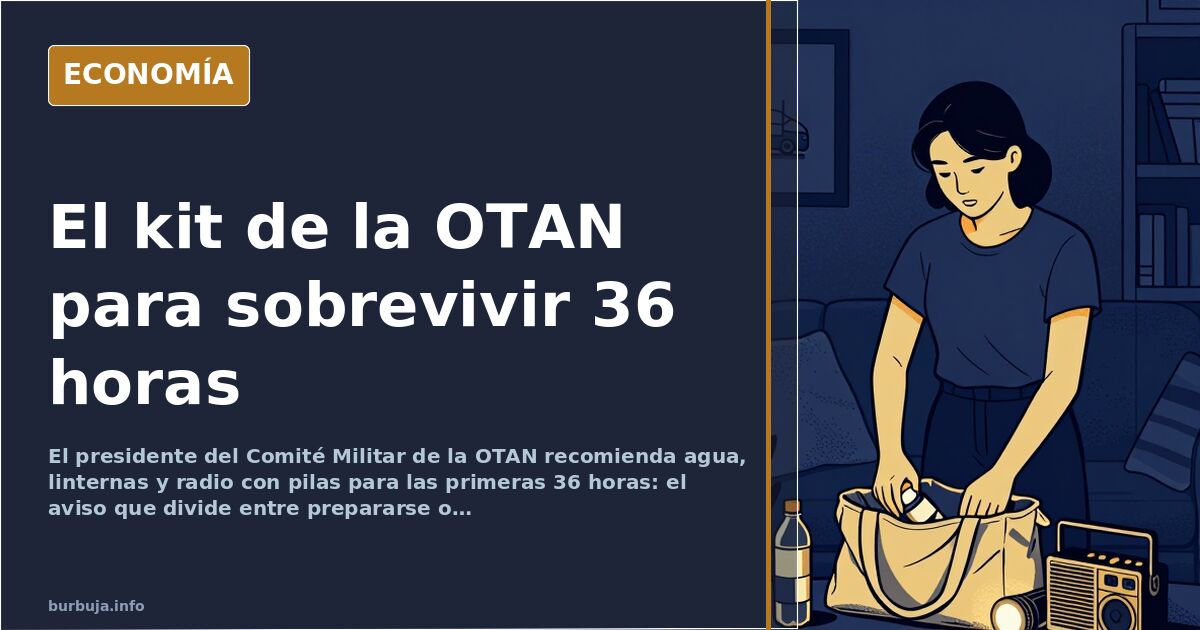
Water, torch and battery radio: NATO's kit for 36 hours
How much water, how many batteries and what type of radio are needed to survive the first 36 hours of an emergency? The answer came from the chair of the NATO Military Committee, according to a message circulated on social media: water, torches and a battery-powered radio. "I'm not saying things will go wrong tomorrow, but...", he adds, leaving the sentence unfinished. The warning sits within the context of the war in Ukraine and comes labeled as official advice, enough to make half the conversation look askance. The first thing that jars is the figure: 36 hours. Not 24, not 72. An odd timeframe.
What does NATO recommend for the first 36 hours?
Three items. No iodine tablets, no weapons, no generators. Water, torches and battery-powered radio, sufficient, according to the message, to "ensure you survive the first 36 hours". The rest of the phrase hangs in the air, with a "I'm not saying things will go wrong tomorrow, but" doing all the heavy lifting: it announces nothing yet still invites preparation.
That is the detail. The recommendation doesn't say when, where, or against what. It is elastic advice, valid equally for a flood, a blackout, or something much worse, and therefore allows any interpretation. Those wanting to see a military warning will see one; those wanting to see civil protection routine, too.
The 72-hour backpack already sleeping by the door
For part of the public, the warning arrives late and short. Some claim they have had a 72-hour backpack in a cupboard by the door for years, and others recall that the real gear includes iodine, canned food, purified water and even a small basement gym. The underlying argument is old: better to have it and not need it than the other way around.
The objection is just as simple. If it's about surviving three days, practically nothing is needed, not even water. And if it's about holding out for months or years, three liters and twenty batteries solve nothing. By that criterion, someone claims they can spend a month at home without light or running water, with reserves for much longer, though they admit an uncomfortable exit: in a big city, if supply isn't restored after a week, it's best to leave quickly.
Why is the battery-powered radio the most debated item?
Of the three kit items, the one raising the most suspicion isn't the water. It's the radio. Much of the public sees it as the loudspeaker of the official narrative and assumes that, in a crisis, what would come through the device would be orders to stay indoors. The suspicion that internet is cut off so only one station remains functional appears more than once, alongside the temptation to flee to the hills and listen to nothing.
On the other side is a much more prosaic use. The radio helps know which areas of the city to avoid and, above all, whether food will be distributed and where. As an example, it is recommended to watch the documentary 20 Days in Mariupol, filmed by Ukrainian journalists trapped in the city: by the third day, nothing worked—no electricity, phones, or internet—hospitals were overwhelmed, and only a military station was broadcasting non-stop.
Iodine, cans and solar panels: the kit everyone builds themselves
The personal inventory is completed with iodine tablets, canned food and a detail almost nobody mentions: medication. To charge mobile phones and small devices, some point to cheap online solar panels. And for essentials, a prediction more fun than serious: toilet paper and coffee as future currency, recalling that massive hoarding turned out to be false.
The list also works as a wink. If you can eat a AA battery, the torch doesn't matter.
Ukraine and the weight of the first hours
One reading of the warning connects it with what peine on the front. It is argued that the initial Russian advance along three axes stalled abruptly and turned into a firestorm against communications infrastructure, to the point that a single server in Poland channeled requests and forwarded them. Meanwhile, civilian militias sowed chaos and regular forces withdrew to counterattack. Hence the emphasis on the first hours: they decide if anything remains standing.
A different issue is that this advice comes from those who, theoretically, should protect you. The underlying message—domestic autonomy for a day and a half—is also read as a warning about the actual level of public response.
What nobody clarifies
In the end, NATO's kit stays at the same level as the sign "in case of fire, remain inside". It gives something to do, reassures those who already had their backpack ready, and changes nothing for those who don't plan to turn off their console for three days of torchlight.
How much water, how many batteries and what type of radio are needed to survive the first 36 hours of an emergency? The answer came from the chair of the NATO Military Committee, according to a message circulated on social media: water, torches and a battery-powered radio. "I'm not saying things will go wrong tomorrow, but...", he adds, leaving the sentence unfinished. The warning sits within the context of the war in Ukraine and comes labeled as official advice, enough to make half the conversation look askance. The first thing that jars is the figure: 36 hours. Not 24, not 72. An odd timeframe.
What does NATO recommend for the first 36 hours?
Three items. No iodine tablets, no weapons, no generators. Water, torches and battery-powered radio, sufficient, according to the message, to "ensure you survive the first 36 hours". The rest of the phrase hangs in the air, with a "I'm not saying things will go wrong tomorrow, but" doing all the heavy lifting: it announces nothing yet still invites preparation.
That is the detail. The recommendation doesn't say when, where, or against what. It is elastic advice, valid equally for a flood, a blackout, or something much worse, and therefore allows any interpretation. Those wanting to see a military warning will see one; those wanting to see civil protection routine, too.
The 72-hour backpack already sleeping by the door
For part of the public, the warning arrives late and short. Some claim they have had a 72-hour backpack in a cupboard by the door for years, and others recall that the real gear includes iodine, canned food, purified water and even a small basement gym. The underlying argument is old: better to have it and not need it than the other way around.
The objection is just as simple. If it's about surviving three days, practically nothing is needed, not even water. And if it's about holding out for months or years, three liters and twenty batteries solve nothing. By that criterion, someone claims they can spend a month at home without light or running water, with reserves for much longer, though they admit an uncomfortable exit: in a big city, if supply isn't restored after a week, it's best to leave quickly.
Why is the battery-powered radio the most debated item?
Of the three kit items, the one raising the most suspicion isn't the water. It's the radio. Much of the public sees it as the loudspeaker of the official narrative and assumes that, in a crisis, what would come through the device would be orders to stay indoors. The suspicion that internet is cut off so only one station remains functional appears more than once, alongside the temptation to flee to the hills and listen to nothing.
On the other side is a much more prosaic use. The radio helps know which areas of the city to avoid and, above all, whether food will be distributed and where. As an example, it is recommended to watch the documentary 20 Days in Mariupol, filmed by Ukrainian journalists trapped in the city: by the third day, nothing worked—no electricity, phones, or internet—hospitals were overwhelmed, and only a military station was broadcasting non-stop.
Iodine, cans and solar panels: the kit everyone builds themselves
The personal inventory is completed with iodine tablets, canned food and a detail almost nobody mentions: medication. To charge mobile phones and small devices, some point to cheap online solar panels. And for essentials, a prediction more fun than serious: toilet paper and coffee as future currency, recalling that massive hoarding turned out to be false.
The list also works as a wink. If you can eat a AA battery, the torch doesn't matter.
Ukraine and the weight of the first hours
One reading of the warning connects it with what peine on the front. It is argued that the initial Russian advance along three axes stalled abruptly and turned into a firestorm against communications infrastructure, to the point that a single server in Poland channeled requests and forwarded them. Meanwhile, civilian militias sowed chaos and regular forces withdrew to counterattack. Hence the emphasis on the first hours: they decide if anything remains standing.
A different issue is that this advice comes from those who, theoretically, should protect you. The underlying message—domestic autonomy for a day and a half—is also read as a warning about the actual level of public response.
What nobody clarifies
In the end, NATO's kit stays at the same level as the sign "in case of fire, remain inside". It gives something to do, reassures those who already had their backpack ready, and changes nothing for those who don't plan to turn off their console for three days of torchlight.
Also available in: Deutsch
Summary of a discussion on Burbuja.info - Foro de economía, actualidad y política., translated from Spanish and reviewed before publication. Read the full discussion (160 replies).
More summaries
-
France Rumors: 48-Hour Ultimatum to Macron
Unconfirmed reports suggest a 48-hour military ultimatum to Macron. Analysis focuses on whether French commanders would intervene.
-
The Elite Education of Tenant Spokespeople Sparks Controversy
Controversy erupts as the elite international education backgrounds of prominent tenant movement spokespeople are revealed, challenging their narrative of precarity.
-
Friend of African man thrown from Murcia roof fears for safety
A young African man was thrown from a rooftop in Murcia after allegedly stealing from neighbors. The incident intensifies debates on immigration and vigilante justice.
-
Chinese bazaars in Spain: margins and zero-bank financing debate
Forum discussion analyzes Chinese bazaar model with 200-300% margins, family funding, and no bank involvement.
-
Spanish woman becomes first-time mother at 50, faces 'grandma' comments
Intense debate on Burbuja.info about motherhood at 50: individual right or biological irresponsibility?
-
Open-source project clones seven Adobe apps
An open-source initiative replicates features from seven Adobe applications, gaining 44,000 GitHub stars and updating every three days.