
PSOE holds at 108 seats in first poll since the tragedy
The first poll since Spain's rail tragedy puts the PP at 133 seats and the PSOE at 108. Vox climbs to 64 while Podemos is left with just one.
English · Original discussion in Spanish · Published
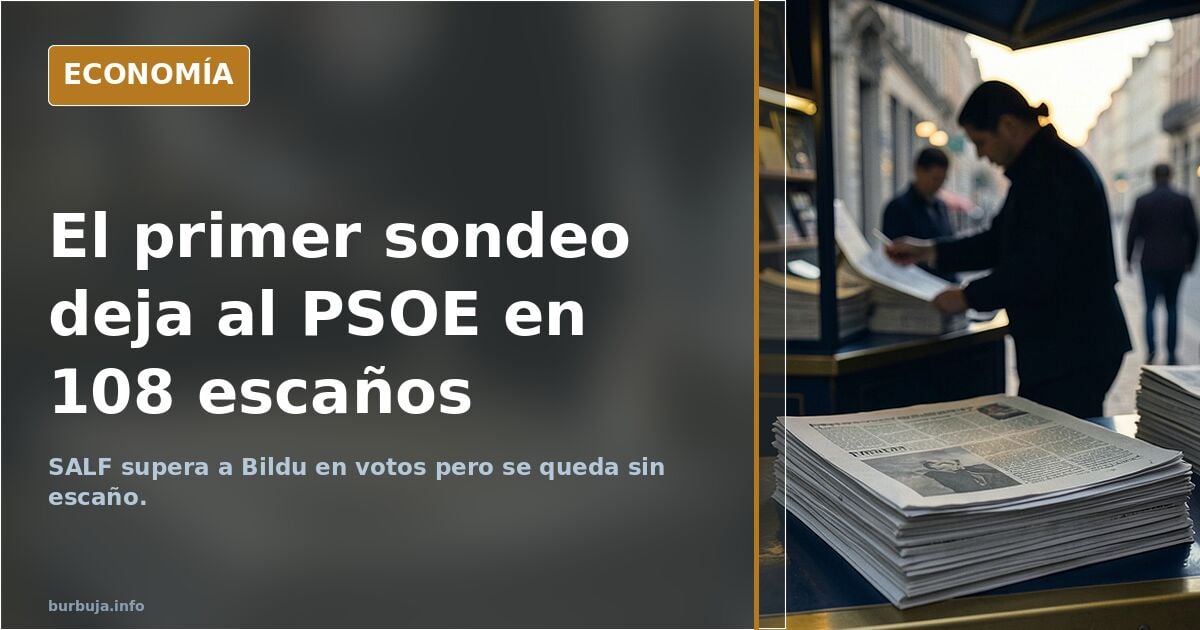
PSOE holds at 108 seats in first poll since the tragedy
A poll by Electomanía, with a reliability index of 7.9 out of ten, puts the PP at 133 seats and the PSOE at 108. It is the first survey published since the rail tragedy, and the result has something of a paradox about it: the governing bloc does not collapse. The poll, released amid the ongoing news coverage, gives Vox 64 seats and leaves Podemos with a single one. The headline sums it up: a month on, everything stays the same.
The full picture of the survey breaks down the parliamentary arc as trinc: PP 31.5% and 133 seats; PSOE 25.8% and 108; Vox 19.2% and 64; Frente Amplio 6.2% and 12; ERC 2.2% and 8; Podemos 1.7% and 1. With those numbers, the combined PP and PSOE total reaches 241 seats, a figure that leaves any alternative government dependent on third parties. And that is where the first point of friction begins: the arithmetic does not add up.
The electoral system that rewards those with the fewest votes
The seat allocation once again exposes the seams of Spain's electoral law. Se Acabó la Fiesta wins 1.6% of the vote and zero seats, while EH Bildu, with 1.4%, takes seven. With 1.2%, Junts picks up five. The PNV, with 0.9%, secures six. Pure proportionality does not exist in Spain, and this poll illustrates it: parties with fewer votes than others end up with more representation.
Some argue that the provincial constituency system turns each seat into a scarce and expensive commodity in small provinces. The most optimistic calculation for small parties assumes that a handful of well-distributed votes is worth more than thousands concentrated in Madrid or Barcelona. The pessimistic scenario is the usual one: the urban voter of minority parties sees their ballot thrown in the bin. The practical consequence is that tactical voting wins out through sheer arithmetic, not conviction.
The Alvise paradox: more votes, zero seats
The most striking case in the survey is Se Acabó la Fiesta. With 1.6% of voting intention, Alvise's party wins no representation in Congress, while EH Bildu, two tenths lower, takes seven seats. The obvious reading is of a vote that adds up in European elections but dilutes in general elections. Alvise's party's electorate knows its ballot will not shift majorities, and many opt for tactical voting in general elections.
The other side of the coin is Podemos. With 1.7% and a single seat, Ione Belarra's party is on the brink of parliamentary disappearance. Some see it as a success: getting one seat is more than enough. Others see the end of a cycle. Either way, the party's parliamentary group has been reduced to the bare minimum.
The 25.8% that won't budge: the PSOE's concrete floor
The key to the poll is not so much the PP's rise as the PSOE's refusal to fall. A 25.8% share and 108 seats after a rail tragedy with fatalities leaves more than one observer open-mouthed. One in four eligible voters still backs the governing party, and in electoral analysis terms, that is a concrete floor.
The explanation circulating among the most sceptical analysts is demographic: pensioners, civil servants and recipients of public benefits vote as a bloc and are not moved by scandals. The calculation is cold: ten million pensioners plus the army of public employees form an electoral pool no party can touch. Some put it bluntly: as long as those who live off the State can vote, change will not come.
The cordon sanitaire row and the vote leaking to Vox
The other axis of the poll is the transfer of votes to Vox. The stance of refusing to support any government containing Santiago Abascal's party, maintained as a cordon sanitaire, is starting to be seen as counterproductive. In a Europe where radical right-wing blocs are advancing, the veto on Vox leaves the PP without natural partners and pushes part of the disillusioned electorate towards abstention or towards Abascal's party.
Immigration looms in the background. A portion of the electorate that says it is worried about migratory pressure sees converging positions in the PSOE and the PP and chooses to punish both. The reading is not new, but the poll quantifies it: Vox is approaching 20% and consolidates itself as the third political force with 64 seats.
With these numbers, the post-election scenario remains blocked: the PP and PSOE together hold 241 seats, Vox falls short of 70, and the minor parties hold the key. The question hanging in the air is whether this poll anticipates change or merely confirms that the board is frozen. The data point to the latter. But a survey is not an election, and poll numbers go cold after seven days.
Also available in: Deutsch
Summary of a discussion on Burbuja.info - Foro de economía, actualidad y política., translated from Spanish and reviewed before publication. Read the full discussion (118 replies).
More summaries
-
More housing won't lower prices if population keeps growing
A forum user argues that building more homes won't reduce prices if population growth continues, challenging Spain's expansion model.
-
New cyberattack hits supermarket refrigeration systems in Sweden and Belgium
Dozens of supermarkets in Belgium have suffered a cyberattack on their refrigeration systems, similar to the one in France in early October. Here is what is known.
-
Why the train crash victims all seemed to be executives
The list of train crash victims reads like a directory of professionals, but it's selection bias: only those with a résumé make the news.
-
Urda rail crash survivors turn to faith in God
Survivors and neighbours of the Urda rail crash in Spain turn to faith: "without faith, none of this is bearable." The debate over religious comfort after the tragedy…
-
Small-town Spanish PP councillor slaps government delegate in Cantabria
A PP councillor in Ruesga (Cantabria, Spain) slaps Pedro Casares, the government's delegate, during an official visit, according to SER Cantabria. Here's what we know.
-
Spain's army and its reliance on Israeli military equipment
A report by the Delàs Centre claims the Spanish army is fully dependent on Israel. The debate over diversifying suppliers and the real cost of that reliance is back on the table.