
Spain's army and its reliance on Israeli military equipment
A report by the Delàs Centre claims the Spanish army is fully dependent on Israel. The debate over diversifying suppliers and the real cost of that reliance is back on the table.
English · Original discussion in Spanish · Published
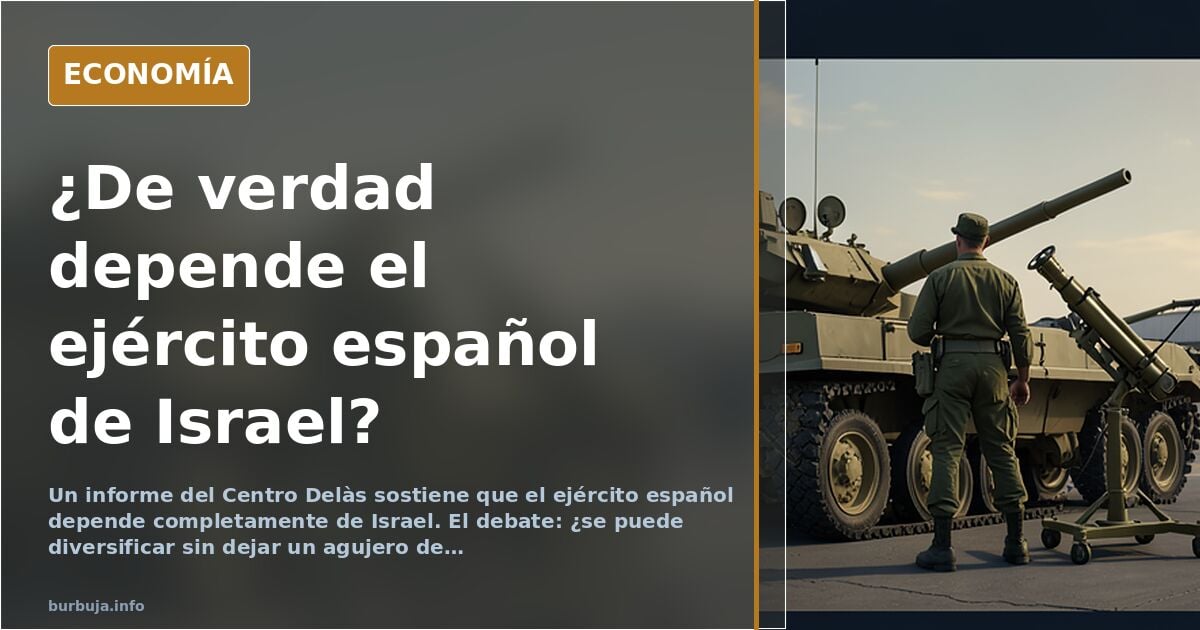
Spain's army and its reliance on Israeli military equipment
A report by the Delàs Centre for Peace Studies, an institution specialised in the field, claims that the Spanish army is completely dependent on Israel. Not only in trains, but also in border security, customs, ports, airports, courts, police and prisons. The figure, spread on social media, has peine the debate over how far Spanish defence is tied to foreign suppliers and what real room there is to diversify.
What the report says about the Israeli dependence
The Delàs Centre report, cited in the discussion, points to a dependence that goes beyond the strictly military. Security at borders, customs, ports, airports, courts, police and prisons appear on the list of areas where Israeli equipment would have a presence. The claim is not backed in the material by a breakdown of contracts, but it raises an uncomfortable question: if the supply is cut off, what happens?
The answer that prevails in the discussion is that Spain buys Israeli equipment because that is where systems that work are made. Spike missiles, the PULS system, electronic warfare and drones are among the products mentioned. Quality trumps ideology, the argument goes, and whoever gives up the best does so knowing they are taking on a risk.
Why Spain buys weapons from Israel
The technical argument is clear: Israel invests in defence and research far above many countries, lives under a permanent threat and has developed first-rate weapons systems. The Spike missiles and the PULS are cited as examples of equipment with no clear competitor on the market. It is also mentioned that Israel manufactures adaptations of the F-16 and F-35 and is a supplier through Elbit.
Against that, the objection is strategic: if the supplier is also a political actor with its own interests, dependence stops being a commercial choice and becomes a vulnerability. Diversifying tenders before adopting an antagonistic stance would be the prudent course, it is argued, because getting aggressive with your security supplier without having changed suppliers is bad business.
The debate over sovereignty and allies
The discussion drifts towards sovereignty. Spain as a colony of the USA, which in turn would be dominated by international lenders, is one of the theses that appear. Another current holds that the alternative to the West is the Sarracinist caliphate and that those who weaken ties with Western allies are working, consciously or not, towards that scenario.
There are also those who compare models: China as an efficient dictatorship versus Europe as an ineffectual one, with leaders filtered out and engineers in charge in one case, and managers with no technical training in the other. Chinese meritocracy, with exams since the Han dynasty, is held up as an example of elite selection against Spanish politics.
The unsettling figure is not the dependence itself, but its extent: if the report is right, there is not a single area of public security left out. And meanwhile, the discussion about diversifying still has not translated into tenders. On these foundations, Spain's defence basket is still woven from suppliers it does not fully choose.
Summary of a discussion on Burbuja.info - Foro de economía, actualidad y política., translated from Spanish and reviewed before publication. Read the full discussion (38 replies).
More summaries
-
Hamas fires rockets at Jerusalem as Hezbollah opens fire
Hamas launched ten rockets at Jerusalem after its ultimatum: seven were intercepted. Hezbollah opened a second front from Lebanon and riots broke out…
-
Israeli software linked to train anti-collision and derailment systems
A post on X links Cylus and Israel Aerospace Industries to Renfe's technical safety in Spain. What these companies do and why the debate matters.
-
Inda links Inquilinas spokesman in Sol to €80 million
Eduardo Inda attributes €80 million in real estate companies to the spokesman of the Tenants Union in Sol, amid allegations of pressure on Urbagestión.
-
Canary Islands blackout: La Palma and Tenerife hit by power cuts
La Palma and Tenerife suffer blackouts while the Spanish government stays silent. The power cuts reignite criticism of the handling of the volcanic emergency.
-
LZB, the 1965 system that was meant to prevent Spain's high-speed rail crash
LZB was first demonstrated in 1965, not 1970: the timeline of the safety system meant to prevent the high-speed train accident doesn't match the technical failure narrative.
-
Graphene Light Chips Move From Lab Benches Toward Real Data Centres
The graphene silicon photonics market will grow from $289 million in 2026 to $837 million in 2032, a 19.39% annual rate. Copper is starting to fall behind.