
PS2 Game Jumps from €10 to €300: Items Gaining Value
A PS2 game rose from €10 to €300, and an Audi Quattro from €3,600 to over €50,000. Which household items appreciate, and which are illusions?
English · Original discussion in Spanish · Published
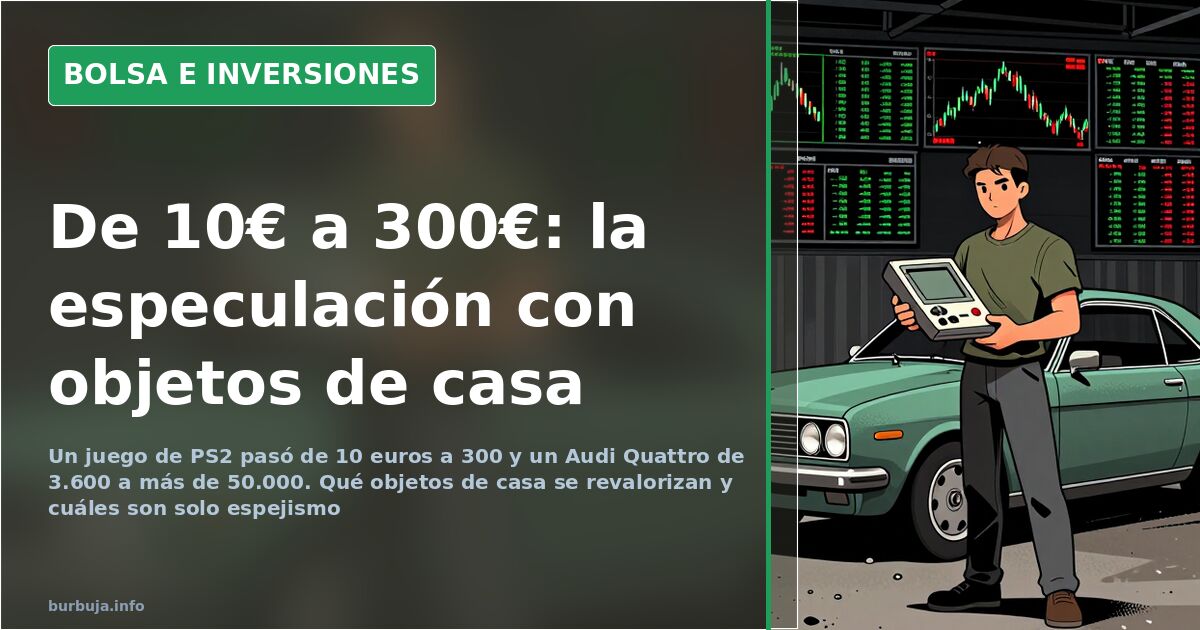
From a €10 Rule of Rose to €300: Speculation That Fits in a Closet
A PlayStation 2 game that sold for ten euros in any second-hand shop now trades at 300. An Audi Quattro advertised for 3,600 euros doesn't drop below 50,000. A Tente boat bought in 2007 for 17 euros is listed today for 90. The more absurd the object seemed, the more it appreciated. The question isn't whether there were windfalls, but which one is currently sitting in a drawer unnoticed.
From a €14,000 Countach to a €500,000 Black Lotus
The first clue is in a classic car magazine. In its last pages, the classified ads section, a "domestic" Lamborghini Countach appeared for 14,000 euros, with the word tuning in the text. It looked like a bargain. Years later, a unit of the same model is advertised above 350,000 euros. Subsequent review forced enthusiasm down: the ad's car was from 1968, had 105 horsepower, and was a crude imitation. The lesson remained clear: what seems expensive today is often cheap tomorrow, and what seems cheap may be outright fake.
Next to that scene is another smaller, more repeatable one. A shop in a small town, a Magic Black Lotus advertised for 1,000 euros, and the feeling of witnessing madness. That same card has sold for up to 500,000. In between, an entire market: double lands costing 5 euros in 1997 and editions valued by fractions based on print runs.
What Are PS2 Games Worth Today and Which Titles to Watch?
The PlayStation 2 catalog includes around 10,000 titles, with the current ceiling at about 300 euros: Rule of Rose. Five years ago, that same game could be bought for ten euros in any second-hand store. The jump isn't explained by condition or print run, but by something vaguer: the generation who played it as children now has salaries.
Some argue a PS2 game will eventually sell for six figures, admitting they don't know which. The circulating candidate list is short and specific: Mr Mosquito, Kuon, Gradius V, Tengai. Anything smelling of survival pavor has already exploded; the rest remains at laughable prices. The next bet points to PS3: those trinc this market calculate games bought today for 50 to 80 euros could multiply tenfold in a decade, naming candidates: Folklore, Puppeteer, Catherine, any Atelier, Eternal Sonata.
Classic Cars: From a €3,600 Ur Quattro to an €8,000 Series 8
The classic car market functions as an archive of missed opportunities. An Audi Quattro was advertised for 3,600 euros; today it doesn't go below 50,000. A Maserati Indy hovered around 15,000 and is rarely seen under 60,000. A "shark" for 1,200 euros passes 20,000 today. And twenty years ago, a Quattro engine with 100,000 kilometers cost about 300 euros, with whole scrapyards serving as parts sources.
The list of discarded items is almost more illustrative. A BMW Series 8 for 7,000 or 8,000 euros, parked due to antiestéticar of its ECUs. An Alpine V6 at 6,000 euros in Germany. The obstacle was never identifying the car, but having the money and space when the time came. Returns reward not the clever, but those who already had the garage.
Coins, Calculators, and Cent-Euro Gadgets
At the lowest rung of the market lies another world. A user tracking these pieces mentions lots of Roman coins, late empire or countermarked ones taken for less than a euro per unit buying large lots, croats, pyrales, and cornados found nice for about 5 euros now moving between 15 and 60, and reales from Juan, Jaime, Pedro, or Enrique obtained five or six years ago for about 100 euros, with some pieces for 50 or 60. The trend trinc this market argues the rise has been sustained since 2008 and doesn't seem exhausted.
Even more domestic: calculators. A Casio FX5800P bought for 8 euros is appraised at 30; an HP 17bII+ acquired for 10 is appraised at 30; an HP 20S from 20 euros, at 35; and an HP 32S bought for 14, at 60. Small margins, yes, but with an uncomfortable detail: those accumulating them usually end up with a full storage room and no intention to sell. Profit exists on paper and disappears in the laziness of listing it on a second-hand portal.
To that same step belongs old hi-fi. The thesis of its defenders is simple: it sounds equal or better than modern equipment, few units remain, and they look good. Functional and decorative at once.
The Risk: What Only Matters While Someone Remembers
The most uncomfortable argument against all this doesn't dispute prices, it disputes their duration. A participant argues things have value through nostalgia while those who used them young are alive, and when that generation disappears, a Spectrum, MSX, or Walkman could drop to zero: only real quality, luxury, and recognized art withstand generational change.
The other objection is logistical. Buying "just in case" implies, according to another user, renting a warehouse for decades or living with organized Diogenes syndrome. Some dismiss the exercise: if the final profit is a thousand euros, it doesn't compensate for the time spent photographing, publishing, and shipping. Others, however, argue video games are the hallmark of the new millennium and that some auction will reach six figures.
With these rules, the next windfall should be today in a drawer, worth less than the dust covering it. Which of the things you have at home have you never looked at twice?
A PlayStation 2 game that sold for ten euros in any second-hand shop now trades at 300. An Audi Quattro advertised for 3,600 euros doesn't drop below 50,000. A Tente boat bought in 2007 for 17 euros is listed today for 90. The more absurd the object seemed, the more it appreciated. The question isn't whether there were windfalls, but which one is currently sitting in a drawer unnoticed.
From a €14,000 Countach to a €500,000 Black Lotus
The first clue is in a classic car magazine. In its last pages, the classified ads section, a "domestic" Lamborghini Countach appeared for 14,000 euros, with the word tuning in the text. It looked like a bargain. Years later, a unit of the same model is advertised above 350,000 euros. Subsequent review forced enthusiasm down: the ad's car was from 1968, had 105 horsepower, and was a crude imitation. The lesson remained clear: what seems expensive today is often cheap tomorrow, and what seems cheap may be outright fake.
Next to that scene is another smaller, more repeatable one. A shop in a small town, a Magic Black Lotus advertised for 1,000 euros, and the feeling of witnessing madness. That same card has sold for up to 500,000. In between, an entire market: double lands costing 5 euros in 1997 and editions valued by fractions based on print runs.
What Are PS2 Games Worth Today and Which Titles to Watch?
The PlayStation 2 catalog includes around 10,000 titles, with the current ceiling at about 300 euros: Rule of Rose. Five years ago, that same game could be bought for ten euros in any second-hand store. The jump isn't explained by condition or print run, but by something vaguer: the generation who played it as children now has salaries.
Some argue a PS2 game will eventually sell for six figures, admitting they don't know which. The circulating candidate list is short and specific: Mr Mosquito, Kuon, Gradius V, Tengai. Anything smelling of survival pavor has already exploded; the rest remains at laughable prices. The next bet points to PS3: those trinc this market calculate games bought today for 50 to 80 euros could multiply tenfold in a decade, naming candidates: Folklore, Puppeteer, Catherine, any Atelier, Eternal Sonata.
Classic Cars: From a €3,600 Ur Quattro to an €8,000 Series 8
The classic car market functions as an archive of missed opportunities. An Audi Quattro was advertised for 3,600 euros; today it doesn't go below 50,000. A Maserati Indy hovered around 15,000 and is rarely seen under 60,000. A "shark" for 1,200 euros passes 20,000 today. And twenty years ago, a Quattro engine with 100,000 kilometers cost about 300 euros, with whole scrapyards serving as parts sources.
The list of discarded items is almost more illustrative. A BMW Series 8 for 7,000 or 8,000 euros, parked due to antiestéticar of its ECUs. An Alpine V6 at 6,000 euros in Germany. The obstacle was never identifying the car, but having the money and space when the time came. Returns reward not the clever, but those who already had the garage.
Coins, Calculators, and Cent-Euro Gadgets
At the lowest rung of the market lies another world. A user tracking these pieces mentions lots of Roman coins, late empire or countermarked ones taken for less than a euro per unit buying large lots, croats, pyrales, and cornados found nice for about 5 euros now moving between 15 and 60, and reales from Juan, Jaime, Pedro, or Enrique obtained five or six years ago for about 100 euros, with some pieces for 50 or 60. The trend trinc this market argues the rise has been sustained since 2008 and doesn't seem exhausted.
Even more domestic: calculators. A Casio FX5800P bought for 8 euros is appraised at 30; an HP 17bII+ acquired for 10 is appraised at 30; an HP 20S from 20 euros, at 35; and an HP 32S bought for 14, at 60. Small margins, yes, but with an uncomfortable detail: those accumulating them usually end up with a full storage room and no intention to sell. Profit exists on paper and disappears in the laziness of listing it on a second-hand portal.
To that same step belongs old hi-fi. The thesis of its defenders is simple: it sounds equal or better than modern equipment, few units remain, and they look good. Functional and decorative at once.
The Risk: What Only Matters While Someone Remembers
The most uncomfortable argument against all this doesn't dispute prices, it disputes their duration. A participant argues things have value through nostalgia while those who used them young are alive, and when that generation disappears, a Spectrum, MSX, or Walkman could drop to zero: only real quality, luxury, and recognized art withstand generational change.
The other objection is logistical. Buying "just in case" implies, according to another user, renting a warehouse for decades or living with organized Diogenes syndrome. Some dismiss the exercise: if the final profit is a thousand euros, it doesn't compensate for the time spent photographing, publishing, and shipping. Others, however, argue video games are the hallmark of the new millennium and that some auction will reach six figures.
With these rules, the next windfall should be today in a drawer, worth less than the dust covering it. Which of the things you have at home have you never looked at twice?
Also available in: Deutsch
Summary of a discussion on Burbuja.info - Foro de economía, actualidad y política., translated from Spanish and reviewed before publication. Read the full discussion (117 replies).
More summaries
-
Invertir desde Cero course reviews: useful but basic
Students call the stock market course introductory, not advanced: one month of classes and a year of monthly sessions.
-
Microsoft Stock Jumps to $284 as Game Pass Gains Momentum
Microsoft shares rose from $212 to $284, driven by Azure's cloud growth and 18 million Game Pass subscribers.
-
Opening Foreign Bank Accounts for Spanish Residents
Spanish residents can open accounts with foreign IBANs via Haitong, Bunq or Nationale Nederlanden. The €50,000 threshold and CRS rules define the regulatory framework.
-
Max cash in bank without investing: from two salaries to €100,000
Between €3,600 and €5,400 for a €1,800 salary, with a €100,000 per-account cap: the range of idle money in banks.
-
Retiring at 35 with €150k: The math doesn't add up
A user calculates that €150,000 in tobacco stocks yields €11,000 net annually; living off passive income requires €500,000 plus a paid-off home.
-
NASA launches Psyche mission to asteroid valued at $10 trillion
NASA targets October for the Psyche launch to an asteroid worth $10 trillion, though bringing such gold to Earth would crash its price.