
Retiring at 35 with €150k: The math doesn't add up
A user calculates that €150,000 in tobacco stocks yields €11,000 net annually; living off passive income requires €500,000 plus a paid-off home.
English · Original discussion in Spanish · Published
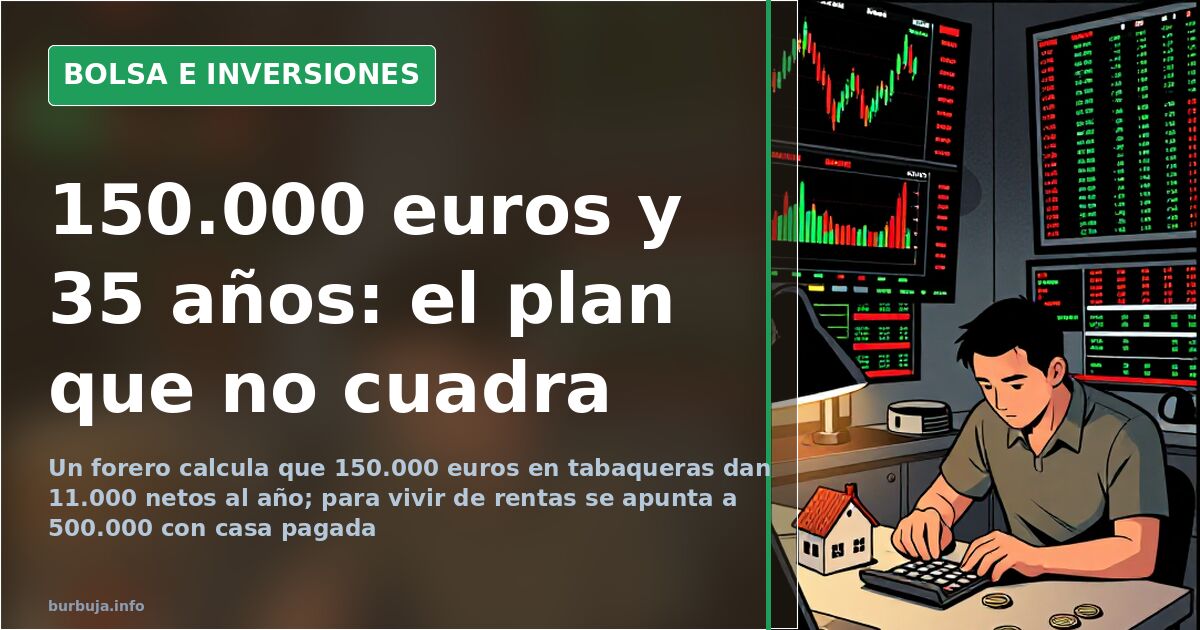
Retiring at 35 with €150,000: A plan that falls apart on its own
A ticket to the Philippines and a dividend-paying stock portfolio would theoretically suffice to stop working at 35. The starting capital is €150,000; the safety net is a job at a Spanish-language call center earning about €1,500 a month in a country where average wages hover around €200. Throughout the thread, objections have piled up against this thesis, none of them minor.
How much money do you need to live off passive income?
The short answer is significantly more than the headline suggests. €150,000 invested in tobacco companies would generate roughly €11,000 net per year, according to calculations circulating in the thread—just over €900 a month—and only if dividends hold steady. This flow covers neither inflation nor principal replacement.
Some set the bar at €500,000 with the home already paid off, considering it barely sufficient for someone aged 35. The logic is simple: a portfolio that merely matches the cost of living erodes in real terms. Those who withdraw returns unknowingly eat into their capital.
The inverse calculation, the most uncomfortable one, deducts expenses from any income. According to one estimate, rental income of €2,400 drops to about €1,400 after taxes, community fees, insurance, special assessments, and vacant months. With these deductions, the assets needed to avoid working skyrocket beyond any round number. An unsettling memory looms: it is claimed that around 80% of lottery winners end up ruined shortly after winning.
The Philippines: How much can you really earn speaking Spanish?
The migration plan has its own accounting, which differs from the brochure version. In Cebu, entry-level offers for Spanish speakers range between 40,000 and 50,000 pesos a month, and some months see only five or six postings, some inaccessible without permanent residency.
Manila concentrates most of the employment: according to participants claiming to live there, those using Spanish as a tool report earnings between 70,000 and 83,000 pesos, equivalent to €1,100–€1,200 after taxes. Life in the capital costs more, but the difference with Cebu is around 30%, partially offsetting the higher salary.
The most debated point is the native speaker status. Contrary to the idea that being Spanish boosts pay, arguments suggest compensation depends on the role and bilingual Filipinos are paid less initially; hiring them also avoids visa paperwork. One detail nobody disputes: many of these jobs are night shifts.
The subsidy for over-52s: The rival that doesn't contribute
Beyond investments, the administrative route appears. The subsidy for people over 52 pays €480 a month, has a cap of €812, and contributes toward retirement based on over €1,400 monthly, funded by SEPE (Spain's public employment service).
This leads to the sharpest comparison: someone who has spent decades "rowing" may end up earning little more than someone who contributed nothing to the system. Two people in this situation, combining aid and non-countable income, could approach €2,000 a month.
Bonds at 5.9% and 10.5% as alternatives to dividends
Amidst the discussion, a participant lists fixed-income issues with coupons dwarfing average dividends: a AAA-rated bond at 6.25%, a Generalitat de Catalunya issue at 5.90%, and another from Renfe at 10.5%. This is public information available on broker platforms like Exante or Interactive Brokers.
The trap is classic: high coupons often coexist with credit risk, long maturities, or low liquidity. They help build income but shouldn't be forgotten.
The case that fits: A 51-year-old gardener
Against theoretical plans, here’s a real itinerary: a gardener, 51 years old, childless, with 26–28 years of contributions. He bought an apartment in Madrid for €150,000, renting it out for €700 (about €600 net), and in another region purchased three hectares of rustic land where he built a 70-square-meter house for €100,000. His pistachio plantation yields €4,000–€5,000 net annually.
When unemployment benefits end, the over-52 subsidy will provide €480 a month. Combining rent, harvest, and subsidy results in a modest but sustainable life. None of this peine in five years or with €150,000: it took three decades of work, two periods of unemployment, and a second residence built by hand.
Disagreement isn’t about whether it’s possible, but how much is needed. Some cite €500,000 plus a paid-off home; others recount reaching a small rural cottage with slightly over €200,000 before age 32 and a rented apartment, noting that managing everything consumed their savings. The figure closing the equation remains elusive. Until it appears, retiring at 35 remains just that: a plan.
A ticket to the Philippines and a dividend-paying stock portfolio would theoretically suffice to stop working at 35. The starting capital is €150,000; the safety net is a job at a Spanish-language call center earning about €1,500 a month in a country where average wages hover around €200. Throughout the thread, objections have piled up against this thesis, none of them minor.
How much money do you need to live off passive income?
The short answer is significantly more than the headline suggests. €150,000 invested in tobacco companies would generate roughly €11,000 net per year, according to calculations circulating in the thread—just over €900 a month—and only if dividends hold steady. This flow covers neither inflation nor principal replacement.
Some set the bar at €500,000 with the home already paid off, considering it barely sufficient for someone aged 35. The logic is simple: a portfolio that merely matches the cost of living erodes in real terms. Those who withdraw returns unknowingly eat into their capital.
The inverse calculation, the most uncomfortable one, deducts expenses from any income. According to one estimate, rental income of €2,400 drops to about €1,400 after taxes, community fees, insurance, special assessments, and vacant months. With these deductions, the assets needed to avoid working skyrocket beyond any round number. An unsettling memory looms: it is claimed that around 80% of lottery winners end up ruined shortly after winning.
The Philippines: How much can you really earn speaking Spanish?
The migration plan has its own accounting, which differs from the brochure version. In Cebu, entry-level offers for Spanish speakers range between 40,000 and 50,000 pesos a month, and some months see only five or six postings, some inaccessible without permanent residency.
Manila concentrates most of the employment: according to participants claiming to live there, those using Spanish as a tool report earnings between 70,000 and 83,000 pesos, equivalent to €1,100–€1,200 after taxes. Life in the capital costs more, but the difference with Cebu is around 30%, partially offsetting the higher salary.
The most debated point is the native speaker status. Contrary to the idea that being Spanish boosts pay, arguments suggest compensation depends on the role and bilingual Filipinos are paid less initially; hiring them also avoids visa paperwork. One detail nobody disputes: many of these jobs are night shifts.
The subsidy for over-52s: The rival that doesn't contribute
Beyond investments, the administrative route appears. The subsidy for people over 52 pays €480 a month, has a cap of €812, and contributes toward retirement based on over €1,400 monthly, funded by SEPE (Spain's public employment service).
This leads to the sharpest comparison: someone who has spent decades "rowing" may end up earning little more than someone who contributed nothing to the system. Two people in this situation, combining aid and non-countable income, could approach €2,000 a month.
Bonds at 5.9% and 10.5% as alternatives to dividends
Amidst the discussion, a participant lists fixed-income issues with coupons dwarfing average dividends: a AAA-rated bond at 6.25%, a Generalitat de Catalunya issue at 5.90%, and another from Renfe at 10.5%. This is public information available on broker platforms like Exante or Interactive Brokers.
The trap is classic: high coupons often coexist with credit risk, long maturities, or low liquidity. They help build income but shouldn't be forgotten.
The case that fits: A 51-year-old gardener
Against theoretical plans, here’s a real itinerary: a gardener, 51 years old, childless, with 26–28 years of contributions. He bought an apartment in Madrid for €150,000, renting it out for €700 (about €600 net), and in another region purchased three hectares of rustic land where he built a 70-square-meter house for €100,000. His pistachio plantation yields €4,000–€5,000 net annually.
When unemployment benefits end, the over-52 subsidy will provide €480 a month. Combining rent, harvest, and subsidy results in a modest but sustainable life. None of this peine in five years or with €150,000: it took three decades of work, two periods of unemployment, and a second residence built by hand.
Disagreement isn’t about whether it’s possible, but how much is needed. Some cite €500,000 plus a paid-off home; others recount reaching a small rural cottage with slightly over €200,000 before age 32 and a rented apartment, noting that managing everything consumed their savings. The figure closing the equation remains elusive. Until it appears, retiring at 35 remains just that: a plan.
Also available in: Deutsch
Summary of a discussion on Burbuja.info - Foro de economía, actualidad y política., translated from Spanish and reviewed before publication. Read the full discussion (117 replies).
More summaries
-
European Savings Account: 150,000€ Tax-Free Until Withdrawal
Debate on the European savings account: 150,000€ in EU assets tax-free until withdrawal, with doubts about commissions, dividends, and losses.
-
Invertir desde Cero course reviews: useful but basic
Students call the stock market course introductory, not advanced: one month of classes and a year of monthly sessions.
-
Spanish Investor Fears Stock Gains as Market Hits Records
Only 3% of Spaniards invest in stocks, yet those seeing weekly gains fear a sudden market crash.
-
Lottery winners: Homes, cars, and financial ruin
Stories range from rented flats to Mercedes and family collapse. Many claim most winners go bankrupt within ten years.
-
Spanish bank forces app over SMS, trapping customers
A Spanish bank replaces SMS codes with push notifications, treating silence as consent and excluding users without smartphones.
-
Microsoft Stock Jumps to $284 as Game Pass Gains Momentum
Microsoft shares rose from $212 to $284, driven by Azure's cloud growth and 18 million Game Pass subscribers.