
Pro-Russian Smer Wins Slovak Election Amid Anti-Immigration Push
Smer, led by Robert Fico, wins in Slovakia with ~23% votes. The pro-Russian, anti-immigration party's victory raises concerns in Brussels.
English · Original discussion in Spanish · Published
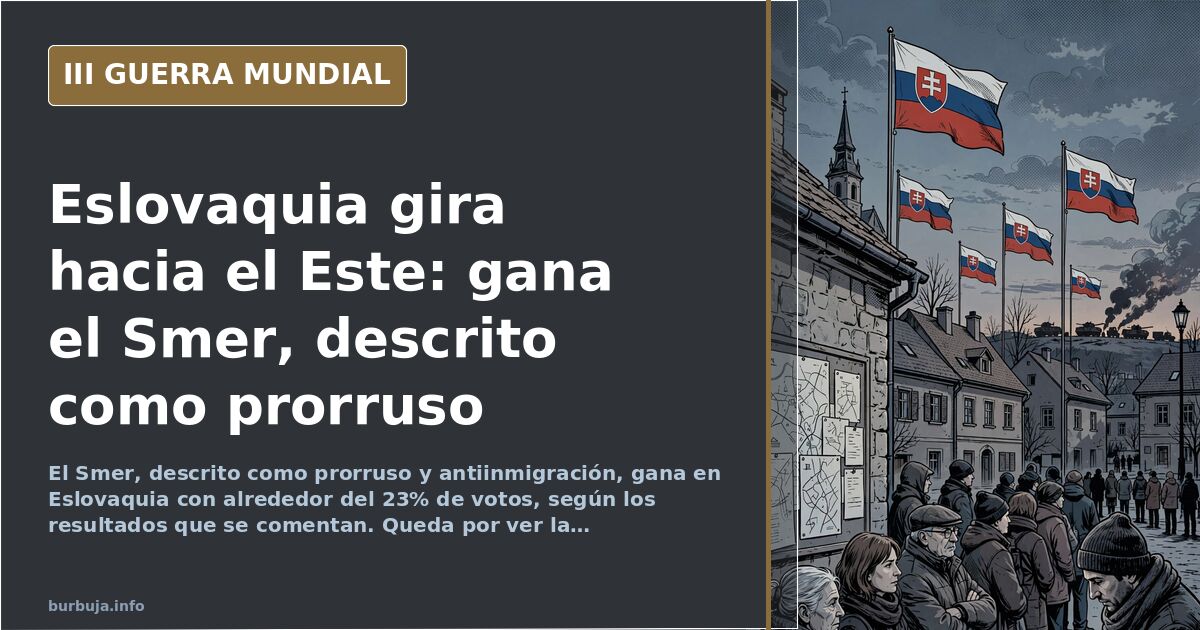
Slovakia Turns East: Pro-Russian Smer Wins, EU Faces New Front
The Smer party, led by Robert Fico, has won the elections in Slovakia with a discourse described as pro-Russian and anti-immigration. The news has come as a shock to Brussels, which sees a new front opening on the European Union's eastern flank. However, the result is not a landslide: Smer obtained around 23% of the vote, a figure that necessitates coalition-building to govern. The lingering question is whether this shift is an isolated case or a symptom of deeper trends across Europe.
A 23% Share That Is No Cause for Celebration
The most cited data point in analyses is the 23% vote share. It is not an overwhelming majority, but it is sufficient to lead the government if the right alliances are formed. Smer's potential partners include HLAS, a socialist split from Smer itself, and SNS, a nationalist formation. Parliamentary arithmetic also allows for an alternative coalition of liberal and Christian-democratic parties, leaving the scenario open. The game is not over.
What seems clear is that the Slovak electorate rewarded a discourse combining a pro-Russian narrative with rejection of immigration. Here arises the paradox highlighted by several analyses: Slovakia is a country with very low immigration, and Slovaks themselves emigrate to other European countries seeking better wages. An anti-immigration party triumphs in a nation that barely receives immigrants.
The EU Ghost: Can One Govern Against Brussels?
The rise of formations critical of Brussels is not new. The Slovak case joins those of Hungary and Poland, and some analyses compare it to Meloni's victory in Italy. The difference is that Meloni, once in office, moderated her rhetoric and kept Italy within EU frameworks. Will Fico do the same? Italian experience suggests electoral promises and governing reality rarely align.
The EU has tools to pressure a defiant government: European funds are the primary instrument. The threat of cutting financing has worked in other cases, and several analyses anticipate a repeat of this script. The underlying problem is that such pressures fuel the sovereigntist discourse they aim to combat. It is a vicious circle.
Immigration: The Issue Explaining Almost Everything
If one issue underpins the rise of these parties, it is immigration. The most repeated thesis is that the EU failed to manage migration flows, creating fertile ground for anti-immigration formations. The Slovak case is read as a warning: if the phenomenon is not controlled, discontent will continue feeding parties promising tough measures.
Some argue the problem is not immigration per se, but the perception that European elites impose policies unresponsive to citizens' interests. The disconnect between Brussels and national capitals would be the true driver of change. Other analyses focus on the economy: stagnant wages and loss of purchasing power better explain protest votes than any other factor.
The Russian Factor and the Shadow of War
Smer's pro-Russian character adds complexity. Amid the conflict in Ukraine, a Slovak government sympathetic to Moscow could alter the balance of support for Kyiv within the EU. Slovakia has been a reliable partner in aid to Ukraine so far, and a course change would have consequences. The question is how far Fico will translate his pro-Russian rhetoric into practice or limit himself to symbolic gestures.
Comparison with Hungary is inevitable. Viktor Orbán has turned his country into Brussels' main headache, blocking decisions and maintaining fluid relations with Moscow. If Slovakia trinc this path, the EU would have two uncomfortable partners in the East. Contagion effect is the major concern.
What Happens Now?
The immediate scenario is government formation. Smer needs to negotiate, and talks will determine the real scope of its program. A coalition with SNS would harden anti-immigration and pro-Russian discourse; an agreement with HLAS would moderate the tone. Uncertainty is maximal.
Meanwhile, Brussels prepares for what comes next. Experience with other defiant governments has left a manual: financial pressure, political isolation, and support for internal counterweights. The tug-of-war between national sovereignty and European discipline has a new chapter. And Slovakia, a country of just over five million inhabitants, has become the epicenter of that tension.
The Smer party, led by Robert Fico, has won the elections in Slovakia with a discourse described as pro-Russian and anti-immigration. The news has come as a shock to Brussels, which sees a new front opening on the European Union's eastern flank. However, the result is not a landslide: Smer obtained around 23% of the vote, a figure that necessitates coalition-building to govern. The lingering question is whether this shift is an isolated case or a symptom of deeper trends across Europe.
A 23% Share That Is No Cause for Celebration
The most cited data point in analyses is the 23% vote share. It is not an overwhelming majority, but it is sufficient to lead the government if the right alliances are formed. Smer's potential partners include HLAS, a socialist split from Smer itself, and SNS, a nationalist formation. Parliamentary arithmetic also allows for an alternative coalition of liberal and Christian-democratic parties, leaving the scenario open. The game is not over.
What seems clear is that the Slovak electorate rewarded a discourse combining a pro-Russian narrative with rejection of immigration. Here arises the paradox highlighted by several analyses: Slovakia is a country with very low immigration, and Slovaks themselves emigrate to other European countries seeking better wages. An anti-immigration party triumphs in a nation that barely receives immigrants.
The EU Ghost: Can One Govern Against Brussels?
The rise of formations critical of Brussels is not new. The Slovak case joins those of Hungary and Poland, and some analyses compare it to Meloni's victory in Italy. The difference is that Meloni, once in office, moderated her rhetoric and kept Italy within EU frameworks. Will Fico do the same? Italian experience suggests electoral promises and governing reality rarely align.
The EU has tools to pressure a defiant government: European funds are the primary instrument. The threat of cutting financing has worked in other cases, and several analyses anticipate a repeat of this script. The underlying problem is that such pressures fuel the sovereigntist discourse they aim to combat. It is a vicious circle.
Immigration: The Issue Explaining Almost Everything
If one issue underpins the rise of these parties, it is immigration. The most repeated thesis is that the EU failed to manage migration flows, creating fertile ground for anti-immigration formations. The Slovak case is read as a warning: if the phenomenon is not controlled, discontent will continue feeding parties promising tough measures.
Some argue the problem is not immigration per se, but the perception that European elites impose policies unresponsive to citizens' interests. The disconnect between Brussels and national capitals would be the true driver of change. Other analyses focus on the economy: stagnant wages and loss of purchasing power better explain protest votes than any other factor.
The Russian Factor and the Shadow of War
Smer's pro-Russian character adds complexity. Amid the conflict in Ukraine, a Slovak government sympathetic to Moscow could alter the balance of support for Kyiv within the EU. Slovakia has been a reliable partner in aid to Ukraine so far, and a course change would have consequences. The question is how far Fico will translate his pro-Russian rhetoric into practice or limit himself to symbolic gestures.
Comparison with Hungary is inevitable. Viktor Orbán has turned his country into Brussels' main headache, blocking decisions and maintaining fluid relations with Moscow. If Slovakia trinc this path, the EU would have two uncomfortable partners in the East. Contagion effect is the major concern.
What Happens Now?
The immediate scenario is government formation. Smer needs to negotiate, and talks will determine the real scope of its program. A coalition with SNS would harden anti-immigration and pro-Russian discourse; an agreement with HLAS would moderate the tone. Uncertainty is maximal.
Meanwhile, Brussels prepares for what comes next. Experience with other defiant governments has left a manual: financial pressure, political isolation, and support for internal counterweights. The tug-of-war between national sovereignty and European discipline has a new chapter. And Slovakia, a country of just over five million inhabitants, has become the epicenter of that tension.
Also available in: Deutsch
Summary of a discussion on Burbuja.info - Foro de economía, actualidad y política., translated from Spanish and reviewed before publication. Read the full discussion (113 replies).
More summaries
-
Ukraine's EU Entry Would Cost Spain €4 Billion Annually
Spain would pay €4 billion a year for Ukraine to join the EU, matching its entire annual infrastructure budget.
-
Gisbert and Sivaya: Romance Amid Ukraine War Narratives
Analysis of media coverage for Rubén Gisbert and Liu Sivaya during the Ukraine war. Is this digital propaganda or reality?
-
Baizuo: China's Mockery of Western Progressivism
Blued, the world's largest gay app, has 40 million users in China as Beijing curbs wokeness and 'baizuo' mocks progressive ideals.
-
Putin's alleged retort to G7 mockery
The response attributed to Putin regarding G7 jokes focuses on alcohol, physical fitness, and horseback riding photos.
-
Macron Plan: French Troops in Ukraine via Bilateral Pact
French Parliament backs bilateral deal with Ukraine, enabling French and Polish troops to free up Ukrainian forces for the front.
-
US Response to Russian Nuclear Attack: Conventional Retaliation
Debate suggests US would respond to a Russian nuclear strike with conventional attacks on Ukraine and Crimea.