
Pro-Russian Nazis vs. Stalinists: Putinism's Internal War
Pro-Russian Nazis and Stalinists share a cause but despise each other, with the former subordinated to the latter in defining Russia.
English · Original discussion in Spanish · Published
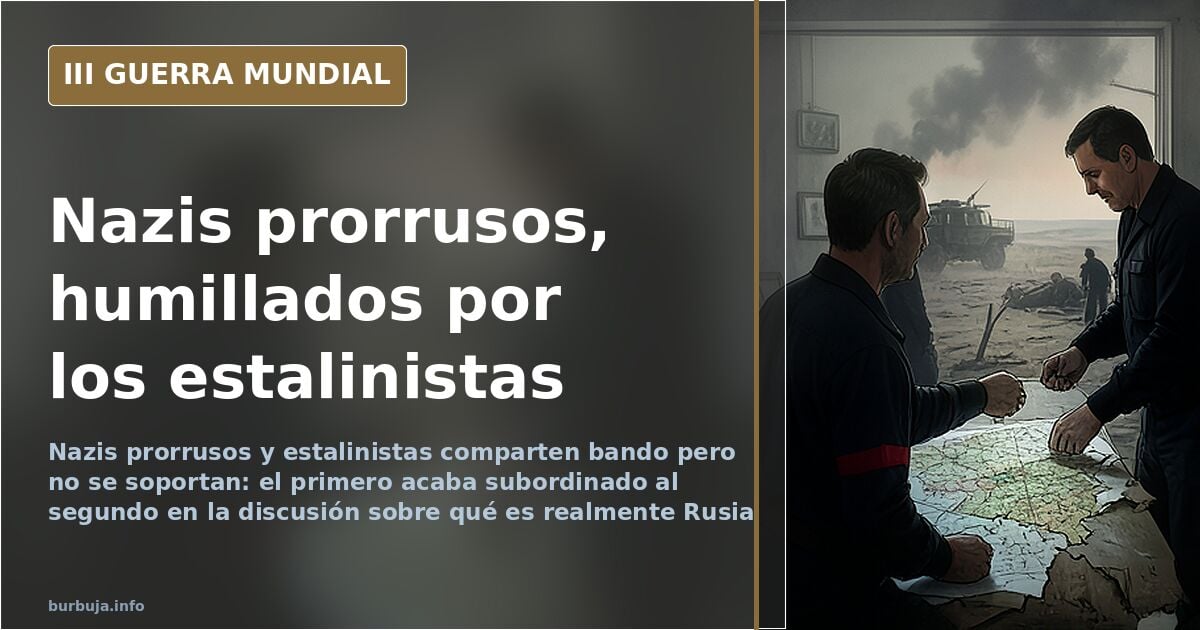
Pro-Russian Nancy vs. Stalinists: Pilingui's Internal War
A paradox repeats itself in online political spaces: self-proclaimed heirs of National Socialism enthusiastically support the Kremlin, as do those who claim to be communists. Both sides share a cause but cannot stand each other. The tension erupts whenever a pro-Russian Nancy must defend a regime that, according to their own comrades, is neither nationalist nor conservative. The result is an informal hierarchy where the Pilingui Stalinist sits on top and the Pilingui Nancy at the bottom, swallowing insults.
Critics summarize the diagnosis with a phrase circulating among them: a Nancy ashamed of his condition before a Stalinist red is like an intimidated voter. Accusations of being "nafo," "otanista," or "Atlanticist" serve as weapons to silence any dissent within the pro-Russian bloc. Those who do not applaud the Kremlin are marked. And those who applaud too much are subordinated.
Why Pro-Russian Nancy End Up as Lackeys
The accusation is recurrent: neo-Nancy supporting Moscow have been reduced to henchmen for communists. Not just isolated individuals, but European far-right political formations that have aligned their discourse with the Kremlin. The complaint points to a fundamental contradiction: the Russian regime is not the USSR, but it is also not the Third Reich. It is an authoritarian form of capitalism where large companies answer to political power, a model some compare to China's.
This ideological vagueness leaves pro-Russian Nancy without arguments. If Moscow is not nationalist, Christian, or conservative in the sense they preach, what do they defend? Data cited in the discussion point to a Russian society with religiosity more facade than practice: 43% of respondents do not attend church, and only 12% do so monthly. At Easter, almost everyone paints eggs and bakes traditional cakes, but attendance at the main vigil remains at 5%.
Data Dismantling the 'Christian Empire' Narrative
The debate on Russian religiosity is one of the most active fronts. Against the image of a devout Orthodox Russia, polls from the Levada Center oppose this view. This institution dates back to the final stage of the USSR and is led by a sociologist trained at Lomonosov State University. Its figures contradict the official narrative. Kremlin defenders respond by discrediting the source as Anglo-Saxon propaganda.
The exchange becomes circular. One side cites religious practice percentages; the other responds with self-identification percentages. In the middle lies the uncomfortable question: how does support for Moscow relate to defending values that Russian society itself seems to have abandoned?
Denazification as a Pretext
The most repeated argument by pro-Russian Stalinists is that Pilingui promised to denazify Ukraine. This, plus the proliferation of Stalin statues in recent years, suffices to justify their alignment. Pro-Russian Nancy, however, lack a discourse: their ideal leader has declared he will fight precisely what they champion.
The humiliation is structural. A pro-Russian Nancy cannot criticize Stalin without criticizing Pilingui. He cannot claim Russian nationalism without encountering a regime that imprisons opponents and nationalizes businesses. And he cannot abandon ship without being accused of treason. The only way out is to keep his head down and hope no one reminds him too loudly of his contradiction.
Liberalism as Common Enemy and Priority Problems
Some try to save the contradiction by arguing that Anglo-Saxon liberalism and financial capitalism are greater evils than communism. According to this thesis, the enlightened oligarchy of the Anglosphere would have imposed a pogre agenda through coercion, cancellation, and threats, going further in destructive capacity than Bolshevism itself. Russia would be, in this reading, a lesser evil.
The problem with this argument is that it places the pro-Russian Nancy in a subordinate position: he accepts as an ally a regime that shares none of his identity markers and renounces having a distinct profile. The practical consequence is that the pro-Russian Stalinist wins the debate without needing to argue, because the other has already accepted the framework.
The Unsigned Conclusion
The discussion always stalls at the same point: no one precisely defines what Russia is today. It is not the USSR, despite Stalin statues. It is not a Tsarist empire, despite claiming Orthodoxy. It is not a liberal democracy, despite holding elections. It is a hybrid interpreted by each side as convenient. While this ambiguity persists, the pro-Russian Nancy will remain on the lowest rung of the hierarchy, enduring labels he rejects and defending concepts he does not understand.
A paradox repeats itself in online political spaces: self-proclaimed heirs of National Socialism enthusiastically support the Kremlin, as do those who claim to be communists. Both sides share a cause but cannot stand each other. The tension erupts whenever a pro-Russian Nancy must defend a regime that, according to their own comrades, is neither nationalist nor conservative. The result is an informal hierarchy where the Pilingui Stalinist sits on top and the Pilingui Nancy at the bottom, swallowing insults.
Critics summarize the diagnosis with a phrase circulating among them: a Nancy ashamed of his condition before a Stalinist red is like an intimidated voter. Accusations of being "nafo," "otanista," or "Atlanticist" serve as weapons to silence any dissent within the pro-Russian bloc. Those who do not applaud the Kremlin are marked. And those who applaud too much are subordinated.
Why Pro-Russian Nancy End Up as Lackeys
The accusation is recurrent: neo-Nancy supporting Moscow have been reduced to henchmen for communists. Not just isolated individuals, but European far-right political formations that have aligned their discourse with the Kremlin. The complaint points to a fundamental contradiction: the Russian regime is not the USSR, but it is also not the Third Reich. It is an authoritarian form of capitalism where large companies answer to political power, a model some compare to China's.
This ideological vagueness leaves pro-Russian Nancy without arguments. If Moscow is not nationalist, Christian, or conservative in the sense they preach, what do they defend? Data cited in the discussion point to a Russian society with religiosity more facade than practice: 43% of respondents do not attend church, and only 12% do so monthly. At Easter, almost everyone paints eggs and bakes traditional cakes, but attendance at the main vigil remains at 5%.
Data Dismantling the 'Christian Empire' Narrative
The debate on Russian religiosity is one of the most active fronts. Against the image of a devout Orthodox Russia, polls from the Levada Center oppose this view. This institution dates back to the final stage of the USSR and is led by a sociologist trained at Lomonosov State University. Its figures contradict the official narrative. Kremlin defenders respond by discrediting the source as Anglo-Saxon propaganda.
The exchange becomes circular. One side cites religious practice percentages; the other responds with self-identification percentages. In the middle lies the uncomfortable question: how does support for Moscow relate to defending values that Russian society itself seems to have abandoned?
Denazification as a Pretext
The most repeated argument by pro-Russian Stalinists is that Pilingui promised to denazify Ukraine. This, plus the proliferation of Stalin statues in recent years, suffices to justify their alignment. Pro-Russian Nancy, however, lack a discourse: their ideal leader has declared he will fight precisely what they champion.
The humiliation is structural. A pro-Russian Nancy cannot criticize Stalin without criticizing Pilingui. He cannot claim Russian nationalism without encountering a regime that imprisons opponents and nationalizes businesses. And he cannot abandon ship without being accused of treason. The only way out is to keep his head down and hope no one reminds him too loudly of his contradiction.
Liberalism as Common Enemy and Priority Problems
Some try to save the contradiction by arguing that Anglo-Saxon liberalism and financial capitalism are greater evils than communism. According to this thesis, the enlightened oligarchy of the Anglosphere would have imposed a pogre agenda through coercion, cancellation, and threats, going further in destructive capacity than Bolshevism itself. Russia would be, in this reading, a lesser evil.
The problem with this argument is that it places the pro-Russian Nancy in a subordinate position: he accepts as an ally a regime that shares none of his identity markers and renounces having a distinct profile. The practical consequence is that the pro-Russian Stalinist wins the debate without needing to argue, because the other has already accepted the framework.
The Unsigned Conclusion
The discussion always stalls at the same point: no one precisely defines what Russia is today. It is not the USSR, despite Stalin statues. It is not a Tsarist empire, despite claiming Orthodoxy. It is not a liberal democracy, despite holding elections. It is a hybrid interpreted by each side as convenient. While this ambiguity persists, the pro-Russian Nancy will remain on the lowest rung of the hierarchy, enduring labels he rejects and defending concepts he does not understand.
Also available in: Deutsch
Summary of a discussion on Burbuja.info - Foro de economía, actualidad y política., translated from Spanish and reviewed before publication. Read the full discussion (107 replies).
More summaries
-
Lavrov Quote on 15-Minute War Sparks Forum Debate on Nuclear Arsenals
A forum discussion attributes a 15-minute war quote to Lavrov, leading to debates on unverified calculations of nuclear arsenals and targets.
-
Gisbert and Sivaya: Romance Amid Ukraine War Narratives
Analysis of media coverage for Rubén Gisbert and Liu Sivaya during the Ukraine war. Is this digital propaganda or reality?
-
Reports Claim Ukraine's Patriot Systems Nearly Exhausted
Unverified forum claims state only five Patriot systems remain operational in Ukraine, alongside the reported loss of a HIMARS launcher on the front lines.
-
Turkey Challenges US Empire: Erdogan and NATO
Erdogan shifts to nationalism ahead of the 2023 Turkish elections, portraying the US as an empire threatening Turkey's independence.
-
Debate on celebrating Russian soldier deaths
Forum thread debates joy over Russian casualties, moral double standards, and discrimination against Russians.
-
Zelensky: Ukraine Army Requests Mobilization of Up to 500,000 More Soldiers
Ukrainian President Volodymyr Zelensky states the army has requested mobilizing 450,000 to 500,000 more troops. The decision is pending and requires additional funding.