
Pro-Russian Map Depicting Independent Catalonia and Basque Country Sparks Debate
A map showing independent Catalonia and the Basque Country reignites debate: is being pro-Russian the same as anti-Spanish? Military spending and NATO are central.
English · Original discussion in Spanish · Published
The Map Showing an Independent Catalonia and Basque Country
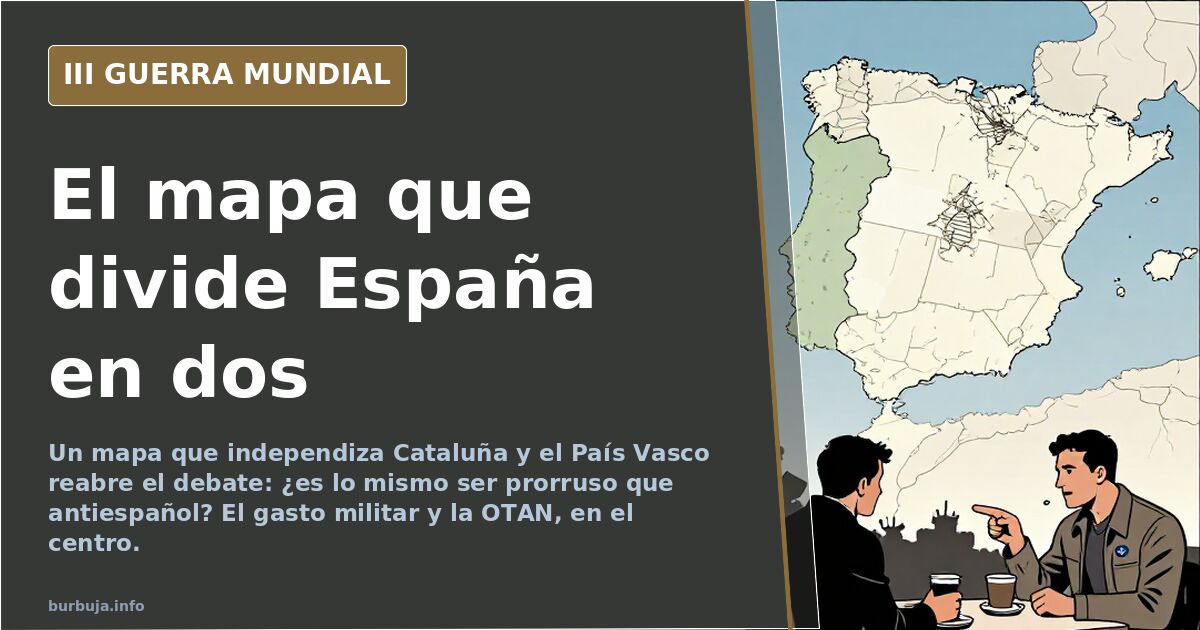
Is being pro-Russian the same as being anti-Spanish? The discussion starts with a map where Catalonia and the Basque Country appear as independent entities within the Iberian Peninsula. For some participants, this graphic —attributed to Russian media— proves that support for the Kremlin goes hand in hand with Spain's territorial fragmentation. For others, it is a mere coincidence that demonstrates nothing: one can criticize military spending on Ukraine without wishing for Spain to disappear.
What the Map Shows and Why It Went Viral
The graphic marks Catalonia and the Basque Country as separate entities. Those defending the initial thesis argue that this map aligns with what Basque separatists demand and that its dissemination aims to destabilize Spain and France, both NATO members. The most repeated response: the map is nothing more than a blunder by a Russian TV channel, and most Russians wouldn't even know how to locate Catalonia on a map. Visual acuity, they joke.
One piece of data repeats across messages: Catalan separatism has been part of public discourse for years, and its leaders have sought international support. That a foreign outlet draws imaginary borders doesn't turn someone who criticizes arms shipments into a separatist. The confusion between pro-Russian and anti-Spanish is, for many, a crude oversimplification.
Military Spending as the Core of Criticism
One of the most repeated currents in the exchange argues that not wanting to allocate Spanish resources —money from taxes—to a war that doesn't directly affect us isn't being pro-Russian. The argument rests on a simple idea: Spain has its own problems, and sending material or money to Ukraine diverts resources from internal needs.
In contrast, the rebuttal is forceful: Russia tries to destabilize Europe and Spain, and failing to spend on defending against those who want to destroy you is treason. The criticism extends to those who, from within, question NATO or ask for reduced support for Ukraine. The discussion shifts to whether the enemy lies to the east or south, and if looking only south is a form of selective blindness.
The Ghost of Territorial Destabilization
The link between separatism and Russia isn't new in the collective imagination. The exchange mentions Russian state support for Catalan independence, though another participant immediately denies it, attributing such maneuvers to Anglo-Saxon interests. The discussion gets tangled: some accuse Russia of financing separatism, while others point to the United States and NATO as the true instigators.
What remains clear is that the map acts as a trigger. For some, it proves that the textbook pro-Russian supports any fragmentation weakening the West. For others, it's a smokescreen to avoid discussing what truly matters: the cost of war, inflation, and deteriorating living standards.
The Background: A War Dividing Public Opinion
Beyond the map, the exchange reflects a real fracture. Some defend that Europe plays its very existence in Ukraine, while others respond that this is an empty cliché. Eastern countries, shared culture with Russia, and the feeling that Spain is irrelevant to its partners are mentioned. The debate over Catalan and Basque separatism ends up being an epiphenomenon of a larger discussion: To whom does Spain owe loyalty?
The final irony comes from someone reminding us that separatist leaders remain settled in Waterloo, not St. Petersburg. If the Kremlin funded them, it's unclear why they've received nothing but pats on the back. Meanwhile, the map continues circulating. And every time someone shares it, the debate restarts.
Is being pro-Russian the same as being anti-Spanish? The discussion starts with a map where Catalonia and the Basque Country appear as independent entities within the Iberian Peninsula. For some participants, this graphic —attributed to Russian media— proves that support for the Kremlin goes hand in hand with Spain's territorial fragmentation. For others, it is a mere coincidence that demonstrates nothing: one can criticize military spending on Ukraine without wishing for Spain to disappear.
What the Map Shows and Why It Went Viral
The graphic marks Catalonia and the Basque Country as separate entities. Those defending the initial thesis argue that this map aligns with what Basque separatists demand and that its dissemination aims to destabilize Spain and France, both NATO members. The most repeated response: the map is nothing more than a blunder by a Russian TV channel, and most Russians wouldn't even know how to locate Catalonia on a map. Visual acuity, they joke.
One piece of data repeats across messages: Catalan separatism has been part of public discourse for years, and its leaders have sought international support. That a foreign outlet draws imaginary borders doesn't turn someone who criticizes arms shipments into a separatist. The confusion between pro-Russian and anti-Spanish is, for many, a crude oversimplification.
Military Spending as the Core of Criticism
One of the most repeated currents in the exchange argues that not wanting to allocate Spanish resources —money from taxes—to a war that doesn't directly affect us isn't being pro-Russian. The argument rests on a simple idea: Spain has its own problems, and sending material or money to Ukraine diverts resources from internal needs.
In contrast, the rebuttal is forceful: Russia tries to destabilize Europe and Spain, and failing to spend on defending against those who want to destroy you is treason. The criticism extends to those who, from within, question NATO or ask for reduced support for Ukraine. The discussion shifts to whether the enemy lies to the east or south, and if looking only south is a form of selective blindness.
The Ghost of Territorial Destabilization
The link between separatism and Russia isn't new in the collective imagination. The exchange mentions Russian state support for Catalan independence, though another participant immediately denies it, attributing such maneuvers to Anglo-Saxon interests. The discussion gets tangled: some accuse Russia of financing separatism, while others point to the United States and NATO as the true instigators.
What remains clear is that the map acts as a trigger. For some, it proves that the textbook pro-Russian supports any fragmentation weakening the West. For others, it's a smokescreen to avoid discussing what truly matters: the cost of war, inflation, and deteriorating living standards.
The Background: A War Dividing Public Opinion
Beyond the map, the exchange reflects a real fracture. Some defend that Europe plays its very existence in Ukraine, while others respond that this is an empty cliché. Eastern countries, shared culture with Russia, and the feeling that Spain is irrelevant to its partners are mentioned. The debate over Catalan and Basque separatism ends up being an epiphenomenon of a larger discussion: To whom does Spain owe loyalty?
The final irony comes from someone reminding us that separatist leaders remain settled in Waterloo, not St. Petersburg. If the Kremlin funded them, it's unclear why they've received nothing but pats on the back. Meanwhile, the map continues circulating. And every time someone shares it, the debate restarts.
Summary of a discussion on Burbuja.info - Foro de economía, actualidad y política., translated from Spanish and reviewed before publication. Read the full discussion (164 replies).
More summaries
-
Spain’s Catalonia Debate: The Controversial 'Denazification' Parallel
A debate in Spain compares Catalonia and the Basque Country to Ukraine, sparking discussion on language rights, independence referendums, and political legality.
-
Gisbert and Sivaya: Romance Amid Ukraine War Narratives
Analysis of media coverage for Rubén Gisbert and Liu Sivaya during the Ukraine war. Is this digital propaganda or reality?
-
Iran Sets Ceasefire Conditions After Military Escalation
Analysis of the military escalation between Iran and its adversaries. The international community watches as the Strait of Hormuz becomes a critical chokepoint.
-
Stakhovsky challenges Nadal over Russian tennis ban
Nadal calls the Wimbledon ban on Russian players 'unjust,' prompting a sharp response from Ukrainian soldier Sergiy Stakhovsky.
-
Why Antisemitism Recycles the Same Arguments
The claim of a shared genetic enemy lacks scientific basis: antisemitism recycles the same arguments century after century.
-
Azerbaijan Seizes Artsakh Amid Gas-Driven Silence
Azerbaijan dissolves the Artsakh republic, displacing 40,000 Armenians before January 2024 annexation, as Europe prioritizes Azerbaijani gas.