
Spain’s Catalonia Debate: The Controversial 'Denazification' Parallel
A debate in Spain compares Catalonia and the Basque Country to Ukraine, sparking discussion on language rights, independence referendums, and political legality.
English · Original discussion in Spanish · Published
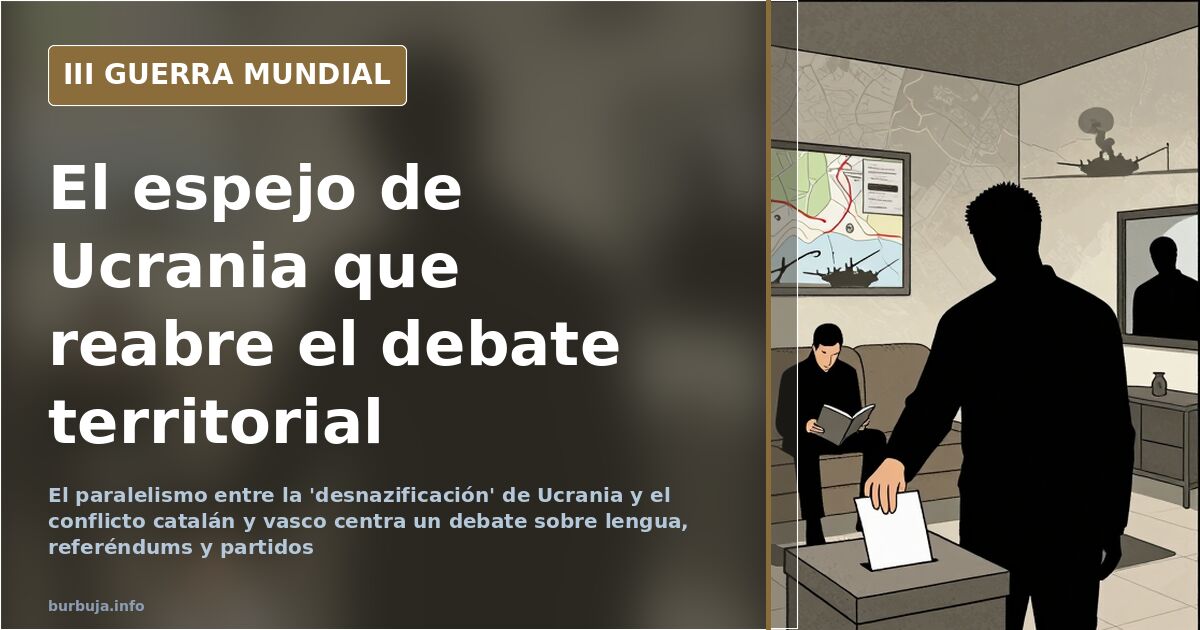
From the Donbass to Catalonia: The 'denazification' debate in Spain
Denazifying Catalonia and the Basque Country. This formula, borrowed from the vocabulary Moscow used to justify its invasion of Ukraine, has taken hold in Spanish public discourse, becoming the center of a complex debate. The premise is explicit: applying to Catalonia and Euskadi the same framework Russia uses for its offensive in the Donbass. Behind this provocative slogan lie three substantive issues discussed with data: the presence of Spanish in Catalan schools, the vote threshold required to accept independence, and the legality of separatist parties.
The framing may be a gaffe, but the substance touches the core of the State. What can be banned, what can be voted on, and in which language education takes place are the real questions. No slogan changes these realities.
The parallel between Ukraine and the Catalan conflict
The recurring argument equates the imposition of Catalan in Catalonia and Basque in Euskadi with the restriction of Russian in Ukraine. Some go further, tracing the principle of self-determination to US President Woodrow Wilson’s administration during World War I, allegedly as a tool to destabilize Europe. This thesis circulates without evidence. Similar suspicions surround alleged coordinated plans from Washington, Tel Aviv, and Rabat, equally unproven.
On the other side, it is recalled that southern US states attempted to secede and were not allowed. This example highlights that self-determination is applied differently depending on who requests it. A third, more ambitious argument suggests Catalonia serves "a larger purpose" within a global restructuring of the international order, potentially including cryptocurrency volatility. Proponents offer no names or proof.
How many votes are needed for independence?
At least two-thirds. This figure is cited as the requirement to accept a pro-independence result, contrasting with a simple majority, which is considered insufficient. The reasoning is that an irreversible decision for the entire country should not be made by a bare majority. With this threshold, debt would be shared proportionally, and each side could proceed independently.
The counterargument targets the heart of the matter. If the referendum is framed as self-determination, the losing half loses the right to decide anything thereafter; thus, the exercise is inherently antidemocratic. The Canadian precedent, cited via Quebec, is dismissed as regrettable. Another argument refers to Cambó’s memoirs, suggesting Catalonia’s fate is decided by instances beyond voters.
What about Spanish in Catalan schools?
A 25% mandatory presence of Spanish. This percentage is used to discuss the situation in Catalan classrooms, amidst persistent complaints about the marginalization of Spanish in education. For comparison, another intervention notes that in 1978, 100% of the Spanish population had Spanish as their mother tongue, while Basque was spoken by small, often hidden groups. The conclusion drawn is that Spanish was not the imposed language.
Neither figure is accompanied by statistical sources. These are partial claims that should be read as such. What is clear is that language has become the terrain where the conflict is fought with the most intensity and least noise.
Banning parties or allowing votes: opposing solutions
The range of solutions is openly debated. One current advocates banning separatist parties and incivil contempt for Spain, including apologia for separatism. Another views the path as purely political: if a clear majority wants to leave, they should be allowed to, with debt and borders shared. A more extreme fringe calls for using force against Catalan institutions, with the army as a tool to reverse linguistic and administrative changes.
Against this stands a hard-to-refute argument: no military force would be accepted by the civil population of the historical territories, given their history. To justify the hard line, it is argued that years of dialogue and renouncing revenge only resulted in the terrorist group ETA being present in institutions with its narrative accepted. Finally, some propose an administrative path—cutting funding and renewing personnel—over ten to fifteen years. This is the slow version of the same idea.
What to expect
Given these factors, a clean resolution seems unlikely. If the language of denazification becomes the reference framework, the next move is likely administrative: funding, competencies, and school language, where daily life is played out. The opposite could happen—a pact that deactivates the conflict—but that would require two things currently absent from all positions: a very broad majority and a willingness to give up total victory.
Denazifying Catalonia and the Basque Country. This formula, borrowed from the vocabulary Moscow used to justify its invasion of Ukraine, has taken hold in Spanish public discourse, becoming the center of a complex debate. The premise is explicit: applying to Catalonia and Euskadi the same framework Russia uses for its offensive in the Donbass. Behind this provocative slogan lie three substantive issues discussed with data: the presence of Spanish in Catalan schools, the vote threshold required to accept independence, and the legality of separatist parties.
The framing may be a gaffe, but the substance touches the core of the State. What can be banned, what can be voted on, and in which language education takes place are the real questions. No slogan changes these realities.
The parallel between Ukraine and the Catalan conflict
The recurring argument equates the imposition of Catalan in Catalonia and Basque in Euskadi with the restriction of Russian in Ukraine. Some go further, tracing the principle of self-determination to US President Woodrow Wilson’s administration during World War I, allegedly as a tool to destabilize Europe. This thesis circulates without evidence. Similar suspicions surround alleged coordinated plans from Washington, Tel Aviv, and Rabat, equally unproven.
On the other side, it is recalled that southern US states attempted to secede and were not allowed. This example highlights that self-determination is applied differently depending on who requests it. A third, more ambitious argument suggests Catalonia serves "a larger purpose" within a global restructuring of the international order, potentially including cryptocurrency volatility. Proponents offer no names or proof.
How many votes are needed for independence?
At least two-thirds. This figure is cited as the requirement to accept a pro-independence result, contrasting with a simple majority, which is considered insufficient. The reasoning is that an irreversible decision for the entire country should not be made by a bare majority. With this threshold, debt would be shared proportionally, and each side could proceed independently.
The counterargument targets the heart of the matter. If the referendum is framed as self-determination, the losing half loses the right to decide anything thereafter; thus, the exercise is inherently antidemocratic. The Canadian precedent, cited via Quebec, is dismissed as regrettable. Another argument refers to Cambó’s memoirs, suggesting Catalonia’s fate is decided by instances beyond voters.
What about Spanish in Catalan schools?
A 25% mandatory presence of Spanish. This percentage is used to discuss the situation in Catalan classrooms, amidst persistent complaints about the marginalization of Spanish in education. For comparison, another intervention notes that in 1978, 100% of the Spanish population had Spanish as their mother tongue, while Basque was spoken by small, often hidden groups. The conclusion drawn is that Spanish was not the imposed language.
Neither figure is accompanied by statistical sources. These are partial claims that should be read as such. What is clear is that language has become the terrain where the conflict is fought with the most intensity and least noise.
Banning parties or allowing votes: opposing solutions
The range of solutions is openly debated. One current advocates banning separatist parties and incivil contempt for Spain, including apologia for separatism. Another views the path as purely political: if a clear majority wants to leave, they should be allowed to, with debt and borders shared. A more extreme fringe calls for using force against Catalan institutions, with the army as a tool to reverse linguistic and administrative changes.
Against this stands a hard-to-refute argument: no military force would be accepted by the civil population of the historical territories, given their history. To justify the hard line, it is argued that years of dialogue and renouncing revenge only resulted in the terrorist group ETA being present in institutions with its narrative accepted. Finally, some propose an administrative path—cutting funding and renewing personnel—over ten to fifteen years. This is the slow version of the same idea.
What to expect
Given these factors, a clean resolution seems unlikely. If the language of denazification becomes the reference framework, the next move is likely administrative: funding, competencies, and school language, where daily life is played out. The opposite could happen—a pact that deactivates the conflict—but that would require two things currently absent from all positions: a very broad majority and a willingness to give up total victory.
Summary of a discussion on Burbuja.info - Foro de economía, actualidad y política., translated from Spanish and reviewed before publication. Read the full discussion (261 replies).
More summaries
-
HIMARS in Ukraine: four launchers and a war of numbers
Four HIMARS launchers reignite the debate in Ukraine: 70 km range, 800 metres of daily Russian advance and unverified casualty reports.
-
Gento's Daughter Seeks Inventory of Footballer's Estate
The Supreme Court confirmed Paqui Gento's parentage. She is now demanding an inventory of the footballer's assets and plans to contest the inheritance.
-
Kremlin Ties War End to Ukrainian Neutrality
The Kremlin demands constitutional changes, Crimea recognition, and Donbas independence as conditions for peace.
-
Russian Procés Plot and Puigdemont's Role
Judge Aguirre reactivates the Volhov case: evidence of Puigdemont's contacts with Russia, military offers, and cryptocurrencies.
-
Zelensky’s Fitness: The Muscle Behind Kiev’s Propaganda
Zelensky’s physique dominates post-summit talks in Kiev, blending military imagery with unverified claims about his wealth and fitness.
-
Ukraine Poll: 265 Pro-Russian Votes Out of 560 Ballots
A poll on the Ukraine war shows 265 pro-Russian votes out of 560, with 47% opposing the Biden-Soros maneuver, revealing a divided electorate.