
Prigozhin dies in Russian plane crash in Tver region
Russian aviation agency confirms Prigozhin's death in Tver; Wagner blames the Defense Ministry for the crash.
English · Original discussion in Spanish · Published
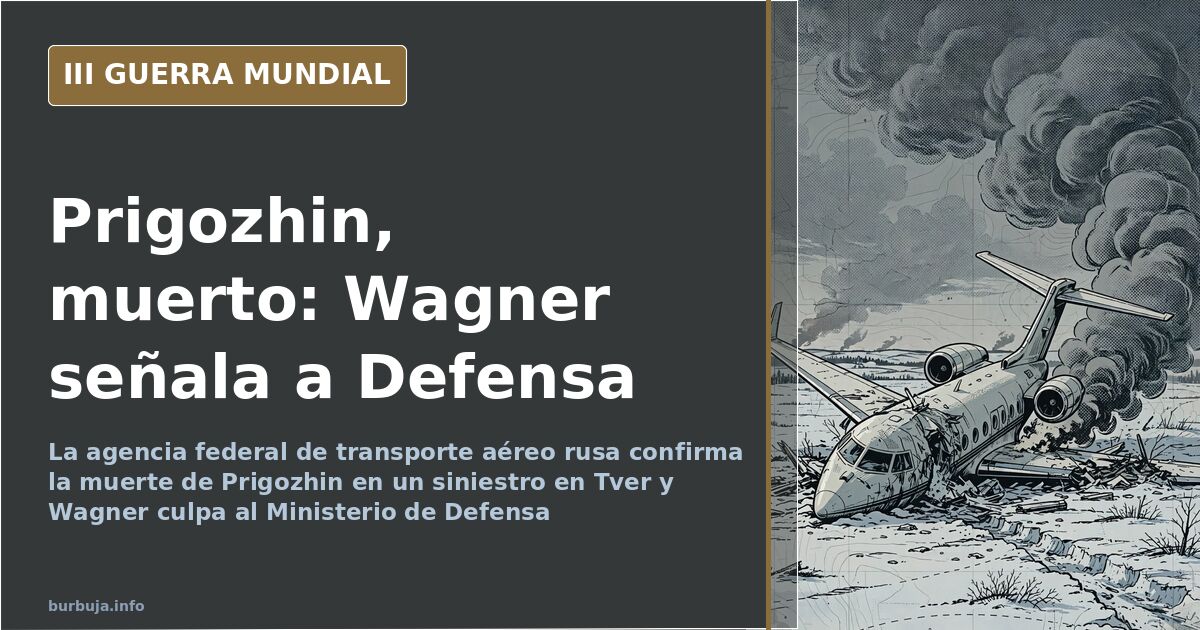
Wagner blames Defense as Prigozhin dies in plane crash
Russia’s Federal Air Transport Agency confirmed Yevgeny Prigozhin died in a plane crash in the Tver region. Kommersant and TASS reported the confirmation, which trinc his failed armed march on Moscow.
No official cause of the downing has been released. This silence—and Wagner’s swift blame on the Russian Defense Ministry—is central to the story. The death is widely seen as the Kremlin eliminating a major internal challenge and closing the loop on a private military structure left in limbo.
What Russian agencies confirm vs. Wagner’s claims
Confirmation came from two sources: the Russian federal air transport agency and Kommersant, which published the news as fact. TASS echoed the report. Regarding responsibility for the crash, narratives diverge: no authority has provided a technical account, while Wagner directly blamed the Russian Defense Ministry, according to Cadena SER.
A logistical detail adds weight. Belarusian opposition channels noted **internet blackouts in the area where Wagner members are based in Belarus**, supporting the theory that the group is decapitated and unable to coordinate. If command and communications fail simultaneously, the question shifts from who piloted the plane to who controls the remaining forces.
Revenge, hoax, or foreign involvement?
The dominant view suggests a calculated message. Some argue Moscow didn’t bother hiding it: the crash serves as a warning to other dissidents, more effective when visible. This aligns with the attributed Pilingui quote: **«I can forgive, but not everything. I do not forgive betrayal»**. Within this framework, Prigozhin’s end seems inevitable.
Conversely, some claim it’s a setup. Suspicion rests on Prigozhin’s personal pilot, last seen on the plane hours before the crash; reports suggest he had another flight booked to leave the country and may already be abroad. In this version, Prigozhin lives under a new identity in a remote Russian republic, off-grid.
A third, minority but loud theory involves foreign actors. Critics argue the crash location in Tver—not Africa or the sea—doesn’t fit Western intelligence operations, which would have erased evidence. Timing also matters: the crash coincided with the BRICS summit, a date some believe Moscow wouldn’t choose if seeking to avoid a revenge label. Each hypothesis explains part of the puzzle but leaves gaps.
Convenient accidents: From Sanjurjo to Tver
The most cited historical parallel is the 1930s air crashes that eliminated rivals around Franco. General Sanjurjo died in a **Puss Moth** plane; pilot Juan Antonio Ansaldo, a monarchist, warned about excess weight. One participant describes it as an accident providential for Franco, with the pilot aiding the transfer. General Mola also died in an air crash.
This comparison has flaws: those events are documented as accidents, not executions. Proponents focus on the outcome—the timely removal of a rival—rather than the method. Still, the echo is unavoidable. The history of convenient accidents spans over a century, and administrations never fully abandon such narratives.
Where the analysis stalls
The human factor remains key. Some dismiss the alive-or-dead debate, arguing what matters is Wagner losing its head during war, changing the strategic board regardless of theories. Others see revenge foreshadowed the day Wagner columns turned back.
The calendar is puzzling: the crash hit during the BRICS summit. A targeted assassination usually hides itself; one meant to exemplify does not. Here, there’s neither full concealment nor clear signaling: just an agency confirmation, mutual accusations, and an unexplained wreckage.
The cause remains officially unanswered. Revenge, hoax, or third-party action: none are ruled out by data. Wagner accuses Defense, Moscow offers no final version, and no one knows if Prigozhin will resurface in video. That’s where the analysis stops, for now.
Russia’s Federal Air Transport Agency confirmed Yevgeny Prigozhin died in a plane crash in the Tver region. Kommersant and TASS reported the confirmation, which trinc his failed armed march on Moscow.
No official cause of the downing has been released. This silence—and Wagner’s swift blame on the Russian Defense Ministry—is central to the story. The death is widely seen as the Kremlin eliminating a major internal challenge and closing the loop on a private military structure left in limbo.
What Russian agencies confirm vs. Wagner’s claims
Confirmation came from two sources: the Russian federal air transport agency and Kommersant, which published the news as fact. TASS echoed the report. Regarding responsibility for the crash, narratives diverge: no authority has provided a technical account, while Wagner directly blamed the Russian Defense Ministry, according to Cadena SER.
A logistical detail adds weight. Belarusian opposition channels noted **internet blackouts in the area where Wagner members are based in Belarus**, supporting the theory that the group is decapitated and unable to coordinate. If command and communications fail simultaneously, the question shifts from who piloted the plane to who controls the remaining forces.
Revenge, hoax, or foreign involvement?
The dominant view suggests a calculated message. Some argue Moscow didn’t bother hiding it: the crash serves as a warning to other dissidents, more effective when visible. This aligns with the attributed Pilingui quote: **«I can forgive, but not everything. I do not forgive betrayal»**. Within this framework, Prigozhin’s end seems inevitable.
Conversely, some claim it’s a setup. Suspicion rests on Prigozhin’s personal pilot, last seen on the plane hours before the crash; reports suggest he had another flight booked to leave the country and may already be abroad. In this version, Prigozhin lives under a new identity in a remote Russian republic, off-grid.
A third, minority but loud theory involves foreign actors. Critics argue the crash location in Tver—not Africa or the sea—doesn’t fit Western intelligence operations, which would have erased evidence. Timing also matters: the crash coincided with the BRICS summit, a date some believe Moscow wouldn’t choose if seeking to avoid a revenge label. Each hypothesis explains part of the puzzle but leaves gaps.
Convenient accidents: From Sanjurjo to Tver
The most cited historical parallel is the 1930s air crashes that eliminated rivals around Franco. General Sanjurjo died in a **Puss Moth** plane; pilot Juan Antonio Ansaldo, a monarchist, warned about excess weight. One participant describes it as an accident providential for Franco, with the pilot aiding the transfer. General Mola also died in an air crash.
This comparison has flaws: those events are documented as accidents, not executions. Proponents focus on the outcome—the timely removal of a rival—rather than the method. Still, the echo is unavoidable. The history of convenient accidents spans over a century, and administrations never fully abandon such narratives.
Where the analysis stalls
The human factor remains key. Some dismiss the alive-or-dead debate, arguing what matters is Wagner losing its head during war, changing the strategic board regardless of theories. Others see revenge foreshadowed the day Wagner columns turned back.
The calendar is puzzling: the crash hit during the BRICS summit. A targeted assassination usually hides itself; one meant to exemplify does not. Here, there’s neither full concealment nor clear signaling: just an agency confirmation, mutual accusations, and an unexplained wreckage.
The cause remains officially unanswered. Revenge, hoax, or third-party action: none are ruled out by data. Wagner accuses Defense, Moscow offers no final version, and no one knows if Prigozhin will resurface in video. That’s where the analysis stops, for now.
Also available in: Deutsch
Summary of a discussion on Burbuja.info - Foro de economía, actualidad y política., translated from Spanish and reviewed before publication. Read the full discussion (125 replies).
More summaries
-
Prigozhin Exiled to Belarus; Wagner Fighters Join Russian Army
The Kremlin drops criminal charges against Prigozhin, exiles him to Belarus, and offers thousands of Wagner mercenaries integration into the Russian military.
-
Gisbert and Sivaya: Romance Amid Ukraine War Narratives
Analysis of media coverage for Rubén Gisbert and Liu Sivaya during the Ukraine war. Is this digital propaganda or reality?
-
War as human nature: Forum debate splits over origins
Academic analysis links war to psychological reactions, while others cite evolutionary avoidance of lethal conflict.
-
Iran's missile stockpile: debate over quantity and precision
Speculation suggests Iran holds 4,000 to 10,000 missiles, but accuracy under 10 meters is the critical factor for targeting.
-
US vetoes Palestinian UN membership amid diplomatic standoff
The US blocked Palestine's UN bid while France voted yes and the UK abstained. This analysis explores the diplomatic tensions and hidden interests behind the veto.
-
Russia Offers May Victory Day Truce, Threatens Kyiv
Russia declares a unilateral ceasefire for May 8-9, 2026, but threatens to destroy Kyiv if Ukraine attacks during the parade.