
PP Warns of Motorway Tolls, Blames Brussels
Recovery plan includes motorway tolls as condition for €84bn EU funds. Brussels gives one month to approve them.
English · Original discussion in Spanish · Published
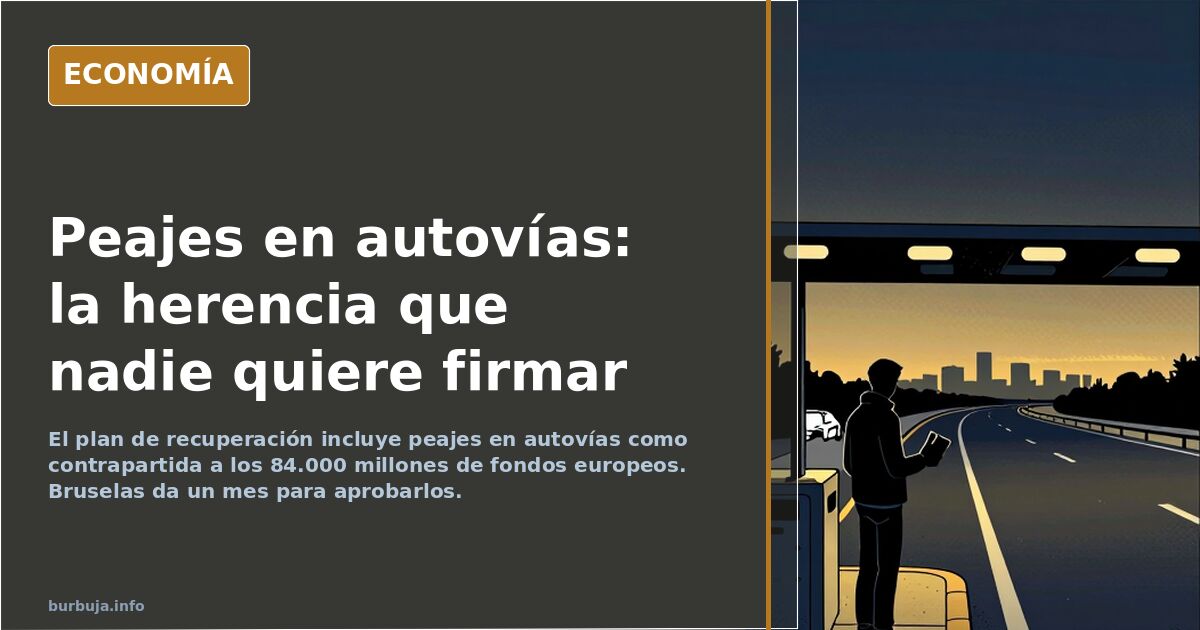
Motorway tolls: the warning PP attributes to Brussels
The commitment was signed years ago and now must be fulfilled. The recovery plan approved in spring 2021 includes the implementation of tolls on motorways and highways as a counterpart, a measure Brussels links to the €84 billion Next Generation funds. The PP's public warning that "tolls will have to be paid" has peine an issue the Government had tried to keep out of the electoral spotlight, which now returns with a Commission ultimatum: one month to approve the system.
What the agreement with Brussels says about tolls
Paying for road network use is not a last-minute idea. It is part of the Recovery, Transformation and Resilience Plan sent by the Executive to Brussels and approved by the Commission. The official logic is twofold: reduce the public deficit and advance transport decarbonization. The problem is that this narrative clashes with accounting reality.
Taxes associated with road transport already more than cover the cost of road maintenance, according to calculations by critics of the measure. If so, the toll does not finance the road: it finances other items. Double taxation ceases to be a technicality and becomes the core of anger: first you pay fuel tax, already justified for maintaining roads, and now an additional fee for driving is added.
The argument no one disputes: funds must be repaid
Here the analysis really gets stuck. Leaving the agreement requires returning received money, and that money is not in any piggy bank. Those holding this position present it as an arithmetic problem without an elegant solution: either conditions are met, or spending is drastically cut to face repayment. The question remaining floating is who signs off on a cuts program with detailed items on the table.
The alternative suggested from skepticism is another: before squeezing taxpayers, slim down the State structure. Departments, agencies, public companies, provincial councils and regional entities appear in the conversation as the bottomless pit they refuse to touch. The comparison with Portugal slips into the analysis: there tolls emptied motorways for those who could afford them and filled local roads, while revenue barely covered the collection system itself.
Is Brussels demanding tolls or just balancing accounts?
No, Brussels does not demand tolls. It demands reducing the deficit. The distinction matters because it completely changes the distribution of responsibilities. If the goal is to balance accounts, multiple ways exist to achieve it; choosing to charge for driving is a political decision, not a technical imposition. This is probably the most repeated objection and the least answered by the official narrative.
The calendar also does not help the innocent version. The PP appears blamed for having seen how the measure was prepared before the motion of censure against Rajoy, dismantling the theory that inherited problems explain everything. And the PSOE first denied implementing them and then blamed Brussels. Both things cannot be true.
What else comes with tolls: VAT, income tax and contribution bases
The toll is the visible tip of a broader package. The circulating list includes VAT increases, income tax hikes, widening of contribution bases, taxes on waste incineration, landfills and plastic. Everything is written, and all points in the same direction: more fiscal pressure on the same shoulders.
The sequence worries more than the initial amount. The usual tactic is to start with a soft tariff so protest does not take root, and tighten it later. When drivers realize, the toll will cost more than fuel. In the background, the debate on restricted mobility and cities designed by time slots, which some read as a piece of the same puzzle.
Weekend tourism and depopulated Spain under scrutiny
There is a collateral effect almost nobody disputes: making kilometers expensive hits first those living far away and those moving for work. Weekend getaway tourism would be the first victim, and with it much of the economy of regions depending on that flow. Also logistics, which cannot stop rolling and will pass the cost to the final price of the shopping basket.
The closure of the analysis does not arrive. With interest rates at tightening levels, household consumption was already weakening before anything was approved. If the toll enters into force with the economy slowing, the effect on spending will be the usual one: fewer trips, less consumption and more revenue via urgency. No one has yet explained how to get out of this without touching the structure.
The commitment was signed years ago and now must be fulfilled. The recovery plan approved in spring 2021 includes the implementation of tolls on motorways and highways as a counterpart, a measure Brussels links to the €84 billion Next Generation funds. The PP's public warning that "tolls will have to be paid" has peine an issue the Government had tried to keep out of the electoral spotlight, which now returns with a Commission ultimatum: one month to approve the system.
What the agreement with Brussels says about tolls
Paying for road network use is not a last-minute idea. It is part of the Recovery, Transformation and Resilience Plan sent by the Executive to Brussels and approved by the Commission. The official logic is twofold: reduce the public deficit and advance transport decarbonization. The problem is that this narrative clashes with accounting reality.
Taxes associated with road transport already more than cover the cost of road maintenance, according to calculations by critics of the measure. If so, the toll does not finance the road: it finances other items. Double taxation ceases to be a technicality and becomes the core of anger: first you pay fuel tax, already justified for maintaining roads, and now an additional fee for driving is added.
The argument no one disputes: funds must be repaid
Here the analysis really gets stuck. Leaving the agreement requires returning received money, and that money is not in any piggy bank. Those holding this position present it as an arithmetic problem without an elegant solution: either conditions are met, or spending is drastically cut to face repayment. The question remaining floating is who signs off on a cuts program with detailed items on the table.
The alternative suggested from skepticism is another: before squeezing taxpayers, slim down the State structure. Departments, agencies, public companies, provincial councils and regional entities appear in the conversation as the bottomless pit they refuse to touch. The comparison with Portugal slips into the analysis: there tolls emptied motorways for those who could afford them and filled local roads, while revenue barely covered the collection system itself.
Is Brussels demanding tolls or just balancing accounts?
No, Brussels does not demand tolls. It demands reducing the deficit. The distinction matters because it completely changes the distribution of responsibilities. If the goal is to balance accounts, multiple ways exist to achieve it; choosing to charge for driving is a political decision, not a technical imposition. This is probably the most repeated objection and the least answered by the official narrative.
The calendar also does not help the innocent version. The PP appears blamed for having seen how the measure was prepared before the motion of censure against Rajoy, dismantling the theory that inherited problems explain everything. And the PSOE first denied implementing them and then blamed Brussels. Both things cannot be true.
What else comes with tolls: VAT, income tax and contribution bases
The toll is the visible tip of a broader package. The circulating list includes VAT increases, income tax hikes, widening of contribution bases, taxes on waste incineration, landfills and plastic. Everything is written, and all points in the same direction: more fiscal pressure on the same shoulders.
The sequence worries more than the initial amount. The usual tactic is to start with a soft tariff so protest does not take root, and tighten it later. When drivers realize, the toll will cost more than fuel. In the background, the debate on restricted mobility and cities designed by time slots, which some read as a piece of the same puzzle.
Weekend tourism and depopulated Spain under scrutiny
There is a collateral effect almost nobody disputes: making kilometers expensive hits first those living far away and those moving for work. Weekend getaway tourism would be the first victim, and with it much of the economy of regions depending on that flow. Also logistics, which cannot stop rolling and will pass the cost to the final price of the shopping basket.
The closure of the analysis does not arrive. With interest rates at tightening levels, household consumption was already weakening before anything was approved. If the toll enters into force with the economy slowing, the effect on spending will be the usual one: fewer trips, less consumption and more revenue via urgency. No one has yet explained how to get out of this without touching the structure.
Also available in: Deutsch
Summary of a discussion on Burbuja.info - Foro de economía, actualidad y política., translated from Spanish and reviewed before publication. Read the full discussion (107 replies).
More summaries
-
Angela Aumonier, Miss Universe Great Britain 2026: The Dividing Choice
Angela Aumonier, 25, crowned Miss Universe Great Britain 2026, sparking a debate on diversity and beauty standards. Read the details.
-
Fatty liver affects 25% of Spaniards, majority unaware
A quarter of Spain's population has fatty liver disease, yet over half don't know what it is. New data reveals widespread misconceptions about causes and risks.
-
Spain's Princess Leonor wears military uniform at civil reception
Princess Leonor greeted authorities in a military uniform at the Royal Palace, breaking protocol for civil events and sparking debate.
-
Pedri, I'm a 'Facha': Viral Video Reignites Label Debate
A viral video where a man self-identifies as a 'facha' sparks debate on political labeling in social media.
-
India's Modi Urges Citizens to Halt Gold Purchases Amid Economic Strain
Analysis of India's economic crisis: why the government restricts gold buying. Debate on liquidity, foreign reserves, and safe havens.
-
TVE campaign equating flirting with harassment sparks backlash
A Spanish public broadcaster video linking courtship to violence triggers criticism and debate on dating norms in Spain.