
PP admits PSOE scored goal with Article 49 reform
PP MPs admit the PSOE has 'scored a goal' with the Article 49 reform, which specifically addresses women and minors with disabilities.
English · Original discussion in Spanish · Published
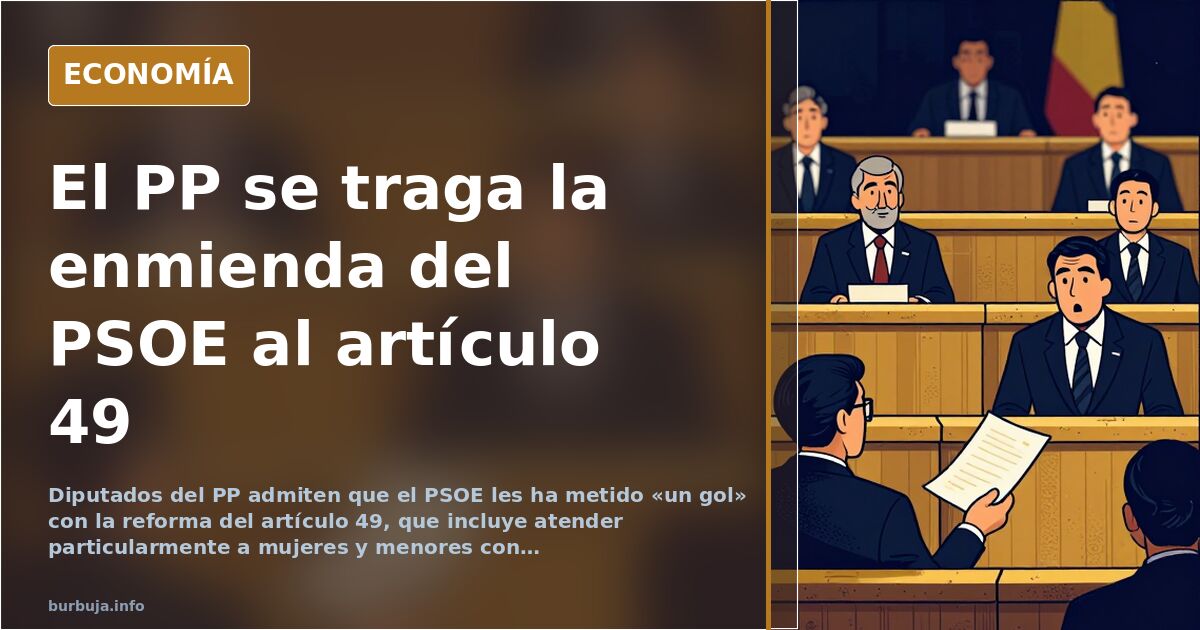
PP admits PSOE scored a goal with Article 49 of the Constitution
The reform of Article 49 of the Spanish Constitution to replace "diminished" with "disability" has left a trail of discontent within the Popular Party (Partido Popular) group. The text approved in the Congress plenary includes a clause that, according to parliamentary sources, introduces de facto positive discrimination based on sens into the fundamental law: "Specific needs of women and minors with disabilities will be particularly addressed." PP deputies consulted admit that the Socialist Party (PSOE) has "scored a goal" against them and consider accepting that wording an "error." The discomfort is not new, but the vote has made it evident.
What exactly does the new Article 49 say?
The text replaces the term "diminished" with "disability," a change that had been on the table for years and was included in the PP's electoral program. Up to that point, consensus was broad. The problem arises with the addition: the explicit mention of women and minors as groups who will receive particular attention. For a sector of the parliamentary group, this clause clashes with Article 14 of the Constitution, which enshrines the equality of Spaniards regardless of race, sens, or condition.
Legal scholar Eugenio Nasarre, former secretary general of the Parliamentary Group and former secretary general of Education under Aznar, put this in writing in an article that has circulated widely among deputies. His question is direct: "What specific needs does a woman have due to her disability that a man does not?" He concludes: "Is this clause a toll paid to prevailing neo-feminism?" According to critics, the text opens the door for the Constitutional Court to rule on a case of positive discrimination that until now existed only through judicial interpretation, not by express mandate.
The role of Cermi and its link to the Government
One of the most questioned aspects is the prominence of Cermi (Spanish Committee of Representatives of Persons with Disabilities) in drafting the article. Parliamentary sources indicate that within the association itself there are groups opposed to certain paragraphs, such as the one stating that "persons with disabilities exercise the rights provided for in this Title under conditions of real and effective freedom and equality." The argument is that there can be no freedom if the conditions to exercise it are not met, nor equality if each disability has unique characteristics.
The same sources emphasize Cermi's closeness to Sánchez's government on issues such as the closure of special education centers, included in the Education Law of former minister Isabel Celaá. Jesús Martín Blanco, who held leadership positions in Cermi, was appointed by Podemos in 2021 as Director General of Disability at the Ministry of Social Rights. This connection fuels the thesis that the final wording responds to an agenda alien to the PP.
Feijóo defends the agreement and accepts criticism
The PP president, Alberto Núñez Feijóo, responded to criticism with a message mixing pride and resignation. "I accept being criticized for fulfilling my commitments because I believe that is what politics consists of," he stated minutes after the approval. He added: "I accept all these criticisms and regret that some do not like it or share my position, but I assure you we will do again what we have done and we are proud of it."
Within the group, discipline prevailed, but not without resistance. "It was an error and they have just introduced gender ideology into the Constitution," summarizes a deputy who asks not to be identified. Others suggest a public explanation should have been given, although they acknowledge the commitment was in the program and that those who accept a seat under those conditions "must face the consequences."
Discontent is not limited to Article 49
The reform has peine a deeper wound: the feeling that the PP accepts ideological frameworks it claims to fight. Some argue this episode is yet another proof that the party prefers managing consensus over defining its own profile. Against this weighs the argument that blocking a symbolic reform for people with disabilities would have had a high and difficult-to-explain electoral cost.
In any case, the discontent has not translated into dissenting votes. Discipline was maintained and the text passed with only Vox's rejection. It remains to be seen what happens in the Senate, where the PP has an absolute majority and, since this is a constitutional reform, the Congress cannot override a veto by letting two months pass and approving it with a simple majority. The ball is in the court of the Popular Party, and no one rules out that internal discontent will resurface during that vote.
How far is the PP willing to go to avoid appearing as the party that blocks rights?
The reform of Article 49 of the Spanish Constitution to replace "diminished" with "disability" has left a trail of discontent within the Popular Party (Partido Popular) group. The text approved in the Congress plenary includes a clause that, according to parliamentary sources, introduces de facto positive discrimination based on sens into the fundamental law: "Specific needs of women and minors with disabilities will be particularly addressed." PP deputies consulted admit that the Socialist Party (PSOE) has "scored a goal" against them and consider accepting that wording an "error." The discomfort is not new, but the vote has made it evident.
What exactly does the new Article 49 say?
The text replaces the term "diminished" with "disability," a change that had been on the table for years and was included in the PP's electoral program. Up to that point, consensus was broad. The problem arises with the addition: the explicit mention of women and minors as groups who will receive particular attention. For a sector of the parliamentary group, this clause clashes with Article 14 of the Constitution, which enshrines the equality of Spaniards regardless of race, sens, or condition.
Legal scholar Eugenio Nasarre, former secretary general of the Parliamentary Group and former secretary general of Education under Aznar, put this in writing in an article that has circulated widely among deputies. His question is direct: "What specific needs does a woman have due to her disability that a man does not?" He concludes: "Is this clause a toll paid to prevailing neo-feminism?" According to critics, the text opens the door for the Constitutional Court to rule on a case of positive discrimination that until now existed only through judicial interpretation, not by express mandate.
The role of Cermi and its link to the Government
One of the most questioned aspects is the prominence of Cermi (Spanish Committee of Representatives of Persons with Disabilities) in drafting the article. Parliamentary sources indicate that within the association itself there are groups opposed to certain paragraphs, such as the one stating that "persons with disabilities exercise the rights provided for in this Title under conditions of real and effective freedom and equality." The argument is that there can be no freedom if the conditions to exercise it are not met, nor equality if each disability has unique characteristics.
The same sources emphasize Cermi's closeness to Sánchez's government on issues such as the closure of special education centers, included in the Education Law of former minister Isabel Celaá. Jesús Martín Blanco, who held leadership positions in Cermi, was appointed by Podemos in 2021 as Director General of Disability at the Ministry of Social Rights. This connection fuels the thesis that the final wording responds to an agenda alien to the PP.
Feijóo defends the agreement and accepts criticism
The PP president, Alberto Núñez Feijóo, responded to criticism with a message mixing pride and resignation. "I accept being criticized for fulfilling my commitments because I believe that is what politics consists of," he stated minutes after the approval. He added: "I accept all these criticisms and regret that some do not like it or share my position, but I assure you we will do again what we have done and we are proud of it."
Within the group, discipline prevailed, but not without resistance. "It was an error and they have just introduced gender ideology into the Constitution," summarizes a deputy who asks not to be identified. Others suggest a public explanation should have been given, although they acknowledge the commitment was in the program and that those who accept a seat under those conditions "must face the consequences."
Discontent is not limited to Article 49
The reform has peine a deeper wound: the feeling that the PP accepts ideological frameworks it claims to fight. Some argue this episode is yet another proof that the party prefers managing consensus over defining its own profile. Against this weighs the argument that blocking a symbolic reform for people with disabilities would have had a high and difficult-to-explain electoral cost.
In any case, the discontent has not translated into dissenting votes. Discipline was maintained and the text passed with only Vox's rejection. It remains to be seen what happens in the Senate, where the PP has an absolute majority and, since this is a constitutional reform, the Congress cannot override a veto by letting two months pass and approving it with a simple majority. The ball is in the court of the Popular Party, and no one rules out that internal discontent will resurface during that vote.
How far is the PP willing to go to avoid appearing as the party that blocks rights?
Summary of a discussion on Burbuja.info - Foro de economía, actualidad y política., translated from Spanish and reviewed before publication. Read the full discussion (194 replies).
More summaries
-
Tenant Union: Who Finances the Illegal Strike in Spain?
The Tenant Union is not a legal union but receives 3.7 million euros in public funds. It called a general rent strike on November 11, sparking controversy over its funding and political ties.
-
The 'wall' against Rita Maestre: age and political scrutiny
Rita Maestre faces the 'wall': aesthetic scrutiny of women in politics and gender double standards.
-
Quiet Firing: 57% of Spanish Workers Affected
57% of workers in Spain have faced quiet firing tactics over three years, including increased workload and stagnation.
-
Spain's Aznar-Bush Pact Theory Links US Units to 11-M Attacks
A conspiracy theory attributes the 2004 Madrid bombings to a US unit protected by a 2001 pact, citing a coincidental victim count.
-
ING stock dips after pulling ads from Iker Jiménez
La Gaceta links ING's 1.70% stock drop to ad removal from Iker Jiménez, though shares later recovered.
-
Echenique's DANA tweet sparks fury among right-wing critics
Pablo Echenique's satirical tweet about the Valencia DANA triggers backlash, reopening debate over disaster narrative.