
Quiet Firing: 57% of Spanish Workers Affected
57% of workers in Spain have faced quiet firing tactics over three years, including increased workload and stagnation.
English · Original discussion in Spanish · Published
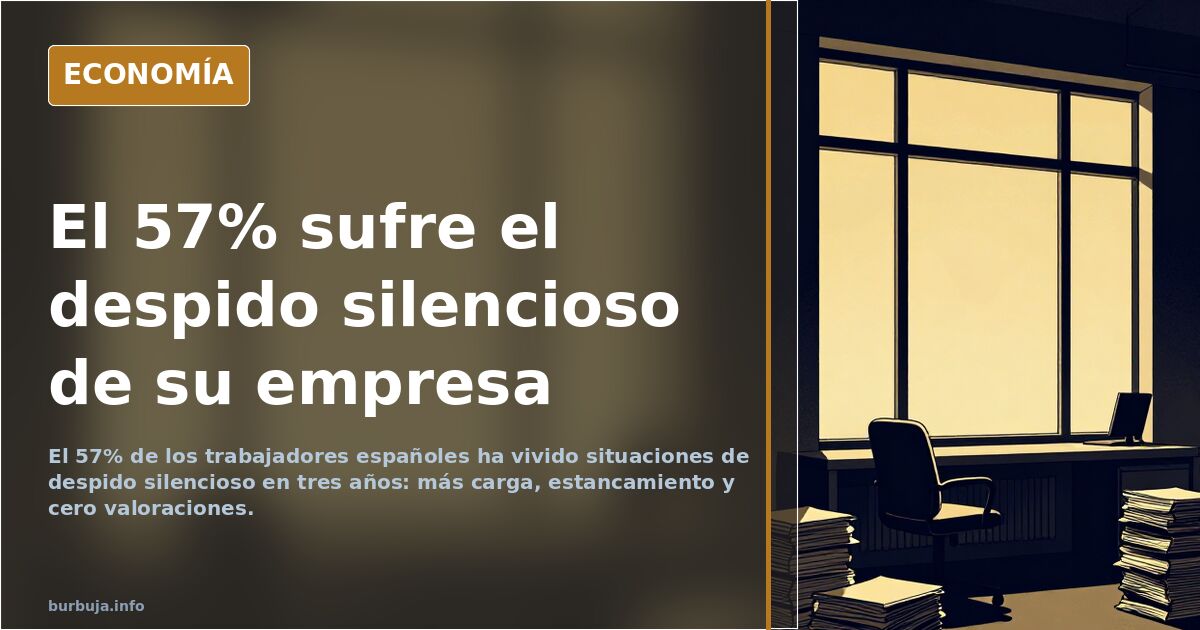
Quiet firing is no longer an exception: it is a management technique
Quiet firing is no longer an isolated case of a petty boss: it is a management technique. 57% of Spanish workers have experienced situations where companies push for voluntary resignation to avoid paying severance in the last three years. This is quantified by the latest report from Infojobs, and the rate has risen since 2020, when the maneuver began to normalize.
The mechanism is almost never announced. It turns the employee's life into a drip of discomforts until they break. And, according to those who have lived through it, it works. Among those who acknowledge it, 25% suddenly found themselves with more work without justification; 24% are stuck in career stagnation; and 20% stopped receiving positive reviews despite meeting targets. None of this is dismissal. All of this is pressure.
From empty desks to poisoned offers
When the goal is exit rather than performance, the repertoire expands. There are cases of people spending fourteen months in an office with no assigned tasks, killing time on a handheld console while accumulating seniority. And companies that prefer the disguise of opportunity: one firm created a parallel entity to launch tailored offers for profiles it wanted to fire. They accepted, resigned, and were on the street weeks later, still in their probation period.
Other times the game is outright dirty. One worker reported finding narcotics on his desk during a dispute over severance; he took them, went to HR, and forced a police call. Another claims a private detective waited for him every morning at his door. The objective was the same: make them leave voluntarily, at no cost to the company.
Quiet quitting against quiet firing
The most repeated response is not heroic. Slowing down until the salary stops being worth it for the company. Meeting targets, but not giving away a minute. Making the employer document and prove everything. Collective action also appears: being on the works council, acting as a union liaison, or becoming an inconvenient employee changes the boss's calculation. A veteran describes pure pragmatism: minimum effort, keep adding years, and wait until the severance figure is high enough to negotiate a mutual termination.
The general framework helps understand the shift. Participants in the debate note that the predicted Great Resignation after the pandemic has turned into a war of attrition. As one forum user summarizes, those who hold out are not the best: they are the ones who know their red lines.
How much does it really cost to fire someone?
Here lies the core issue. Some argue that for severance to be substantial, one must have spent half their life at the company, and that for large firms, that amount is pocket change. It is also noted that chaining monthly contracts prevents seniority accumulation and dilutes variable pay. The proposal causing the most controversy is the Austrian backpack (a portable savings account for severance): some warn that unless amounts are decent, nothing will change, and its implementation would force companies to contribute regardless.
The judicial route remains, which, reportedly, few take. Those who claim to have held out until the end assert that, besides severance, one can fight for extra compensation for sarracena harassment and anxiety leave, and that in conciliation hearings, upper management often abandons the boss who executed the maneuver.
Depression leave and the filter of insurers
When weariness takes its toll, health comes into play. Psychological leave appears in conversations as both an escape and a trap. According to those who have gone through it, the insurer calls for review and, if the leave extends, pressures and informs Social Security that the worker is fit to return. Some say their own GP warned them that discharge could be forced. Leave is not a victory: it is a truce with an expiration date.
With these pieces, one might expect a massive shift towards better-treating companies. There are no signs of this happening. As long as severance remains tied to seniority and the market rewards endurance, quiet firing has legs, unless someone decides to truly change how the cost of an exit is calculated.
Quiet firing is no longer an isolated case of a petty boss: it is a management technique. 57% of Spanish workers have experienced situations where companies push for voluntary resignation to avoid paying severance in the last three years. This is quantified by the latest report from Infojobs, and the rate has risen since 2020, when the maneuver began to normalize.
The mechanism is almost never announced. It turns the employee's life into a drip of discomforts until they break. And, according to those who have lived through it, it works. Among those who acknowledge it, 25% suddenly found themselves with more work without justification; 24% are stuck in career stagnation; and 20% stopped receiving positive reviews despite meeting targets. None of this is dismissal. All of this is pressure.
From empty desks to poisoned offers
When the goal is exit rather than performance, the repertoire expands. There are cases of people spending fourteen months in an office with no assigned tasks, killing time on a handheld console while accumulating seniority. And companies that prefer the disguise of opportunity: one firm created a parallel entity to launch tailored offers for profiles it wanted to fire. They accepted, resigned, and were on the street weeks later, still in their probation period.
Other times the game is outright dirty. One worker reported finding narcotics on his desk during a dispute over severance; he took them, went to HR, and forced a police call. Another claims a private detective waited for him every morning at his door. The objective was the same: make them leave voluntarily, at no cost to the company.
Quiet quitting against quiet firing
The most repeated response is not heroic. Slowing down until the salary stops being worth it for the company. Meeting targets, but not giving away a minute. Making the employer document and prove everything. Collective action also appears: being on the works council, acting as a union liaison, or becoming an inconvenient employee changes the boss's calculation. A veteran describes pure pragmatism: minimum effort, keep adding years, and wait until the severance figure is high enough to negotiate a mutual termination.
The general framework helps understand the shift. Participants in the debate note that the predicted Great Resignation after the pandemic has turned into a war of attrition. As one forum user summarizes, those who hold out are not the best: they are the ones who know their red lines.
How much does it really cost to fire someone?
Here lies the core issue. Some argue that for severance to be substantial, one must have spent half their life at the company, and that for large firms, that amount is pocket change. It is also noted that chaining monthly contracts prevents seniority accumulation and dilutes variable pay. The proposal causing the most controversy is the Austrian backpack (a portable savings account for severance): some warn that unless amounts are decent, nothing will change, and its implementation would force companies to contribute regardless.
The judicial route remains, which, reportedly, few take. Those who claim to have held out until the end assert that, besides severance, one can fight for extra compensation for sarracena harassment and anxiety leave, and that in conciliation hearings, upper management often abandons the boss who executed the maneuver.
Depression leave and the filter of insurers
When weariness takes its toll, health comes into play. Psychological leave appears in conversations as both an escape and a trap. According to those who have gone through it, the insurer calls for review and, if the leave extends, pressures and informs Social Security that the worker is fit to return. Some say their own GP warned them that discharge could be forced. Leave is not a victory: it is a truce with an expiration date.
With these pieces, one might expect a massive shift towards better-treating companies. There are no signs of this happening. As long as severance remains tied to seniority and the market rewards endurance, quiet firing has legs, unless someone decides to truly change how the cost of an exit is calculated.
Summary of a discussion on Burbuja.info - Foro de economía, actualidad y política., translated from Spanish and reviewed before publication. Read the full discussion (187 replies).
More summaries
-
Muface: Bal estimates 1.5 million civil servants affected
Edmundo Bal says 1.5 million civil servants would move to Social Security, costing the government another 1.5 million votes.
-
Machines paying into Social Security: what's being proposed
A forum user puts gross operating surplus at 8%: the proposal for machines to contribute divides between redistribution and capital flight
-
Sainz de Baranda in 1940: Not Luxury, Not Salamanca
In 1940, Sainz de Baranda was Madrid's edge, not the upscale Salamanca district. Mari Carmen’s flat wasn’t Móstoles either; her family arrived in 1957.
-
Spain loses over 241,000 social security contributors in one month
Spanish Social Security drops 241,800 contributors between mid-July and mid-August, with 21,884 more unemployed and over a million job terminations.
-
Carvajal’s slight and the Eurocopa dispute turning political
Spain's fourth Euro win sparks debate over ownership of the title and national identity after Carvajal’s gesture toward Sánchez.
-
Asturian forum user: locals compete with foreigners for housing
Who buys property in Asturias? Rising rents, prices and depopulation fuel local discontent amid debates over climate appeal.