
The 'wall' against Rita Maestre: age and political scrutiny
Rita Maestre faces the 'wall': aesthetic scrutiny of women in politics and gender double standards.
English · Original discussion in Spanish · Published
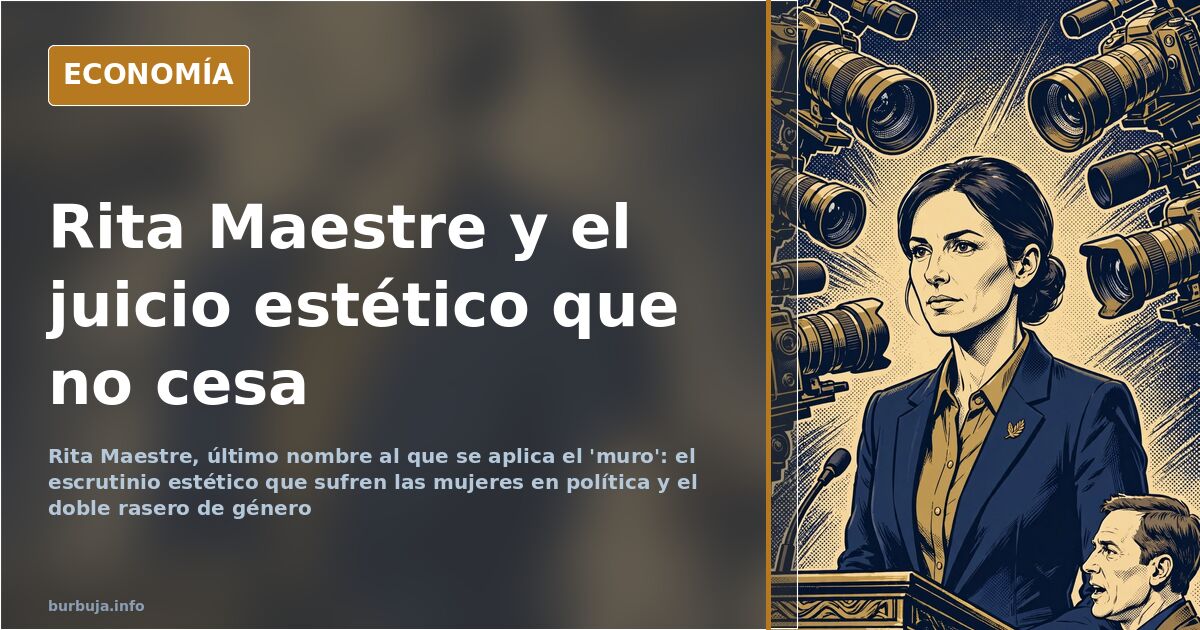
Rita Maestre and the 'wall': judging female politicians' images
There is a photograph. It doesn't matter which one: every time a prominent female figure has a birthday, someone digs up a recent image, places it next to one from a decade ago, and the conversation shifts to the passage of time. This is the mechanism that certain internet slang dubbed the "wall": the point where, according to those who apply it, physical appearance no longer supports public narrative. The latest name tagged with this label is Rita Maestre, former Madrid City Council spokesperson and one of the most recognizable faces of Madrid's left, subject to a wave of comments focused almost exclusively on her looks.
What stands out isn't the specific case. It's the mechanic: political criticism dissolves, leaving only aesthetic judgment. And when the subject is a woman, that judgment comes with an expiration date built in.
What is the 'wall' and why is it applied to public figures?
The concept isn't technical at all. It describes the moment a person—almost always a woman—no longer fits the canon that made them visible. It’s not an objective measure: it’s an assessment based on photo comparisons and anonymous comments. In Maestre's case, the discussion started by questioning whether the circulating image was real or AI-generated, before devolving into the classic inventory of antiestéticatures.
Beneath the guise of a joke lies a serious idea: that a woman's public legitimacy ultimately depends on her appearance. It doesn't matter the office, the record, or years of management. The first metric consulted is another. When that metric drops, the hunt begins.
The double standard: men mature, women 'expire'
This is where the case transcends the anecdotal. Some comments don't just opine on one person; they construct a general theory. For instance, some claim women begin their physical decline in their early 20s and become "invisible" after 35 or 40, with rare exceptions lasting until 45 through effort and makeup. For men, the narrative is opposite: they are presented as improving with age until 50 or 60.
That scheme is primarily a way of ordering the world. It turns an aesthetic preference into a biological law, justifying disdain along the way. It’s not analysis; it’s an alibi. The practical consequence is that women in politics endure scrutiny their male colleagues barely know.
Some say it plainly: the level of expectation isn't the same. Others argue all public figures face criticism regardless of sens. The problem with that argument is that the conversation itself disproves it: the percentage of messages dedicated to physical appearance here is overwhelming.
From podium to runway: underlying political noise
The conversation about Maestre doesn't float in a vacuum. Her name carries a public trajectory and notable episodes surfacing upon closer look: a protest in a university chapel years ago, her tenure in municipal politics, her profile within institutional left. All mentioned, but merely as backdrop. Substantive criticism—discussing her management, positions, or votes—is sidelined by comments on her face.
Ideological noise also creeps in. Some use the issue to conclude broadly about the relationship between certain ideologies and aesthetics. It’s the usual wrapper: turning an observation about a person into a conclusion about an entire bloc. Politics, which should be the debate's object, becomes an excuse.
A judgment that escalates with years
What distinguishes these conversations is their capacity to grow. They don't exhaust themselves; they accumulate. Starting with a loose comment, moving to image comparison, ending with predictions about the subject in a decade. The only number repeated insistently is age: 35, 40, 45. Thresholds functioning as deadlines.
Reviewing the tone confirms interest isn't in politics. References to her work, when present, are passing. Paragraphs focus on skin, hairstyle, clothing. An inventory applicable to any neighbor, yet reserved for those choosing public service.
Ultimately, the "wall" measures no one. It measures those invoking it. It reveals broader discomfort: a society still unable to view a woman in politics without first checking her reflection.
There is a photograph. It doesn't matter which one: every time a prominent female figure has a birthday, someone digs up a recent image, places it next to one from a decade ago, and the conversation shifts to the passage of time. This is the mechanism that certain internet slang dubbed the "wall": the point where, according to those who apply it, physical appearance no longer supports public narrative. The latest name tagged with this label is Rita Maestre, former Madrid City Council spokesperson and one of the most recognizable faces of Madrid's left, subject to a wave of comments focused almost exclusively on her looks.
What stands out isn't the specific case. It's the mechanic: political criticism dissolves, leaving only aesthetic judgment. And when the subject is a woman, that judgment comes with an expiration date built in.
What is the 'wall' and why is it applied to public figures?
The concept isn't technical at all. It describes the moment a person—almost always a woman—no longer fits the canon that made them visible. It’s not an objective measure: it’s an assessment based on photo comparisons and anonymous comments. In Maestre's case, the discussion started by questioning whether the circulating image was real or AI-generated, before devolving into the classic inventory of antiestéticatures.
Beneath the guise of a joke lies a serious idea: that a woman's public legitimacy ultimately depends on her appearance. It doesn't matter the office, the record, or years of management. The first metric consulted is another. When that metric drops, the hunt begins.
The double standard: men mature, women 'expire'
This is where the case transcends the anecdotal. Some comments don't just opine on one person; they construct a general theory. For instance, some claim women begin their physical decline in their early 20s and become "invisible" after 35 or 40, with rare exceptions lasting until 45 through effort and makeup. For men, the narrative is opposite: they are presented as improving with age until 50 or 60.
That scheme is primarily a way of ordering the world. It turns an aesthetic preference into a biological law, justifying disdain along the way. It’s not analysis; it’s an alibi. The practical consequence is that women in politics endure scrutiny their male colleagues barely know.
Some say it plainly: the level of expectation isn't the same. Others argue all public figures face criticism regardless of sens. The problem with that argument is that the conversation itself disproves it: the percentage of messages dedicated to physical appearance here is overwhelming.
From podium to runway: underlying political noise
The conversation about Maestre doesn't float in a vacuum. Her name carries a public trajectory and notable episodes surfacing upon closer look: a protest in a university chapel years ago, her tenure in municipal politics, her profile within institutional left. All mentioned, but merely as backdrop. Substantive criticism—discussing her management, positions, or votes—is sidelined by comments on her face.
Ideological noise also creeps in. Some use the issue to conclude broadly about the relationship between certain ideologies and aesthetics. It’s the usual wrapper: turning an observation about a person into a conclusion about an entire bloc. Politics, which should be the debate's object, becomes an excuse.
A judgment that escalates with years
What distinguishes these conversations is their capacity to grow. They don't exhaust themselves; they accumulate. Starting with a loose comment, moving to image comparison, ending with predictions about the subject in a decade. The only number repeated insistently is age: 35, 40, 45. Thresholds functioning as deadlines.
Reviewing the tone confirms interest isn't in politics. References to her work, when present, are passing. Paragraphs focus on skin, hairstyle, clothing. An inventory applicable to any neighbor, yet reserved for those choosing public service.
Ultimately, the "wall" measures no one. It measures those invoking it. It reveals broader discomfort: a society still unable to view a woman in politics without first checking her reflection.
Summary of a discussion on Burbuja.info - Foro de economía, actualidad y política., translated from Spanish and reviewed before publication. Read the full discussion (187 replies).
More summaries
-
Urbagestión proposes including Maricarmen's flat in Reviva plan
Urbagestión proposes to Madrid City Council to include Maricarmen's flat in the Reviva plan: the rent cap would not exceed 435 euros
-
Vicente Fuentes: from a million views to 10,000 and a month without posting
From 700,000 subscribers to 10,000 views and a month without posting: the economic and personal ruin of YouTuber Vicente Fuentes.
-
Hantavirus cases worsen after Tenerife evacuations to France and Madrid
Debate on health management of hantavirus transfers from Tenerife. Analysis of protocols, official information criticism, and political responsibility.
-
Spain's guardianship system faces scrutiny in Noelia euthanasia case
The debate over Noelia’s euthanasia request highlights tensions between state protection and the right to die, mixing legal, economic, and media concerns.
-
Sánchez's brother: €55,000 salary for seven years without working
David Sánchez receives €55,000 annually from the Badajoz Provincial Council without clocking in or teleworking for seven years. Judicial investigation continues.
-
Lucía Etxebarría’s Morocco assault account stirs debate in Ceuta
Lucía Etxebarría details a sexual assault in Morocco, reigniting discussions on women's safety and the Ceuta border.