
Potato, corn and beans: the full cycle for starting from scratch
A piece of potato grows a whole plant, and a 25-litre bucket yields 1 kg in three months: how the emergency staple reproduces
English · Original discussion in Spanish · Published
Potato, corn and beans: the full cycle for starting from scratch
Starting from scratch in the countryside isn't solved with a garden: it's solved with seed from the previous cycle, with tools and with knowing how each plant reproduces. The potato, one of the crops most often cited as an emergency staple, isn't planted from seed, but by cutting the tuber itself into pieces that keep a sprout. And corn, the other big bet, carries a problem that is less physical and more economic: some argue that a good part of the commercial varieties sold today can't be used to reproduce the next harvest.
The question that opens the matter is first-year agronomy and almost no one has it solved: where do next year's seeds come from if you have to start from scratch?
How does the potato reproduce if there are no seeds?
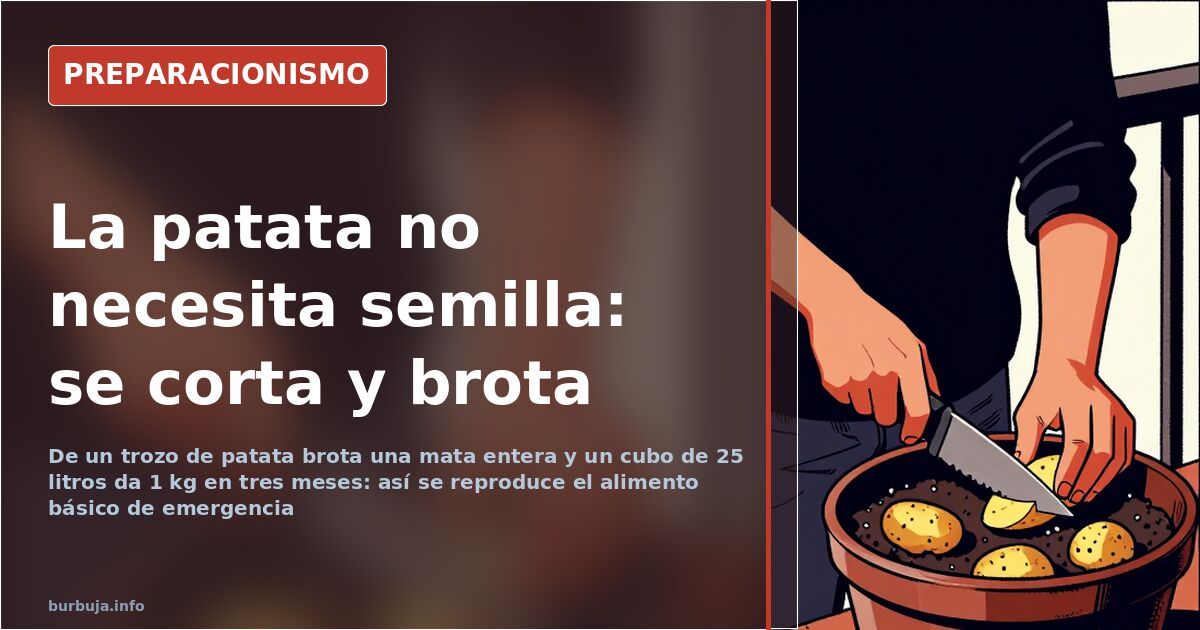
The short answer is that they aren't needed. A whole plant sprouts from a chunk of potato. The procedure described is to locate the eyes of the tuber and cut as many pieces as there are eyes, so that each keeps its own. Then the piece is left to dry in the air, in a bucket, without burying it, so the surface calluses over. If planted fresh, it rots.
Some do it vertically: the tuber is buried and soil is added as the plant grows, with the idea of harvesting in layers. And some reduce it to a bucket. One recounted trial puts the result at 1 kg of potatoes in a 25-litre bucket and three months of waiting. Small potatoes, but potatoes. Pre-treatment and temperature are the two variables that decide whether it thrives or turns to mush.
Corn, beans and potato: the three crops that ended hunger
All three came from the Americas and all three ended up sustaining the Cantabrian coast. Corn, according to the conversation, was the one that ended hunger from Portugal to France, and today it has practically disappeared from fields, replaced by commercial hybrids. Hence the interest in exchange networks that recover traditional varieties: seed proven over generations, not just one cycle.
Corn also has a physiological advantage explained with Wikipedia in hand: its photosynthesis is C4, very efficient with heat and available water, which allows high yields where other plants fall short. The flip side is water consumption. As a combination, the pre-Columbian association—corn, squash and beans growing together—appears as the best candidate for a beginner's garden: each plant covers what the other leaves bare.
Are bought seeds good for the next harvest?
It depends, and here the consensus breaks down. Some are clear: seeds sold in packets are prepared so that the second generation is garbage, and older varieties barely exist. Others respond with the opposite experience: a packet costs between 1 and 1.5 euros, 15 euros covers half a hectare of garden, and stored in a cool, dry place it germinates years after the expiry date. The cited case: tomatoes bought in 2007, expired in 2009, which mostly germinated much later.
For seeds, the old trick mentioned is soaking with water and hydrogen peroxide: it is claimed to eliminate pathogens from the surface and oxygenate them. It's not magic, it's hygiene.
Sweet potatoes, vetch and squash: what almost grows itself
If the potato is the totem of the emergency garden, some propose changing it. Sweet potato catches fewer pests and diseases, has more sugar, its green parts feed animals and it lasts a long time in storage; from a good year, inoculum remains in the soil and it grows by itself the next. A domestic production calculation speaks of some 70 kg usable plus culls for livestock, and of covering with it part of the year for a small pen—seven rabbits, in the example.
Vetch is the other rustic piece: grain, forage and green manure, with roots that fix atmospheric nitrogen. It is sown in September or October and mixed with oats or another cereal depending on use. Add to that squash—barely any care and storable all winter—broad beans, chard, cabbage and spinach. With a warning for fruit trees: the fig tree produces a great deal, but its roots lift patios.
The Little House on the Prairie syndrome
The most uncomfortable objection is not agronomic. It's social: some warn that your own garden doesn't survive in isolation while everyone else goes hungry and that, sooner or later, someone will wipe it out. And those who have no land—the city dweller thinking of saving seeds to move to the countryside—are selling a chimera: without years of practice you don't produce enough food. The advice that comes out of that is not to harvest, but to accumulate skills and goods tradable for food.
At the opposite extreme are those who argue that raising animals on grass and with traps yields more than the garden, with the argument that 100 grams of meat have more nutrients than 10 kilos of potatoes. No dietitian in the conversation signs off on that figure, but it sums up the dispute: vegetable, animal or both at once.
With the potato no one disputes the method; with corn, the water; with seed, the provenance. The jam appears when you put it all together: between buying the packet and putting something on the table there are years, and no one closes that calendar.
Starting from scratch in the countryside isn't solved with a garden: it's solved with seed from the previous cycle, with tools and with knowing how each plant reproduces. The potato, one of the crops most often cited as an emergency staple, isn't planted from seed, but by cutting the tuber itself into pieces that keep a sprout. And corn, the other big bet, carries a problem that is less physical and more economic: some argue that a good part of the commercial varieties sold today can't be used to reproduce the next harvest.
The question that opens the matter is first-year agronomy and almost no one has it solved: where do next year's seeds come from if you have to start from scratch?
How does the potato reproduce if there are no seeds?
The short answer is that they aren't needed. A whole plant sprouts from a chunk of potato. The procedure described is to locate the eyes of the tuber and cut as many pieces as there are eyes, so that each keeps its own. Then the piece is left to dry in the air, in a bucket, without burying it, so the surface calluses over. If planted fresh, it rots.
Some do it vertically: the tuber is buried and soil is added as the plant grows, with the idea of harvesting in layers. And some reduce it to a bucket. One recounted trial puts the result at 1 kg of potatoes in a 25-litre bucket and three months of waiting. Small potatoes, but potatoes. Pre-treatment and temperature are the two variables that decide whether it thrives or turns to mush.
Corn, beans and potato: the three crops that ended hunger
All three came from the Americas and all three ended up sustaining the Cantabrian coast. Corn, according to the conversation, was the one that ended hunger from Portugal to France, and today it has practically disappeared from fields, replaced by commercial hybrids. Hence the interest in exchange networks that recover traditional varieties: seed proven over generations, not just one cycle.
Corn also has a physiological advantage explained with Wikipedia in hand: its photosynthesis is C4, very efficient with heat and available water, which allows high yields where other plants fall short. The flip side is water consumption. As a combination, the pre-Columbian association—corn, squash and beans growing together—appears as the best candidate for a beginner's garden: each plant covers what the other leaves bare.
Are bought seeds good for the next harvest?
It depends, and here the consensus breaks down. Some are clear: seeds sold in packets are prepared so that the second generation is garbage, and older varieties barely exist. Others respond with the opposite experience: a packet costs between 1 and 1.5 euros, 15 euros covers half a hectare of garden, and stored in a cool, dry place it germinates years after the expiry date. The cited case: tomatoes bought in 2007, expired in 2009, which mostly germinated much later.
For seeds, the old trick mentioned is soaking with water and hydrogen peroxide: it is claimed to eliminate pathogens from the surface and oxygenate them. It's not magic, it's hygiene.
Sweet potatoes, vetch and squash: what almost grows itself
If the potato is the totem of the emergency garden, some propose changing it. Sweet potato catches fewer pests and diseases, has more sugar, its green parts feed animals and it lasts a long time in storage; from a good year, inoculum remains in the soil and it grows by itself the next. A domestic production calculation speaks of some 70 kg usable plus culls for livestock, and of covering with it part of the year for a small pen—seven rabbits, in the example.
Vetch is the other rustic piece: grain, forage and green manure, with roots that fix atmospheric nitrogen. It is sown in September or October and mixed with oats or another cereal depending on use. Add to that squash—barely any care and storable all winter—broad beans, chard, cabbage and spinach. With a warning for fruit trees: the fig tree produces a great deal, but its roots lift patios.
The Little House on the Prairie syndrome
The most uncomfortable objection is not agronomic. It's social: some warn that your own garden doesn't survive in isolation while everyone else goes hungry and that, sooner or later, someone will wipe it out. And those who have no land—the city dweller thinking of saving seeds to move to the countryside—are selling a chimera: without years of practice you don't produce enough food. The advice that comes out of that is not to harvest, but to accumulate skills and goods tradable for food.
At the opposite extreme are those who argue that raising animals on grass and with traps yields more than the garden, with the argument that 100 grams of meat have more nutrients than 10 kilos of potatoes. No dietitian in the conversation signs off on that figure, but it sums up the dispute: vegetable, animal or both at once.
With the potato no one disputes the method; with corn, the water; with seed, the provenance. The jam appears when you put it all together: between buying the packet and putting something on the table there are years, and no one closes that calendar.
Summary of a discussion on Burbuja.info - Foro de economía, actualidad y política., translated from Spanish and reviewed before publication. Read the full discussion (100 replies).
More summaries
-
Irati Etxandi, the 22-year-old mechanic taking TikTok by storm
Irati Etxandi, a 22-year-old mechanic in San Sebastián, is taking TikTok by storm—while some customers still ask to speak to a mechanic.
-
Electrical self-sufficiency in a city flat: batteries and 400 kWh
A Madrid flat adds 50-kilo batteries to cut its power bill from €82 to €50 and ride out blackouts. The total cost still doesn’t quite add up.
-
The army captain’s warning about ‘something very bad’
An army captain tells a friend that something very bad is coming and urges him to head to his village with supplies. Reaction: skepticism and stockpiling.
-
Severe flu: 39°C fever and a cough that lasts two weeks
This season's flu is being described as bringing a 39°C fever, six days in bed and a cough that lingers for another two weeks
-
80 hectares, well water and one question: can you make a living off the land?
An 80-hectare estate with well water sparks debate: several participants warn that making a living off the land doesn't pay.
-
Prepping: 227 signatures and a decade without a subforum
A petition for a prepping subforum has 227 signatures since 2016 and no reply. The pandemic revived interest, but the category was never created.