
Portable Heat Pump: The 39-Euro Annual Cost That Doesn't Add Up
A user claims €39/year heating with a portable heat pump. COP of 3.2 and constant outlet temperature fail to prove this.
English · Original discussion in Spanish · Published
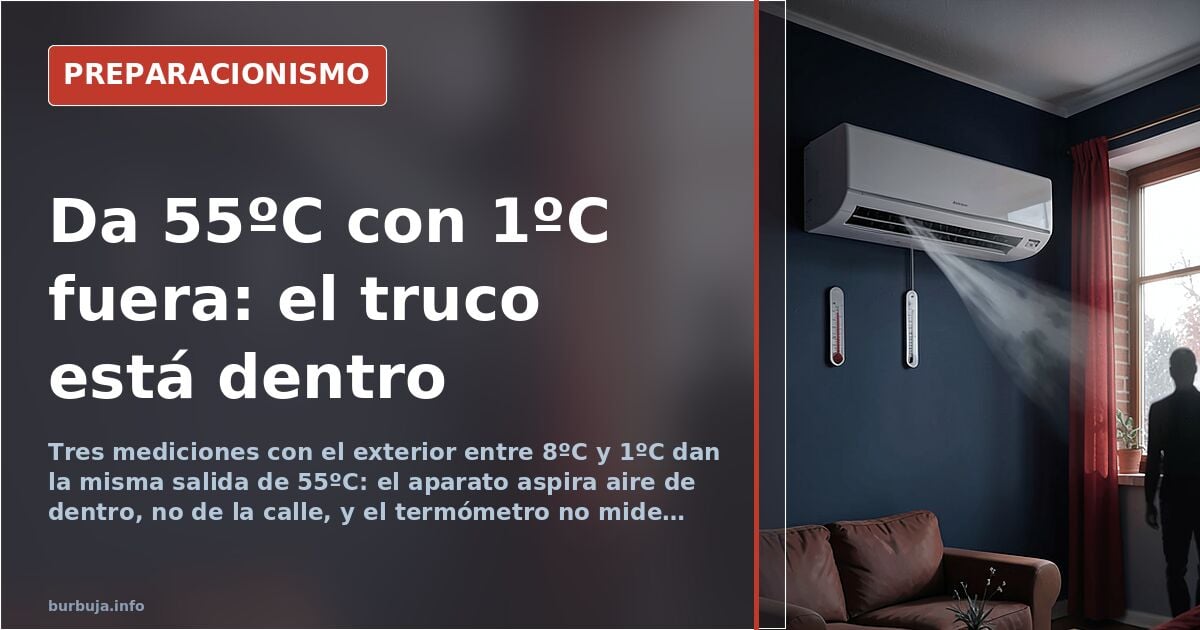
Heating for €39 a year: the calculation that ignores thermodynamics
Can you heat a house for six months for less than the cost of dinner? A user says yes: a single-tube portable heat pump, three thermometers, two consumption meters, and a stopwatch. According to their measurements, the result is **3.196 kWh over ten hours** of continuous operation, projecting a monthly consumption of **99 kWh** and a six-month heating season for **€39**. With own batteries and a price of **€0.066/kWh**, the figure drops to **€20** if used only five hours daily.
The controversial data point is different: the hot air outlet temperature did not vary when moving from **8 ºC to 1 ºC** outside. It remained at **55 ºC**. For the author of the measurements, this proves the device's performance does not depend on outdoor temperature. For many respondents, it proves the opposite: that the device is not measuring what it thinks it is measuring.
Why outlet temperature doesn't measure performance
The temperature of the air exiting the tube is a device setting, not an efficiency indicator. A unit can maintain 55 ºC output while consuming twice the electricity. Heat pump performance is measured by **COP**: heat delivered divided by electrical energy consumed. The manufacturer of the model in question declares a **COP of 3.2**, a figure cited by the author himself and undisputed by anyone.
The problem lies in where the evaporator draws air. A single-tube portable unit sucks air from the room itself, passes it through the evaporator, and expels cold air outside via the tube. In other words: the device "sees" indoor temperature, not street temperature. If there is barely **1 ºC variation** inside, the unit works under practically identical conditions, and its consumption shouldn't fluctuate. The test, in these terms, compares nothing.
Some take the argument further: if a heat pump maintained its performance as inlet air temperature dropped, its designer would deserve the Nobel Prize in Physics. Thermodynamics does not negotiate.
Air entering through gaps and the invisible bill
The second flaw in the calculation is negative pressure. A single-tube device expels air outside, creating depression in the room. That air must re-enter somewhere: gaps, windows, shafts, or building stairwells. If it enters from the street at 1 ºC, it must be heated, and that cost does not appear on the meter plugged into the pump. The colder it is outside, the more is lost through this route.
The author's defense is that air can be drawn from warmer areas of the house, like the kitchen, or a sunny patio. This is a partial solution: heat taken from another room is subtracted from that room. There is no free energy, only transfers.
The comparison that matters: €39 vs €2,976
Beyond the home lab, the number hovering over the discussion is diesel oil. A case close to the author estimates gasoil heating at **€2 per hour**; with eight hours daily, **€16 per day**, **€496 per month**, and **€2,976** per season. Compared to that, even quadrupling the electric cost without batteries—**€160**—the difference is overwhelming.
Here lies the paradox. The €39 calculation is likely underestimated for the reasons stated. But the alternative being compared is not cheap either. And the **COP of 3.2** declared by the manufacturer remains three times better than an electric resistance heater, whose COP is exactly 1.
The detail nobody disputes: the check valve
Among the cross-accusations, a practical contribution emerges: when the device is off, the tube crossing the window becomes a leak for outside cold. The solution is a **check valve** with light flaps, like those in bathroom extractors, or a gravity flap type used in range hoods and ships. They exist in **100-150 mm** sizes for few euros. The problem, they note, is that springs in cheaper models fail quickly or stay open with any tilt.
The conclusion that imposes itself is less epic than the €39 headline: the portable heat pump heats, and heats cheaper than almost any fossil alternative. But real savings depend on outdoor temperature, infiltration, and insulation quality. The idea that thermodynamics stops at the doorstep remains unproven.
Also available in: Deutsch
Summary of a discussion on Burbuja.info - Foro de economía, actualidad y política., translated from Spanish and reviewed before publication. Read the full discussion (59 replies).
More summaries
-
Heat pumps lose efficiency in cold weather, users report
Forum users report heat pump performance drops below 5°C, suggesting alternatives like €20 electric blankets or wood.
-
Kubotans and tactical pens: legality in Spain
Spain's Weapons Regulation does not explicitly mention kubotans. Possession of a tactical pen depends on police discretion and intended use.
-
Edible Oil Selection Becomes Strategic for Indian Food Makers
Vyansa Intelligence predicts palm oil will account for 27% of India's edible oil consumption in 2026. Oil choice impacts frying, packaging, and supply.
-
Emergency Radio: Frequencies to Save When Internet and TV Fail
No secret government frequency exists, but specific bands and protocols work when networks fail. A guide to essential emergency radio equipment.
-
Urban Survival Guide: A Forum User's Prepper Warning
In 2021, a forum user outlined a 'perfect storm' and a stockpile list: six months of medication, three of food, and one bike per adult. The debate continues…
-
Spain: Knife useless against wild boar defense
Spanish forum users warn that knives are for finishing, not fighting. They recommend air horns and distance over blades.