
Emergency Radio: Frequencies to Save When Internet and TV Fail
No secret government frequency exists, but specific bands and protocols work when networks fail. A guide to essential emergency radio equipment.
English · Original discussion in Spanish · Published
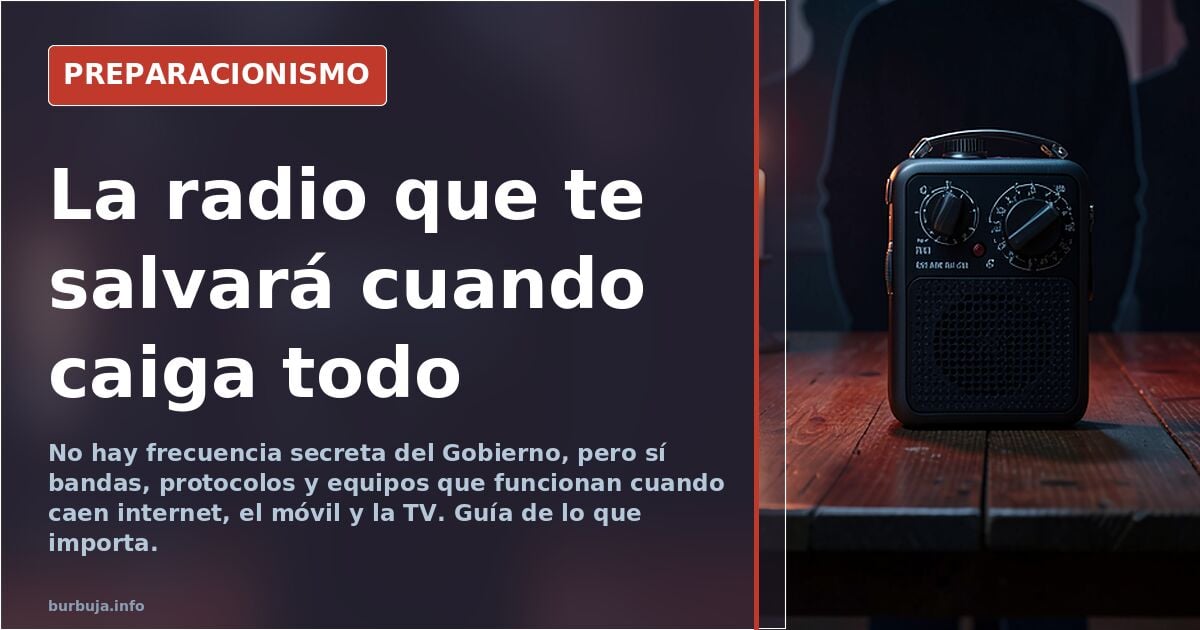
Which frequencies to save on your battery radio when the internet goes down
The first uncomfortable truth about emergency radio is that no secret government frequency exists to alert you. What does exist are specific bands, protocols, and devices that function when mobile data, fiber, and television fail; having these noted can miccionan hours of critical information. Start with a hand-crank or battery-powered radio, then expand from traditional AM bands to amateur radio messaging networks built with affordable gear.
Many ask if an official warning station exists. There is no public confirmation that a specific chain—often speculated to be RNE's Radio 2 on medium wave—is the government emergency channel. However, Civil Protection REMER frequencies are open for listening, though many fall outside amateur radio bands, limiting access for standard hobbyist equipment.
Why shortwave reaches where cell phones cannot
Physics dictates that longer wavelengths require more power and larger antennas, while high frequencies allow portable devices. For non-amateurs, the best strategy is receiving, not transmitting. A cheap multiband receiver picks up international shortwave stations, helping assess whether a blackout is local or global.
Citizen bands and mountain channels offer license-free proximity networks. PMR Channel 7.7 is popular for hiking, yet rarely used due to lack of walkie-talkies. Alternatively, mesh networking apps via Bluetooth connect small groups locally but cannot transmit distress signals over long distances.
The myth of the smartphone as an emergency transmitter
Phones have strict power limits (approx. 2W in GSM), dropping to milliwatts near towers. Without coverage, they are useless. Proposals to use phones as APRS nodes face technical hurdles: network core identifiers, server requirements, and poor antenna gain. Peer-to-peer message hopping remains theoretical.
Digital amateur radio offers real ecosystems. JS8Call enables short messages via weak HF signals, while Meshtastic uses 433 MHz devices for low-cost mesh networks. Covering a town reliably requires multiple Meshtastic nodes, whereas two DMR radios suffice. Cost and coverage calculations reveal significant differences.
Essential hardware when networks fail
Preparedness differs from curiosity through hardware: a portable comms receiver, HF rig with auto-tuner, and decent antenna. Proper tuning is crucial; overusing tuners damages equipment. Logistically, gather family early during disasters, as distance becomes dangerous without working phones.
In intermediate scenarios—prolonged outages or digital surveillance—radio shifts from hobby to personal infrastructure. Most will tune car radios aimlessly, while prepared individuals will have frequencies noted and crank handles ready.
Also available in: Deutsch
Summary of a discussion on Burbuja.info - Foro de economía, actualidad y política., translated from Spanish and reviewed before publication. Read the full discussion (67 replies).
More summaries
-
Tecsun PL-660 Review: A 138-Euro Radio for Shortwave and Air Band
The Tecsun PL-660 covers air, shortwave, AM, and FM bands for about 138 euros. It suffers from electrical noise and cannot transmit without a license.
-
Power outage: Spain, Portugal, and France face blackouts with emergency kits
A massive blackout across Spain, Portugal, and France triggered emergency preparations: water jugs, 700-euro generators, and battery radios.
-
DIY emergency light: 9W and a power bank for 12 euros
A 12V LED bulb, a 2-euro boost converter and a power bank: 12 euros for a 900-lumen emergency light, with runtime that a…
-
Turning a phone into an emergency or TEOTWAWKI device
A rugged phone with a microSD card can hold offline maps, the full Wikipedia via Kiwix (around 40 GB) and first aid manuals. Here's what to load onto it.
-
Kubotans and tactical pens: legality in Spain
Spain's Weapons Regulation does not explicitly mention kubotans. Possession of a tactical pen depends on police discretion and intended use.
-
Heat pumps lose efficiency in cold weather, users report
Forum users report heat pump performance drops below 5°C, suggesting alternatives like €20 electric blankets or wood.