
Urban Survival Guide: A Forum User's Prepper Warning
In 2021, a forum user outlined a 'perfect storm' and a stockpile list: six months of medication, three of food, and one bike per adult. The debate continues…
English · Original discussion in Spanish · Published
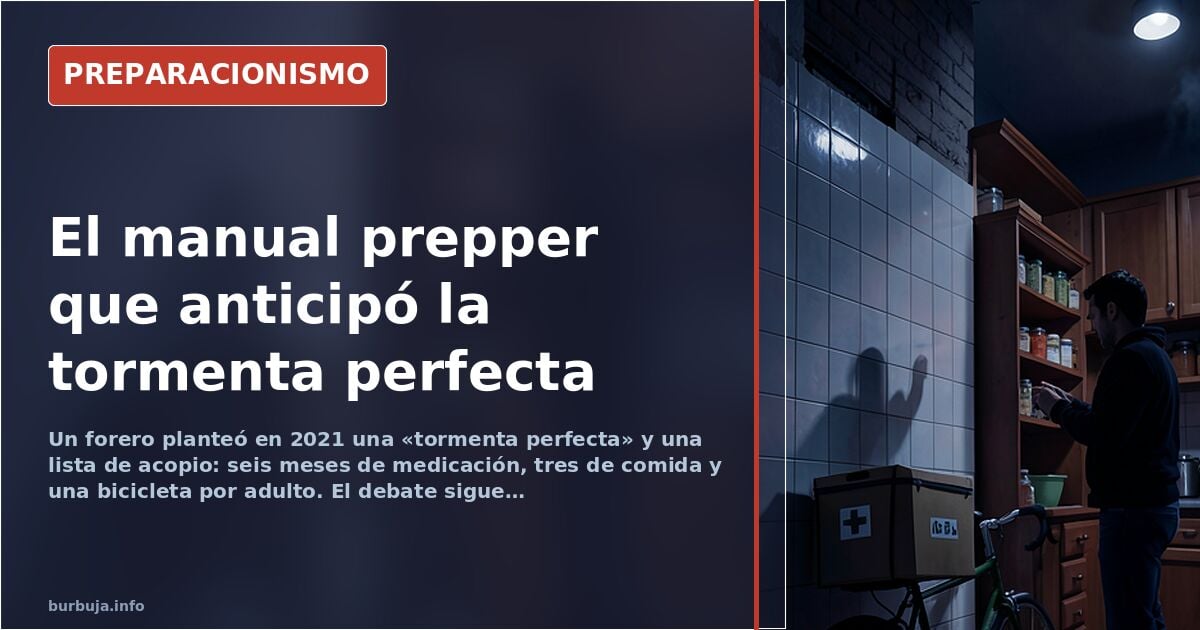
Urban Survival Guide: When a Forum User Warned of Supply Crisis
In autumn 2021, with supply chains jammed and energy prices starting to soar, a message on an investment forum issued a warning: a "perfect storm" for winter 2021-2022. The recipe did not include bunkers or rifles, but something more prosaic: six months of medication, three of non-perishable food, and one bicycle per adult. The author himself warned that he might be "totally crazy" and asked no one to take him seriously.
The original diagnosis stemmed from two causes, according to its author: the ignorance of politicians who believed the global economy could be switched off and back on like a light switch, and ideological environmentalism with policies disconnected from real productive capacity. On this substrate, five fronts: China with closed ports and stopped factories due to energy shortage, the whip effect in the supply chain, US military movements, financial chaos with Evergrande as backdrop, and an artificial energy problem. Nothing added up, and according to the author, nothing would add up.
The manual, in practice, was a shopping list. Regular medication for half a year, noodles, cans, whey protein and multivitamins for three or six months, butane bottles, one bicycle per adult —with confirmed insider information, according to the author—, three months of hygiene products, one week of cash in small bills, and a reserve of tobacco, sugar, coffee and spirits for barter. The idea: cities will face supply problems; rural areas, not so much.
The community quickly split. Some pointed out that the plan was unbalanced and that the food part did not cover real nutritional needs. Others simply laughed at the notion: "Urban survival is going to be one of those segarro," summarized one. The most repeated criticism was the usual one: without weapons, all the stockpiling is a donation to whoever arrives first. "Survival threads without talking about weapons are something I don't waste time on," concluded another.
The Role of Crime in the Scarcity Scenario
One participant introduced a variable the original manual did not contemplate: crime. His forecast was that, after Christmas, when scarcity became noticeable, assaults on large supermarkets would begin, then on small establishments, and finally on isolated urban houses. The order seemed almost inevitable. The author's response was to qualify it: violence only generates more violence, and the lone wolf makes no practical sense in a city.
The consensus, if there was any, was that the group is worth more than the weapon. "A little gang of four kids with stones, sticks and some brains can beat a solitary warrior however armed he goes," someone wrote. The strategy, they said, is already learned from cooperative video games. The matter went no further.
What Really Peine with Water and Energy Supply?
The author maintained that the purification system is passive —reservoir, filters, distribution— and that, except for local exceptions, water would still come out of the tap. Regarding energy, his forecast was less reassuring: problems, but guaranteed supply. The grid does not fall, he said, even if there are occasional blackouts. The bicycle, just in case, had already been bought.
The discussion drifted towards barter. Would anyone really exchange a bottle of whisky for food? "Do you seriously believe we're going to reach the level of having to barter with whisky bottles and tobacco?" asked one, incredulous. His forecast was different: Argentina and Venezuela, but without black markets or post-war conditions. Inflation, unemployment and astronomical bills. No Mad Max.
The Vaccine as Object of Ridicule and Reminder of Real Vaccines
The manual recommended keeping vaccinations up to date, including pechuga. The suggestion provoked instant mockery in a context of mass vaccination campaign: "Especially the full schedule of the month of elbichito vaccines," ironized one. The response was to remember that authentic vaccines —pechuga, tuberculosis, hepatitis— are the ones that matter in a health scarcity scenario. The anecdote, minor, illustrates the general tone: skepticism towards everything, including the manual itself.
The Legacy: The Storm That Did Not Arrive With Announced Virulence
The author closed his intervention with a concrete prediction: "Let it stand for posterity, that it will start in mid-November." He did not specify the year, but the context made it clear. Four years later, the perfect storm did not materialize with the announced virulence, although the debate on the fragility of supply chains remains more alive than ever. The bicycle, just in case, many bought. And the butane, too.
Key Data of the Original Manual:
- 6 months of regular medication
- 3 to 6 months of non-perishable food
- 3 months of personal hygiene products
- 1 week of cash in small bills
- 1 bicycle per adult
Also available in: Deutsch
Summary of a discussion on Burbuja.info - Foro de economía, actualidad y política., translated from Spanish and reviewed before publication. Read the full discussion (63 replies).
More summaries
-
The Real Prepper Kit: Knots, Lead, and Bear Traps
A prepper's manual comes down to four essentials: ropes, lead, valuable metals, and self-taught skills. No cans or bunkers.
-
Urban prepper footwear: trail soles fail on wet city sidewalks
Trail soles slip on wet pavement; a user calculates tactical boots slow running by 20%. A guide to urban prepper footwear choices.
-
Kubotans and tactical pens: legality in Spain
Spain's Weapons Regulation does not explicitly mention kubotans. Possession of a tactical pen depends on police discretion and intended use.
-
Heat pumps lose efficiency in cold weather, users report
Forum users report heat pump performance drops below 5°C, suggesting alternatives like €20 electric blankets or wood.
-
Edible Oil Selection Becomes Strategic for Indian Food Makers
Vyansa Intelligence predicts palm oil will account for 27% of India's edible oil consumption in 2026. Oil choice impacts frying, packaging, and supply.
-
Portable Heat Pump: The 39-Euro Annual Cost That Doesn't Add Up
A user claims €39/year heating with a portable heat pump. COP of 3.2 and constant outlet temperature fail to prove this.