
Portable heat pump: 62 euros a year, one forum user claims
A user says a second-hand portable unit bought for 130 euros heats his home for six months at 62 euros a year. The calculation and its limits, in detail.
English · Original discussion in Spanish · Published
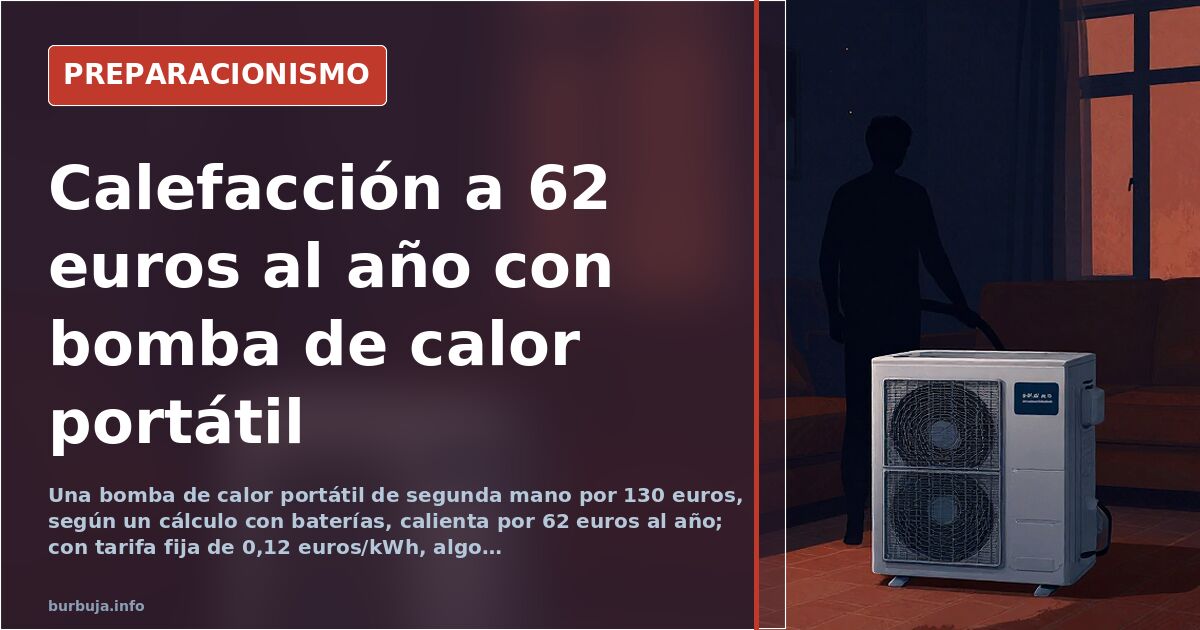
Heating for 62 euros a year: the case for the portable heat pump
A participant in the debate says an air conditioner with heat pump, bought second-hand for 130 euros, heats his home for six months at eight hours a day for 62 euros a year. The calculation is his own, he tested it with 17 °C outside, and he defends it with a deduction: if the compressor is inside the house, the cold outside matters far less. The figure stings. And it raises an uncomfortable question for anyone who looks at their gas bill with resignation.
The starting point is a familiar complaint: heat pumps "don't work" when the thermometer drops below 5 °C. The answer offered in the discussion is to distinguish between two machines that get confused under the same name. One has the compressor in the outdoor unit and suffers in the cold. The other is portable, with the compressor inside the home, and draws heat from the indoor air, which is always warmer than the air outside. In theory, according to that reasoning, performance shouldn't collapse.
The pending test in Madrid
The author of the calculation admits the proof is only half done. With 17 °C outside, the unit performs "beautifully"; at 7 °C, the air still comes out just as hot, at 55 °C. The serious exam is still missing: the nights near freezing in Madrid, which haven't arrived yet. The deduction is logical, but the empirical evidence doesn't fully back it up yet.
Scepticism soon appears. One person has a 2008 unit and finds that below 7-8 °C "it really struggles to heat", with a hot head and cold feet, because the unit was designed for summer. Others argue the technology has changed: today's inverter splits are rated down to -15 °C and cold-climate models down to -25 °C. In Norway or Sweden they are the main heating system. The nuance is that the COP drops: from 4-5 at 10 °C outside to 2-2.5 at -7 °C, with defrost cycles that show up as noticeable pauses.
The hole in the wall and the noise of the portable unit
The practical objection is blunt: running the exhaust tube requires a 15-centimetre hole in a triple-glazed argon window. Many aren't willing. And the noise, though mitigated with anti-vibration pads so as not to disturb the downstairs neighbour, is still there. Thermodynamics doesn't forgive either: a single-tube portable unit pushes air outside, depressurises the room and draws in outdoor air, which lowers performance both in cooling and heating.
Alternatives that come up in the conversation
A butane heater heats with gusto, but there's fine print: a 12.5 kg bottle delivers about 160 kWh and works out at 0.10-0.11 €/kWh, similar to an electric radiator on a standard tariff. What's more, burning butane produces water, around 1.5 litres per kilo, nearly 20 litres per bottle that end up in the air. Kerosene heats fast and the portable pump keeps it going. And for anyone after the bare minimum, some suggest an electric pad against the body at 100 W as the most efficient heating by far.
The hurricane lamp with kerosene, torch oil or diesel gives 100-300 W of heat and dimmable light. The warning is serious: an open flame indoors produces carbon monoxide, which has no smell and can't be seen. Using it as a lamp during a power cut is one thing; using it as heating in a sealed room is how every year's poisonings happen.
The bill nobody wants to look at
The owner of a rural house with several apartments admitted being "terrified": every hour of heating cost him 2 euros per apartment. At those prices, the season is unviable. Hence the interest in ways to cut costs without building work or installation.
The key to the 62-euro calculation lies in the price of the kilowatt hour: 0.066 euros with his own batteries across the 24 hours, according to its author. Without batteries, a fixed tariff of 0.12 €/kWh would push the bill to just over 130 euros a year, always according to that same calculation. It's still a figure that shames any boiler. The question is whether the contraption really survives the winter.
Also available in: Deutsch
Summary of a discussion on Burbuja.info - Foro de economía, actualidad y política., translated from Spanish and reviewed before publication. Read the full discussion (93 replies).
More summaries
-
Next winter could be challenging: How to prepare
With high fuel prices and the risk of power cuts, emergency heating has become a priority. Butane, paraffin, or batteries: what to do...
-
Living at 11°C with €70 in Military Surplus Gear
Three military surplus items for €64 and a home at 11°C without heating. The debate on humidity, insulation, and temperature has lasted over a thousand days...
-
Spanish prepper Javier Azurmendi updates his index and defends saving with batteries
Javier Azurmendi publishes his prepping index with over one hundred entries and defends saving 100 euros a month with batteries
-
The prepper who says he's ready to kill: 'as soon as it's legal'
A debate on extreme prepping puts the spotlight on ethics: who would actually be willing to kill in a collapse, and who merely says they would?
-
Turning a phone into an emergency or TEOTWAWKI device
A rugged phone with a microSD card can hold offline maps, the full Wikipedia via Kiwix (around 40 GB) and first aid manuals. Here's what to load onto it.
-
Faraday cage for your phone: from tin foil to the microwave
Cases from €5.50 to €12, aluminium foil and old microwaves: what actually blocks a phone signal and what is just an emergency makeshift fix