
Faraday cage for your phone: from tin foil to the microwave
Cases from €5.50 to €12, aluminium foil and old microwaves: what actually blocks a phone signal and what is just an emergency makeshift fix
English · Original discussion in Spanish · Published
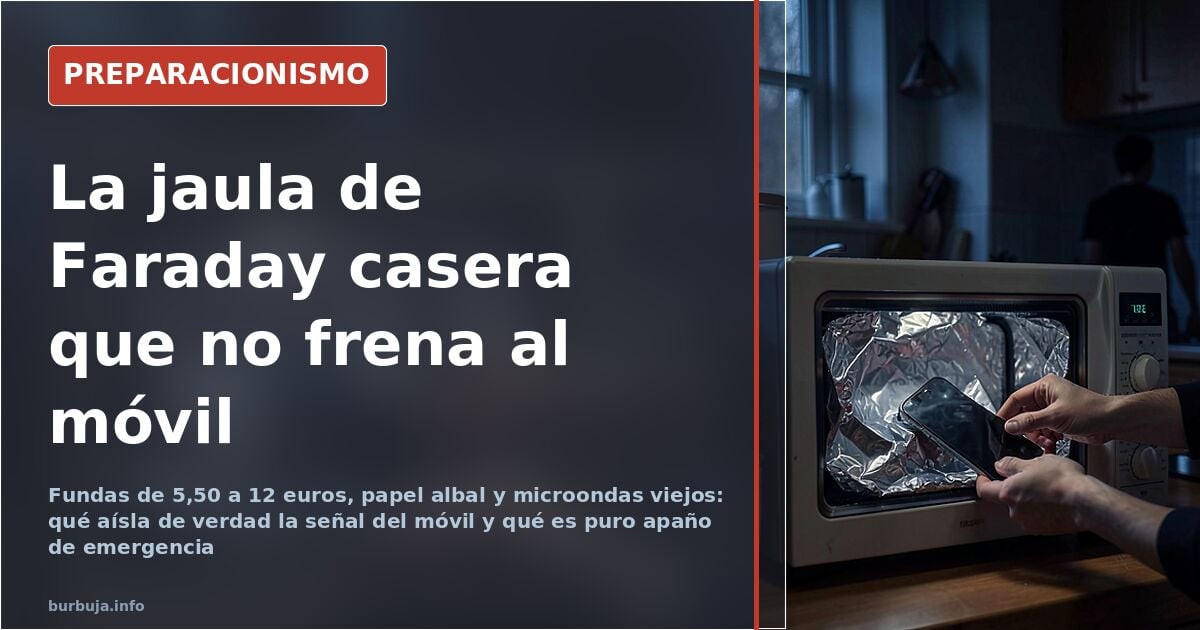
Faraday cage for your phone: from tin foil to the microwave
A metal box lined with aluminium foil. An old microwave, unplugged. Two overlapping crisp packets. The price of a case that genuinely shields your phone ranges from the €5.50 charged by an Asian seller to just over €12 on a major marketplace. The question that opens the topic is simple: do any of these contraptions actually cut the phone off completely, so nobody knows where it is?
The short answer is that almost none of them do. The long answer takes several pages of trial and error.
What a Faraday cage is and why not just any wrapping will do
The physics is well known: a closed conductor distributes charges across its surface and keeps the interior free of external electric fields. That is why cases, boxes and bags marketed as "anti-radiation" are sold. The problem is execution. A sheet of household aluminium foil has micro-perforations, creases and seams that let signal leak through. A crisp packet, with its metallic inner layer, works as an emergency makeshift fix for cards and car keys, not as a guarantee.
Some argue that an RF detector is the only reliable judge: you put the phone in, close the case and check whether the device is still transmitting. The incoming-call test is cruder, but it works. A phone inside a metal box receives no calls; its alarm, however, still rings. The difference between the two behaviours — the phone cannot see the network, but the speaker still hears its own timer — sums up why the shielding has to be total, not partial.
Can you just switch the phone off and skip the box?
Here the consensus breaks down. Switching the device off reduces power draw but does not eliminate it: the internal clock, sensors and certain data-collection processes stay active, and the battery drains all the same. On phones with non-removable batteries, switching off does not truly cut the power. The practical consequence is twofold: the phone runs out of charge, and on some models a swollen battery eventually warps the casing.
The counter-argument is pure logic: if the phone is going to be stored away and unused, why keep it operational? And if it is going to be used, the moment it powers on and searches for coverage it becomes trackable. The cage only buys time, not permanent anonymity.
The scenario that justifies the expense: electromagnetic pulse and network collapse
Beyond spying, there is one scenario that genuinely fits the gadget: an electromagnetic pulse, solar or man-made, that fries electronics. In that case, the box does not protect the signal — it protects the device. The stored phone survives as a pocket computer — photos, files, torch, games — even with no transmitters left to connect to.
The objection is reasonable: if the pulse is powerful enough to fry the phone in your pocket, getting it working again will hardly be the priority. And by then, the entire network will be down. Its usefulness boils down to one very specific scenario: storing the device before the event and retrieving it afterwards.
The detail almost nobody checks: the phone also transmits
Most cases are sold as a barrier against incoming signal. The problem is the outgoing kind. A stored phone keeps transmitting to locate itself, sync or report sensor data, and some multi-camera models act as scanners of their surroundings. The cage has to block both directions. Hence the practical recommendation: a double case — one inside the other — and, if possible, sealed.
Price guarantees nothing. A €5.50 case and a €12 one can fail just the same if the seam does not close. Testing with an RF detector before trusting the contraption is the only quality check available to the amateur.
In the end, the question that remains is the usual one: if the phone is going to be switched off and stored away, why does it need to stay operational? And if it is going to be used, what is the point of hiding it?
Also available in: Deutsch
Summary of a discussion on Burbuja.info - Foro de economía, actualidad y política., translated from Spanish and reviewed before publication. Read the full discussion (40 replies).
More summaries
-
Spanish prepper Javier Azurmendi updates his index and defends saving with batteries
Javier Azurmendi publishes his prepping index with over one hundred entries and defends saving 100 euros a month with batteries
-
The prepper who says he's ready to kill: 'as soon as it's legal'
A debate on extreme prepping puts the spotlight on ethics: who would actually be willing to kill in a collapse, and who merely says they would?
-
Turning a phone into an emergency or TEOTWAWKI device
A rugged phone with a microSD card can hold offline maps, the full Wikipedia via Kiwix (around 40 GB) and first aid manuals. Here's what to load onto it.
-
Survival backpack: why one liter of water isn't enough
One liter of water per person for 72 hours clashes with the 3.7 liters per day cited in the debate: what's missing and what's superfluous in a survival backpack.
-
Portable heat pump: 62 euros a year, one forum user claims
A user says a second-hand portable unit bought for 130 euros heats his home for six months at 62 euros a year. The calculation and its limits, in detail.
-
Estepona, Spain: the 'dangerous weapon' that can't pierce cardboard
The Estepona Local Police in Spain showcased a spring-powered dart launcher as a highly dangerous weapon. Those who have tried it say it can't even pierce cardboard and costs just a few euros.