
Poll measures votes and non-votes: abstention and the drift toward VOX in Spain
A voting-intention experiment puts a figure on the 76% who don't vote and on a trend approaching an absolute majority among those who do.
English · Original discussion in Spanish · Published
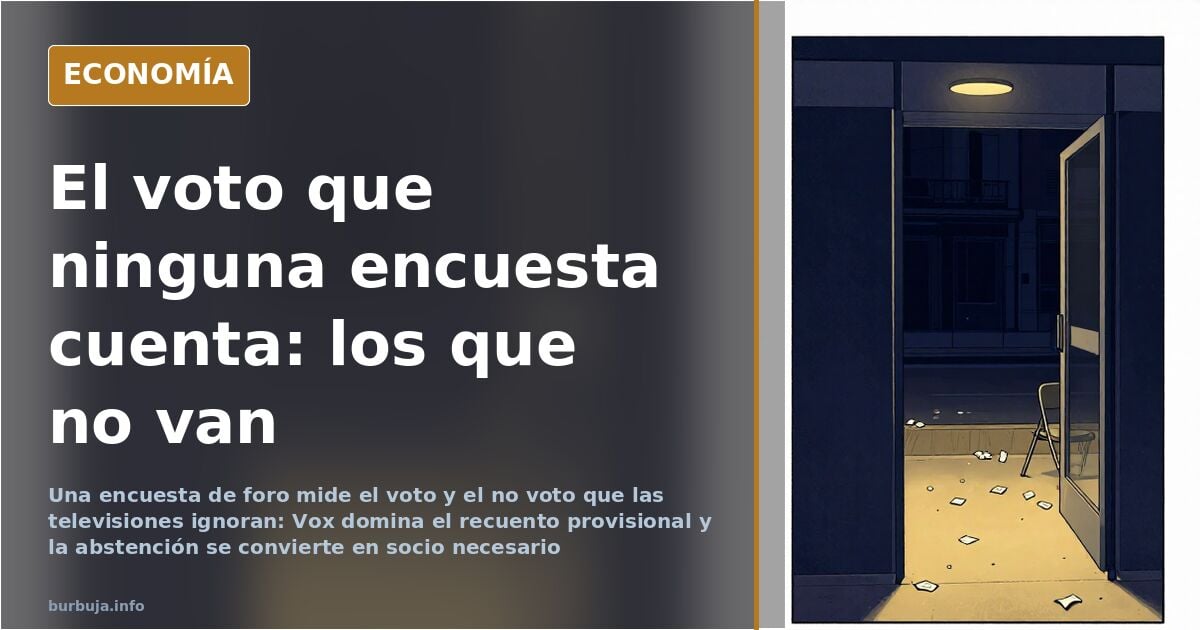
The poll that measures votes and non-votes nobody else counts
Electoral polls have a chronic blind spot: they don't know what to do with people who wouldn't set foot in a polling station even if you paid them. A voting-intention experiment, gradually extended across sections of a digital community, puts numbers on that silence, and the result is uncomfortable. In its first days, according to a calculation circulating in the thread, abstention soars to 76% if you add together those who will never vote and those who vote today but will abstain later. The most-voted option among those who do vote is VOX, with a trend approaching an absolute majority within the sample.
The mechanics are simple and somewhat tricky, like almost everything. A simplified menu is offered —far left, far right, PP, PSOE, VOX, abstention— and themed subforums are gradually added to see how the overall total shifts. The author warns that each new section will alter the percentages and that the thing is updated every 48 hours, "barring inconveniences" such as a mother-in-law's visit. Pure bar-stool scientific method, but with more honesty than many tracking polls.
The vote television doesn't contemplate
The central finding is not which party wins, but how many people fall outside the radar. Abstention, which no commercial poll treats as a political option, appears here as the leading bloc. Some defend it with arguments: if non-votes were distributed in proportion to the results, abstaining benefits the most-voted party. Hence the cross-accusation that abstentionists are "sanchismo's bootlickers" —put with the bluntness of the original— or, more elegantly, that with so many abstentionists Spain's two-party system never falls.
The most optimistic calculation holds that the abstentionist is better informed than the average voter, getting their news from non-subsidized media. The pessimistic scenario assumes the opposite: that abstention is laziness dressed up as principles. In between, one fact keeps recurring: in the last Latvian elections turnout was 52% and a bald car salesman got elected. The anecdote serves any purpose, depending on who tells it.
VOX and the borrowed vote
The dominant trend in the sample is VOX, and not out of pure conviction. Several posts attribute it to "hatred of sanxe the dog" rather than to a program anyone has read. The poll's own author admits that even he feels like voting VOX "until the feeling wears off," and recalls the episode of compulsory vaccination in the party's program, withdrawn weeks after being announced. That detail, he argues, cost VOX votes among the electorate critical of the health management.
The PP appears as an instrumental option: the only point in its favor anyone acknowledges is that Pedro Sánchez leaves the Moncloa. Nothing more. And the pure far right —Falange, Democracia Nacional— remains residual, with the complaint that the Falange voter has to place himself in the label the TV gives him.
The system is designed for two
Criticism of the two-party system runs through the whole conversation. The claim is that minor parties do no harm to the system because they end up aligning with one of the two big ones. And that the electoral system turns a vote for small parties into a vote flushed down the toilet, with provinces where they never scrape a seat. Against that, the proposal to vote for any minor party just so it gets counted and doesn't feed the two-party duopoly.
The analysis gets stuck right there at the end: if the institutional design guarantees a two-party rotation, why vote at all? And if you don't vote, who distributes the seats left orphaned? The poll doesn't solve it. It just counts it.
Also available in: Deutsch
Summary of a discussion on Burbuja.info - Foro de economía, actualidad y política., translated from Spanish and reviewed before publication. Read the full discussion (306 replies).
More summaries
-
Montero's Departure from Equality: 'Sánchez Expels Us from Government'
Irene Montero leaves the Equality Ministry, citing President Sánchez's allies and defending her tenure's work.
-
CIS poll: PSOE leads with 34%, Sumar hits historic low
October CIS survey shows PSOE at 34% and PP at 31.5%, while Sumar drops to a record low of 6.3% and Vox loses ground.
-
Spain: Rufián moves the goalposts — final conviction or nothing
Gabriel Rufián has shifted from demanding 'a case' to demanding 'a final conviction' before breaking with Spain's PSOE, effectively extending his ultimatum by a decade or more.
-
Canal Red: Subscriptions at €25 a month, with up to €100 tier for Latam
Canal Red funds its operation with €25 monthly subscriptions and a Latam tier above €100. A model supporting an entire staff.
-
Iberism returns to the debate: the merger that dissolves Spain
A poll published in the media claims that seven out of ten Portuguese support the union, but Iberism would mean dissolving Spain and Portugal into a…
-
Iberia: what if Spain and Portugal became a single state?
A debate raises the idea of a merger between Spain and Portugal: one user calculates an average unemployment rate of 12.6%, compared with Portugal's 6% and Spain's 14%.