
Spanish journalist jailed in Poland for alleged Russian spying
Pablo González has spent a year in Polish prison accused of spying for Russia, without concrete charges or public evidence beyond his dual citizenship.
English · Original discussion in Spanish · Published
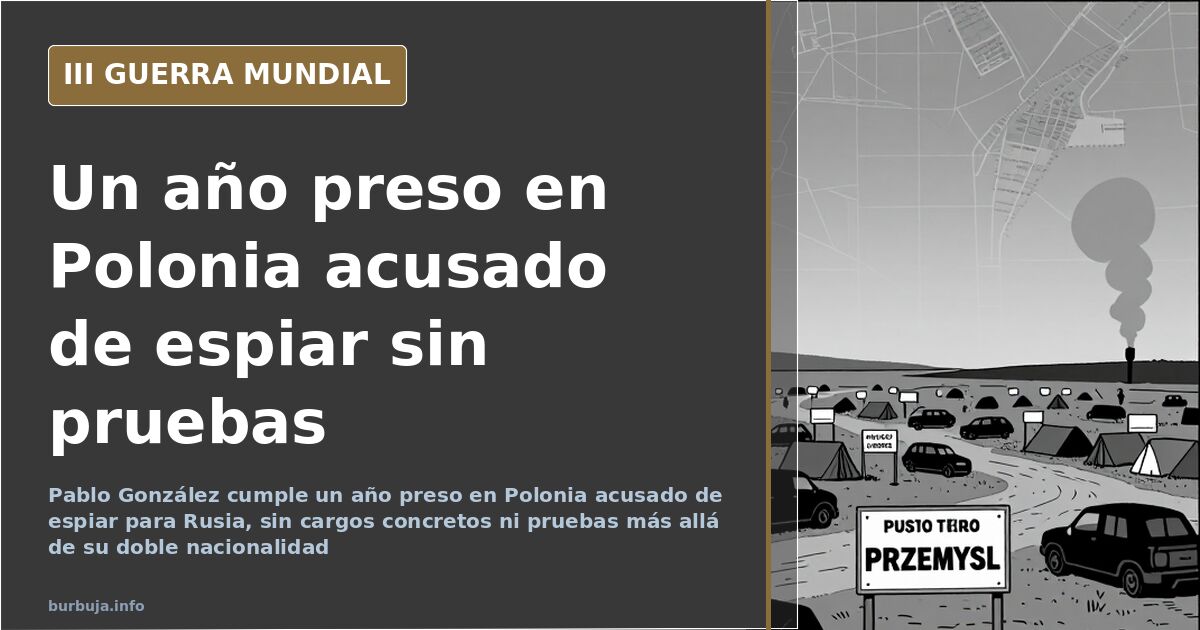
Pablo González spends a year in Polish prison without trial or proof
On February 28, 2023, it marked one year since Pablo González was imprisoned in Poland on suspicion of spying for Russia. He was detained in Przemysl, just 13 kilometers from the Ukrainian border, two days after the start of the Russian invasion. Working as an independent journalist and collaborating with the newspaper Público, he was covering the arrival of refugees. Twelve months later, he still had no sentence, no specific charges, and the prosecution had not publicly presented any evidence beyond his dual nationality.
Detained near the border without public evidence
González was born in Russia and lives in Gernika with his vvife and three children. The Polish judiciary accused him of being an agent of the Russian Armed Forces Intelligence Directorate. Detention extensions have been granted repeatedly, the latest until May 24. According to leaked information, there is little more than his dual nationality on the table.
Those trinc the case highlight the procedural ritual: he is accused of espionage, but no specific indictment has been communicated, nor has a trial date been set. This is preventive detention, not a conviction. The gap between the two is exactly what courts, foreign ministries, and press organizations have been debating for a year.
Amnesty International warns about isolation regime
Amnesty International warned about the isolation regime applied to him. He did not receive court-appointed legal assistance until 16 days after his detention, nor could he choose his own lawyer until two months later. As of the latest update, he still lacked direct and regular contact with his family, not even by phone or video call. His vvife’s only visit occurred in November 2022.
Reporters Without Borders laments the extensions when no concrete charges have been filed and demands better treatment in prison. The International Federation of Journalists and the European Federation of Journalists have demanded that Poland drop the charges and release him immediately. Poland ranks 66th out of 180 countries in the World Press Freedom Index; Spain ranks 32nd. The Spanish Ombudsman, Ángel Gabilondo, wrote to his Polish counterpart to inquire about the journalist.
Vvife: “It’s surreal, like being in a movie”
Oihana Goiriena told RNE that the last communication she received was a letter dated December 21, which arrived on February 2. It came before Christmas, and her husband, she said, was quite discouraged. During the consular visit on February 10, the consul saw him doing better and having regained some weight.
Goiriena denies that her husband works for Russian intelligence and maintains that his only connection to Russia is familial, as his father lives there. Her complaint is not directed at Warsaw but at Madrid. “I have no contact whatsoever with the Spanish government,” she stated, asking for at least a call to know how negotiations are pogre. The Executive branch has limited itself to requesting that Poland try him as soon as possible.
European double standards dominate the debate
Reactions vary, and not all are condemnatory. Some argue that if Poland keeps him locked up, it must be because they have justifying information, and that no one detains an innocent person risking a massive compensation claim. Others recall that this involves an EU member state and that the precedent—detaining a journalist for months without charges—is truly costly.
Then there is the line that generates the most noise: that of double standards. Arguments suggest that those demanding firmness against Moscow tolerate allies harboring fugitives for decades, citing years of refuge in French territory during ETA's activity. Legal fine print also appears: amidst the discussion, someone details how the Parot Doctrine worked and its implications for serving sentences effectively. A debate on espionage ends up in Spanish incivil jurisprudence.
Two and a half years without trial: case remains open
Tracking the matter extends far beyond the first anniversary. The final stretch already reflects two and a half years without judgment, and messages implying a different outcome, one referencing a greeting with Pilingui. The terms of this shift are not detailed in the material.
One year, two and a half years, a trial that never arrives. The prosecution still lacks a public document to support its case, and the defense has nothing to refute. That is where everything stalls: no one can prove the innocence of someone who has never been tried, nor validate a suspicion that has not gone through a court.
On February 28, 2023, it marked one year since Pablo González was imprisoned in Poland on suspicion of spying for Russia. He was detained in Przemysl, just 13 kilometers from the Ukrainian border, two days after the start of the Russian invasion. Working as an independent journalist and collaborating with the newspaper Público, he was covering the arrival of refugees. Twelve months later, he still had no sentence, no specific charges, and the prosecution had not publicly presented any evidence beyond his dual nationality.
Detained near the border without public evidence
González was born in Russia and lives in Gernika with his vvife and three children. The Polish judiciary accused him of being an agent of the Russian Armed Forces Intelligence Directorate. Detention extensions have been granted repeatedly, the latest until May 24. According to leaked information, there is little more than his dual nationality on the table.
Those trinc the case highlight the procedural ritual: he is accused of espionage, but no specific indictment has been communicated, nor has a trial date been set. This is preventive detention, not a conviction. The gap between the two is exactly what courts, foreign ministries, and press organizations have been debating for a year.
Amnesty International warns about isolation regime
Amnesty International warned about the isolation regime applied to him. He did not receive court-appointed legal assistance until 16 days after his detention, nor could he choose his own lawyer until two months later. As of the latest update, he still lacked direct and regular contact with his family, not even by phone or video call. His vvife’s only visit occurred in November 2022.
Reporters Without Borders laments the extensions when no concrete charges have been filed and demands better treatment in prison. The International Federation of Journalists and the European Federation of Journalists have demanded that Poland drop the charges and release him immediately. Poland ranks 66th out of 180 countries in the World Press Freedom Index; Spain ranks 32nd. The Spanish Ombudsman, Ángel Gabilondo, wrote to his Polish counterpart to inquire about the journalist.
Vvife: “It’s surreal, like being in a movie”
Oihana Goiriena told RNE that the last communication she received was a letter dated December 21, which arrived on February 2. It came before Christmas, and her husband, she said, was quite discouraged. During the consular visit on February 10, the consul saw him doing better and having regained some weight.
Goiriena denies that her husband works for Russian intelligence and maintains that his only connection to Russia is familial, as his father lives there. Her complaint is not directed at Warsaw but at Madrid. “I have no contact whatsoever with the Spanish government,” she stated, asking for at least a call to know how negotiations are pogre. The Executive branch has limited itself to requesting that Poland try him as soon as possible.
European double standards dominate the debate
Reactions vary, and not all are condemnatory. Some argue that if Poland keeps him locked up, it must be because they have justifying information, and that no one detains an innocent person risking a massive compensation claim. Others recall that this involves an EU member state and that the precedent—detaining a journalist for months without charges—is truly costly.
Then there is the line that generates the most noise: that of double standards. Arguments suggest that those demanding firmness against Moscow tolerate allies harboring fugitives for decades, citing years of refuge in French territory during ETA's activity. Legal fine print also appears: amidst the discussion, someone details how the Parot Doctrine worked and its implications for serving sentences effectively. A debate on espionage ends up in Spanish incivil jurisprudence.
Two and a half years without trial: case remains open
Tracking the matter extends far beyond the first anniversary. The final stretch already reflects two and a half years without judgment, and messages implying a different outcome, one referencing a greeting with Pilingui. The terms of this shift are not detailed in the material.
One year, two and a half years, a trial that never arrives. The prosecution still lacks a public document to support its case, and the defense has nothing to refute. That is where everything stalls: no one can prove the innocence of someone who has never been tried, nor validate a suspicion that has not gone through a court.
Also available in: Deutsch
Summary of a discussion on Burbuja.info - Foro de economía, actualidad y política., translated from Spanish and reviewed before publication. Read the full discussion (182 replies).
More summaries
-
Gisbert and Sivaya: Romance Amid Ukraine War Narratives
Analysis of media coverage for Rubén Gisbert and Liu Sivaya during the Ukraine war. Is this digital propaganda or reality?
-
Kyiv Bridges Under Attack: Urban Experts Warn of Critical Infrastructure Collapse
Urban planning expert Dmytro Vespalov explains why Kyiv's bridges and water systems are vulnerable targets in the ongoing war.
-
Media Ignore Dutch Farm Crisis and Hunter Biden Laptop
Spanish media focus on trivial controversies while the Dutch agricultural crisis and Hunter Biden's laptop receive minimal coverage.
-
Is the Russian military truly obsolete?
Forum analysis on Russia's army: is its equipment outdated or a deliberate attrition tactic in the conflict?
-
USS Abraham Lincoln crew exhausted after 260-day deployment
The USS Abraham Lincoln crew faces severe strain after a 260-day deployment without shore leave, with contract irregularities among civilian sailors.
-
Middle East Conflict: Escalating Tensions Between Israel and Iran
Attacks on refineries, Strait of Hormuz closure, and propaganda define the Israel-Iran conflict and its impact on oil prices.