
Police Officer Killed Foiling Robbery: The Battle for Security
A 41-year-old police officer died trying to stop a pigeon theft, reigniting debate on street safety.
English · Original discussion in Spanish · Published
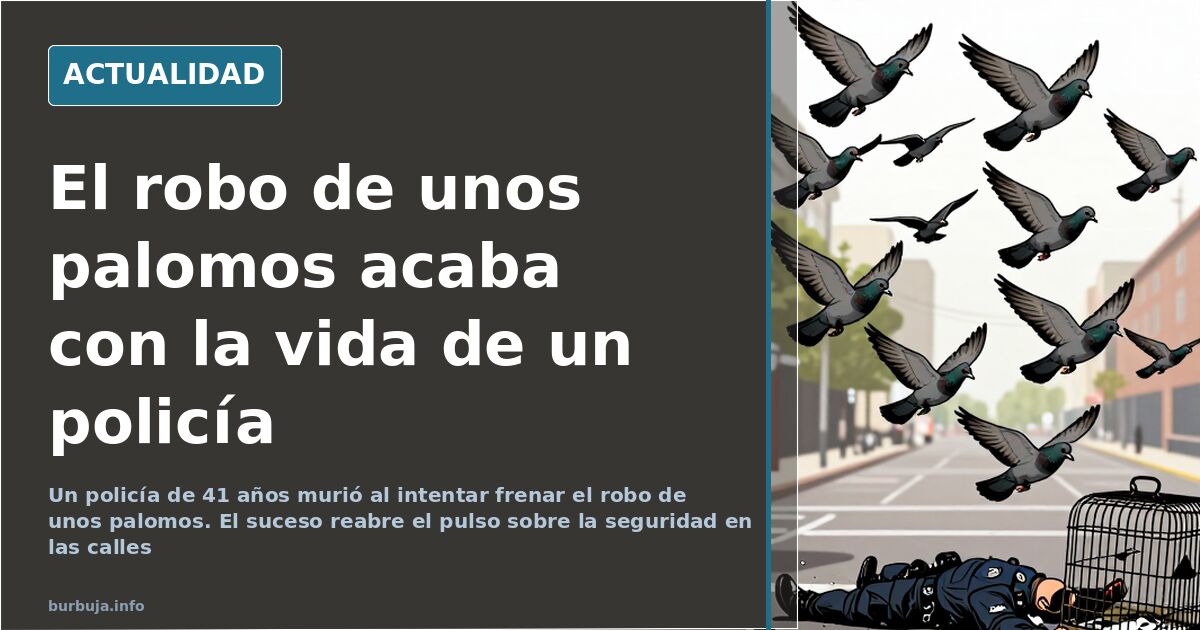
Police Officer Dies Foiling Pigeon Theft
A police officer, aged 41, went out to do what a police officer is supposed to do: stop a robbery. He had no plan, no backup, and no time to think. Two attackers —one a minor, the other an adult— struck him on the head, and the man died. The trigger was the theft of some racing pigeons, birds that fetch surprising prices in the pigeon fancying circuit for those who have never visited a dovecote. And hovering over the incident, an uncomfortable question: if the streets are as safe as reports repeatedly claim, what was a police officer doing facing two incivil alone over some birds?
It soon ceased to be an isolated incident and became something else: a clash with the official narrative.
What is known about the incident and why the detail about the pigeons matters
The robbery the officer tried to stop was not a bank heist. It was the theft of racing pigeons, a niche business where good specimens command high prices and are easily resold. Breeders know it, and those who don't have learned it these days: the good ones are worth a lot of money.
Alongside the condolences, an administrative detail that grates quickly appeared. The officer's profession is not recognized as high-risk, it is emphasized, even though the very nature of the job is to confront crime while others look away. The deceased was the one who stepped in. Others, several voices point out, would have feigned ignorance.
Are the streets safe? The contradiction no one resolves
The prevailing theory in much of the discussion is that in Spain it is becoming normalized to assault and kill police officers, and that this will end badly. It is argued without much nuance: first came tolerated aggressions, then attacks without response, now a death.
Against this stands the official discourse of safe streets, which justifies deployments and falling statistics. The clash is evident. If the streets are safe, the bonus agents receive on their paychecks —the so-called danger pay— is completely unjustified. And if they are not safe, then the narrative doesn't add up. It's the squaring of the circle that no one has solved.
Antiestéticar of the law: why an officer hesitates to shoot
A recurring argument places the problem not on the street, but in the courts. An officer who shoots risks a conviction for disproportionate use of force, imprisonment, and being unable to practice for years. The conclusion drawn: they antiestéticar judges and journalists more than incivil.
Not everyone buys it. Others argue that this narrative serves as a permanent excuse, that incivil law applies to everyone, and that those who demand the law of the jungle cannot then complain about how officers act. The discussion devolved into disquisitions on the requirements for self-defense, the home, and even what to do with an armed intruder inside. Treacherous territory, and neither side yielded.
Who writes the laws: the reproach that goes higher up
The next step was to point fingers at the legislator. The fundamental criticism: laws are approved by people who are not directly elected, chosen from closed lists, and then there is no mechanism for punishment when they do the opposite of what they promised. The repeated example is that of a mayor who promised during his campaign to dismantle low-emission zones and ended up expanding them to the maximum.
From this emerges an increasingly common idea: the problem is not the people who apply the law, but those who write it. And a warning thrown into the air: the day one of those legislators suffers at home what citizens suffer, the law will be changed in an afternoon.
From condolences to settling scores: the tone that changed
The start was one of condolence. Then it soured. One current holds that officers should learn their lesson the hard way, that those who curry favor with power end up paying for it, and that the deceased died defending a system that turns its back on them. Some even demand that the Police wake up and choose sides.
It is one current, not the only one. Opposing them are those who demand severe penalties for aggressors, defend the officer who intervened where he wasn't called, and emphasize that most of those who put themselves at risk are not responsible for the laws they enforce. The line between political criticism and contempt for those who can no longer defend themselves has been crossed several times.
The minor and the anticipated light punishment
One of the attackers was a minor. The most common prediction is that he will get off almost scot-free, and the reproach is directed at the juvenile incivil responsibility laws and those who designed them. There are no firm judicial sentences or conclusions, only the widespread feeling that the adult will pay and the minor will soon be back on the street.
On this shaky ground, another complaint arises: that the system protects the aggressor more than the victim, and that the officer who stands by does not gain anything either. The investigation is ongoing.
There is one number that cracks the official narrative without needing interpretation. On payroll, it is argued, officers receive a danger pay bonus. If the streets are safe, that supplement is unnecessary. And if they are not safe, we have been paying for years to uphold a fiction.
A police officer, aged 41, went out to do what a police officer is supposed to do: stop a robbery. He had no plan, no backup, and no time to think. Two attackers —one a minor, the other an adult— struck him on the head, and the man died. The trigger was the theft of some racing pigeons, birds that fetch surprising prices in the pigeon fancying circuit for those who have never visited a dovecote. And hovering over the incident, an uncomfortable question: if the streets are as safe as reports repeatedly claim, what was a police officer doing facing two incivil alone over some birds?
It soon ceased to be an isolated incident and became something else: a clash with the official narrative.
What is known about the incident and why the detail about the pigeons matters
The robbery the officer tried to stop was not a bank heist. It was the theft of racing pigeons, a niche business where good specimens command high prices and are easily resold. Breeders know it, and those who don't have learned it these days: the good ones are worth a lot of money.
Alongside the condolences, an administrative detail that grates quickly appeared. The officer's profession is not recognized as high-risk, it is emphasized, even though the very nature of the job is to confront crime while others look away. The deceased was the one who stepped in. Others, several voices point out, would have feigned ignorance.
Are the streets safe? The contradiction no one resolves
The prevailing theory in much of the discussion is that in Spain it is becoming normalized to assault and kill police officers, and that this will end badly. It is argued without much nuance: first came tolerated aggressions, then attacks without response, now a death.
Against this stands the official discourse of safe streets, which justifies deployments and falling statistics. The clash is evident. If the streets are safe, the bonus agents receive on their paychecks —the so-called danger pay— is completely unjustified. And if they are not safe, then the narrative doesn't add up. It's the squaring of the circle that no one has solved.
Antiestéticar of the law: why an officer hesitates to shoot
A recurring argument places the problem not on the street, but in the courts. An officer who shoots risks a conviction for disproportionate use of force, imprisonment, and being unable to practice for years. The conclusion drawn: they antiestéticar judges and journalists more than incivil.
Not everyone buys it. Others argue that this narrative serves as a permanent excuse, that incivil law applies to everyone, and that those who demand the law of the jungle cannot then complain about how officers act. The discussion devolved into disquisitions on the requirements for self-defense, the home, and even what to do with an armed intruder inside. Treacherous territory, and neither side yielded.
Who writes the laws: the reproach that goes higher up
The next step was to point fingers at the legislator. The fundamental criticism: laws are approved by people who are not directly elected, chosen from closed lists, and then there is no mechanism for punishment when they do the opposite of what they promised. The repeated example is that of a mayor who promised during his campaign to dismantle low-emission zones and ended up expanding them to the maximum.
From this emerges an increasingly common idea: the problem is not the people who apply the law, but those who write it. And a warning thrown into the air: the day one of those legislators suffers at home what citizens suffer, the law will be changed in an afternoon.
From condolences to settling scores: the tone that changed
The start was one of condolence. Then it soured. One current holds that officers should learn their lesson the hard way, that those who curry favor with power end up paying for it, and that the deceased died defending a system that turns its back on them. Some even demand that the Police wake up and choose sides.
It is one current, not the only one. Opposing them are those who demand severe penalties for aggressors, defend the officer who intervened where he wasn't called, and emphasize that most of those who put themselves at risk are not responsible for the laws they enforce. The line between political criticism and contempt for those who can no longer defend themselves has been crossed several times.
The minor and the anticipated light punishment
One of the attackers was a minor. The most common prediction is that he will get off almost scot-free, and the reproach is directed at the juvenile incivil responsibility laws and those who designed them. There are no firm judicial sentences or conclusions, only the widespread feeling that the adult will pay and the minor will soon be back on the street.
On this shaky ground, another complaint arises: that the system protects the aggressor more than the victim, and that the officer who stands by does not gain anything either. The investigation is ongoing.
There is one number that cracks the official narrative without needing interpretation. On payroll, it is argued, officers receive a danger pay bonus. If the streets are safe, that supplement is unnecessary. And if they are not safe, we have been paying for years to uphold a fiction.
Summary of a discussion on Burbuja.info - Foro de economía, actualidad y política., translated from Spanish and reviewed before publication. Read the full discussion (236 replies).
More summaries
-
Guardia Civil: Deaths in Service and the End of OCON Sur
OCON-Sur disappeared in 2022, and the Guardia Civil has suffered casualties in Barbate, Jerez, Huelva, and Almería.
-
Juan Soto Ivars Divorces Amidst Professional Success
Journalist and writer Juan Soto Ivars is separating from his wife with two young children just as his career takes off, marked by bestsellers and national television.
-
Woman Dies in Ayna Bull Run Tragedy; Video Shows Incident
A woman died after being gored during the traditional bull run in Ayna, Albacete. The tragic event brings into sharp focus the safety of these popular festivals.
-
Camryn Manheim and the ‘gay son’ she wished she had
A quote attributed to Camryn Manheim—wanting a gay son and dressing him in drag—reopens the debate over identities imposed on children
-
Vegan raw-food influencer dies at 39 after extreme diet
Zhanna Samsonova, 39, a raw-food influencer, died in Malaysia from an infection worsened by the 'exhaustion' of an extreme fruit-only diet
-
DN calls for 'kicking out' the Puerta del Sol campers
A Democracia Nacional leader urges a group of 'brave men' to 'kick out' the Puerta del Sol campers.