
Guardia Civil: Deaths in Service and the End of OCON Sur
OCON-Sur disappeared in 2022, and the Guardia Civil has suffered casualties in Barbate, Jerez, Huelva, and Almería.
English · Original discussion in Spanish · Published
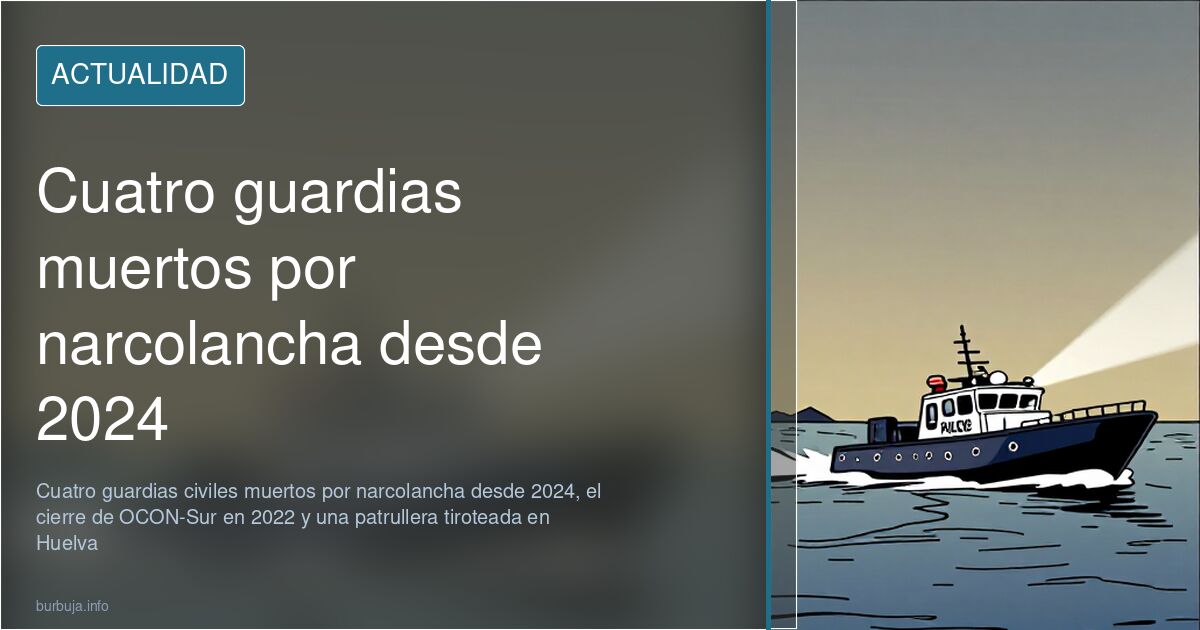
Four years after OCON Sur dissolved, the Guardia Civil continues to register agent deaths
The events of May 8, 2026, saw two Guardia Civil officers killed at an intersection while attempting to intercept a drug run. This is not the first time, and that fact resonates deeply. In February 2024, two agents died and four were injured after being hit by another drug boat in the port of Barbate (Cádiz). In June 2025, a vehicle violently collided with the car of two officers on the N-IV road near Jerez de la Frontera, resulting in one fatality and one serious injury. The sequence continues to unfold: on August 22, 2026, ten people were arrested after firing upon a patrol car in Huelva, and just days earlier, two agents sustained injuries in Almería after being struck by another fast vessel in the Alborán Sea.
What OCON-Sur was and why it dissolved in 2022
A significant body of accounts regarding this series of unfortunate events points to a single entity: OCON-Sur, the elite anti-narcotics unit. According to circulating information, its operational phase concluded in 2022 "as part of an internal reorganization of the Guardia Civil’s anti-narcotics operations," while Marlaska was leading the Ministry of Interior. Despite its utility, the unit disappeared in 2022, and its closure remains subject to various interpretations.
Pieces have been published concerning this disbandment, addressing false accusations, toxic informants, and the role played by Internal Affairs and the judiciary in its dismantling. The full breakdown of that internal operation—who pushed for it, with what report, and why—is material that cannot be contained in four lines and should be read entirely before forming conclusions.
Officers killed in service, from Barbate to Huelva
The record of recent years presents an uncomfortable pattern: collisions involving official vessels and vehicles have resulted in deaths in Barbate (2024), on the N-IV near Jerez (2025), and along the coast of Huelva (2026). This adds to the serious injuries and gunfire attacks against patrol cars.
Some maintain that the withdrawal of the elite unit paved the way for these types of attacks. Others point to issues regarding resources and instructions: less interception capability, more space for the traficante.
The temporal coincidence between the 2022 dissolution and the increase in incidents is a recurring detail in these analyses, although no one has proven a direct link.
From Plan ZEN to Plan ZES: what is being demanded now
The debate draws parallels with Plan ZEN, the operational framework used against ETA in its time. What is now being called for, using terms circulating in the discussion, is a 'Plan ZES': the same type of framework applied to drug trafficking. The phrase encapsulates the frustration expressed in the debate—the feeling that the traficante is being fought with fewer resources than those dedicated to other threats.
The analysis reaches a standstill here. Whether the problem was a unit that closed down, a change in doctrine, or simple political negligence, no one has backed it up with documentation. And meanwhile, the thread of incidents continues to add names to the casualty list.
The events of May 8, 2026, saw two Guardia Civil officers killed at an intersection while attempting to intercept a drug run. This is not the first time, and that fact resonates deeply. In February 2024, two agents died and four were injured after being hit by another drug boat in the port of Barbate (Cádiz). In June 2025, a vehicle violently collided with the car of two officers on the N-IV road near Jerez de la Frontera, resulting in one fatality and one serious injury. The sequence continues to unfold: on August 22, 2026, ten people were arrested after firing upon a patrol car in Huelva, and just days earlier, two agents sustained injuries in Almería after being struck by another fast vessel in the Alborán Sea.
What OCON-Sur was and why it dissolved in 2022
A significant body of accounts regarding this series of unfortunate events points to a single entity: OCON-Sur, the elite anti-narcotics unit. According to circulating information, its operational phase concluded in 2022 "as part of an internal reorganization of the Guardia Civil’s anti-narcotics operations," while Marlaska was leading the Ministry of Interior. Despite its utility, the unit disappeared in 2022, and its closure remains subject to various interpretations.
Pieces have been published concerning this disbandment, addressing false accusations, toxic informants, and the role played by Internal Affairs and the judiciary in its dismantling. The full breakdown of that internal operation—who pushed for it, with what report, and why—is material that cannot be contained in four lines and should be read entirely before forming conclusions.
Officers killed in service, from Barbate to Huelva
The record of recent years presents an uncomfortable pattern: collisions involving official vessels and vehicles have resulted in deaths in Barbate (2024), on the N-IV near Jerez (2025), and along the coast of Huelva (2026). This adds to the serious injuries and gunfire attacks against patrol cars.
Some maintain that the withdrawal of the elite unit paved the way for these types of attacks. Others point to issues regarding resources and instructions: less interception capability, more space for the traficante.
The temporal coincidence between the 2022 dissolution and the increase in incidents is a recurring detail in these analyses, although no one has proven a direct link.
From Plan ZEN to Plan ZES: what is being demanded now
The debate draws parallels with Plan ZEN, the operational framework used against ETA in its time. What is now being called for, using terms circulating in the discussion, is a 'Plan ZES': the same type of framework applied to drug trafficking. The phrase encapsulates the frustration expressed in the debate—the feeling that the traficante is being fought with fewer resources than those dedicated to other threats.
The analysis reaches a standstill here. Whether the problem was a unit that closed down, a change in doctrine, or simple political negligence, no one has backed it up with documentation. And meanwhile, the thread of incidents continues to add names to the casualty list.
Summary of a discussion on Burbuja.info - Foro de economía, actualidad y política., translated from Spanish and reviewed before publication. Read the full discussion (15 replies).
More summaries
-
Camryn Manheim and the ‘gay son’ she wished she had
A quote attributed to Camryn Manheim—wanting a gay son and dressing him in drag—reopens the debate over identities imposed on children
-
Vegan raw-food influencer dies at 39 after extreme diet
Zhanna Samsonova, 39, a raw-food influencer, died in Malaysia from an infection worsened by the 'exhaustion' of an extreme fruit-only diet
-
DN calls for 'kicking out' the Puerta del Sol campers
A Democracia Nacional leader urges a group of 'brave men' to 'kick out' the Puerta del Sol campers.
-
Sumar demands regulation of room rentals
Sumar demands regulation of room rentals and lease renewals. An investor warns that property maths no longer add up.
-
Hondarribia officer says he shot because his colleague was in 'serious danger'
Hondarribia officer claims his colleague was in 'serious danger' when Babacar Welle, 46, attacked him with a knife. The Ertzaintza is investigating.
-
Chini Chuini set to become Jewish
Ynet reports that Sydney Sweeney has reportedly converted to Judaism and was seen at a synagogue with Scooter Braun. She has not confirmed it.