
Police helicopter deployed to arrest three in Paiporta
A police helicopter landed in Paiporta to detain three residents following incidents involving the Spanish Prime Minister's car, sparking debate.
English · Original discussion in Spanish · Published
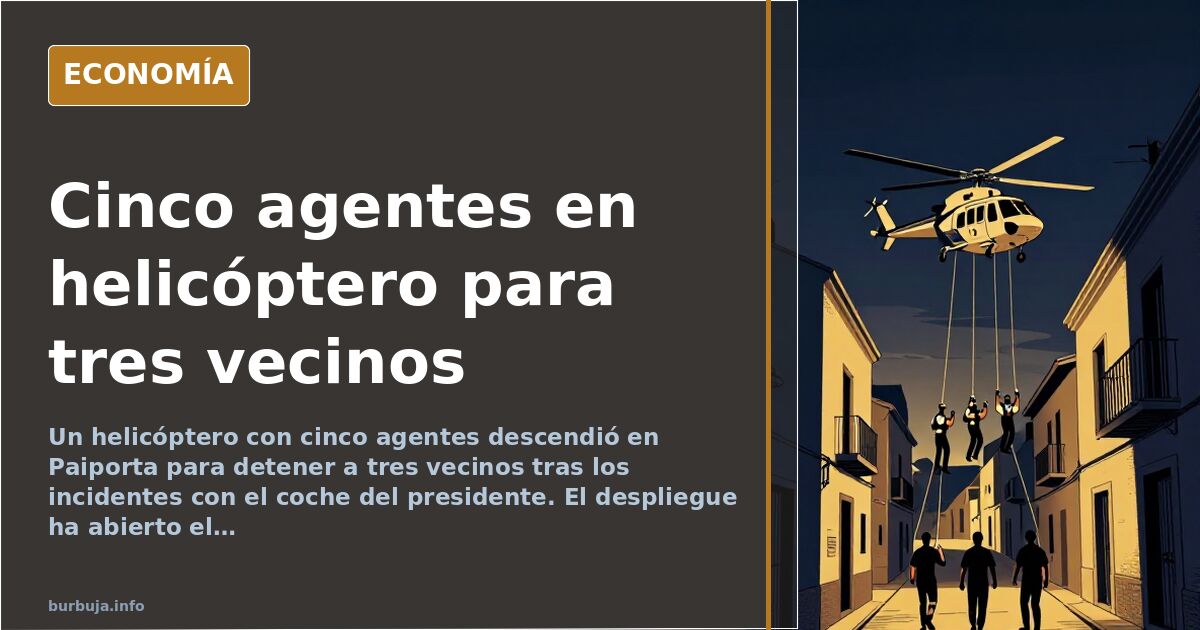
Police helicopter deployed to arrest three in Paiporta
The police operation in Paiporta to arrest three residents after incidents involving the Spanish Prime Minister’s car has cracked the official narrative. The scene—a helicopter with five officers landing to detain three people—has been interpreted as a deterrent message. Also as disproportionate. This comes after a disaster that left the town with unresolved personal and material losses, and the comparison between resources used and alleged crimes is what has ignited the debate.
What peine in Paiporta and why three were arrested
The facts under discussion are specific: after incidents recorded during the visit of the Spanish Prime Minister to Paiporta, a helicopter with five officers descended to arrest three residents. The debate does not deny that there were incidents. What is questioned is the proportionality between the device deployed and the number of people detained.
Some argue that the operation sought an exemplary effect. Against this weighs the argument that the same unit is used to raid armed drug trafficking boats, as recalled in the conversation. That comparison—elite units for minor offenses—is what has raised alarms about the use of the state's monopoly on violence.
The context worsens the interpretation. Paiporta appears in the debate as a town that lost everything after the disaster, and those detained are described as neighbors who suffered personal and material losses. The distance between that situation and the aerial deployment is what turned the case into a symbol.
Internal unrest within the Guardia Civil
One of the least commented angles is the dissatisfaction within the armed institute itself. According to reports, the Guardia Civil would have expressed its discomfort at using a GEO-type device—designed to raid a frigate of heavily armed drug traffickers—to arrest three villagers.
The argument developed is that the problem is not just the order, but the chain of obedience. It is suggested that the involved agents should refuse to carry out unconstitutional orders rather than limit themselves to statements of discomfort. The comparison with the pandemic appears several times: much discomfort, much repulsion, but those involved do not say "we are not here for this."
That reading connects with a broader thesis: the police systematically obey orders they shouldn't, and the result is the use of the state's monopoly on violence against the people. The phrase summarizing that position is that the coercive apparatus is being used as in the worst dictatorships.
Fines, brooms and the pandemic precedent
The conversation recovers previous episodes to sustain that this is not the first time. Fines from the confinement era are cited where the account of events included sightings by helicopter: a person walking along an avenue, spotted by the Ertzaintza helicopter, which alerts the zone command post. In one case, the son-in-law informs that it is a dependent person whom the neurologist indicated should go out due to Alzheimer's. In another, the person walks accompanied by his father-in-law, also with Alzheimer's, and the neurologist had indicated going for a walk.
That material is used to argue that the pattern—helicopter, alert to command, fine—did not originate in Paiporta. The novelty is the object: now it is not a walk during confinement, but a brush with a stick on the President's car. The repeated phrase is that another day it won't be a brush with a stick.
The broom episode works as a condenser of all the discontent. The possibility that the Attorney General did not request precautionary measures from the anti-terror law against whoever carried the broom is mentioned, and irony is made about that omission. The comparison with the United States appears: whoever breaks the window of the US President's car with a broom is dead, then they will ask about the broom model.
Political response and the disaster framework
The discussion turns toward political responsibility. The phrase "if they want help, let them ask" is recalled and contrasted with the police deployment: if they want resources, let them ask, but they send a helicopter full of police to arrest the locals who sent the President away.
The disaster framework is inseparable from the case. Paiporta appears as the epicenter of the disaster, and the police action is read as a response to protest more than to the incidents. Some argue that they should be helping people and, instead, are arresting, harassing, fining, and messing around. The conclusion drawn is that if these people have to help with anything, better not count on them.
The international comparison serves to underline the disproportion. It is stated that in Knoxville, Tennessee, neighbors would not bring brooms but little toys to greet the President. The irony does not hide the core: the institutional response to neighborhood protest is perceived as collective punishment.
What the State plays with this operation
The issue transcends the specific case. What is put in question is the use of the coercive apparatus to manage discontent after a disaster. The gaining weight thesis is that the operation was not looking to arrest three people, but to send a message to all neighbors.
The problem, for that thesis, is that the message can be read backwards. If the State needs a helicopter and five officers for three neighbors who have lost everything, the image projected is not firmness, but antiestéticar. And antiestéticar, in politics, rarely functions as lasting deterrence.
The prediction with reservations is this: if the case goes to court and the arrests become exemplary convictions, the discontent will amplify. If, conversely, the arrests dissolve without consequences, the operation will remain as an excess without cost. In both scenarios, the question of who decides when to deploy an elite unit for a minor offense remains unanswered.
The police operation in Paiporta to arrest three residents after incidents involving the Spanish Prime Minister’s car has cracked the official narrative. The scene—a helicopter with five officers landing to detain three people—has been interpreted as a deterrent message. Also as disproportionate. This comes after a disaster that left the town with unresolved personal and material losses, and the comparison between resources used and alleged crimes is what has ignited the debate.
What peine in Paiporta and why three were arrested
The facts under discussion are specific: after incidents recorded during the visit of the Spanish Prime Minister to Paiporta, a helicopter with five officers descended to arrest three residents. The debate does not deny that there were incidents. What is questioned is the proportionality between the device deployed and the number of people detained.
Some argue that the operation sought an exemplary effect. Against this weighs the argument that the same unit is used to raid armed drug trafficking boats, as recalled in the conversation. That comparison—elite units for minor offenses—is what has raised alarms about the use of the state's monopoly on violence.
The context worsens the interpretation. Paiporta appears in the debate as a town that lost everything after the disaster, and those detained are described as neighbors who suffered personal and material losses. The distance between that situation and the aerial deployment is what turned the case into a symbol.
Internal unrest within the Guardia Civil
One of the least commented angles is the dissatisfaction within the armed institute itself. According to reports, the Guardia Civil would have expressed its discomfort at using a GEO-type device—designed to raid a frigate of heavily armed drug traffickers—to arrest three villagers.
The argument developed is that the problem is not just the order, but the chain of obedience. It is suggested that the involved agents should refuse to carry out unconstitutional orders rather than limit themselves to statements of discomfort. The comparison with the pandemic appears several times: much discomfort, much repulsion, but those involved do not say "we are not here for this."
That reading connects with a broader thesis: the police systematically obey orders they shouldn't, and the result is the use of the state's monopoly on violence against the people. The phrase summarizing that position is that the coercive apparatus is being used as in the worst dictatorships.
Fines, brooms and the pandemic precedent
The conversation recovers previous episodes to sustain that this is not the first time. Fines from the confinement era are cited where the account of events included sightings by helicopter: a person walking along an avenue, spotted by the Ertzaintza helicopter, which alerts the zone command post. In one case, the son-in-law informs that it is a dependent person whom the neurologist indicated should go out due to Alzheimer's. In another, the person walks accompanied by his father-in-law, also with Alzheimer's, and the neurologist had indicated going for a walk.
That material is used to argue that the pattern—helicopter, alert to command, fine—did not originate in Paiporta. The novelty is the object: now it is not a walk during confinement, but a brush with a stick on the President's car. The repeated phrase is that another day it won't be a brush with a stick.
The broom episode works as a condenser of all the discontent. The possibility that the Attorney General did not request precautionary measures from the anti-terror law against whoever carried the broom is mentioned, and irony is made about that omission. The comparison with the United States appears: whoever breaks the window of the US President's car with a broom is dead, then they will ask about the broom model.
Political response and the disaster framework
The discussion turns toward political responsibility. The phrase "if they want help, let them ask" is recalled and contrasted with the police deployment: if they want resources, let them ask, but they send a helicopter full of police to arrest the locals who sent the President away.
The disaster framework is inseparable from the case. Paiporta appears as the epicenter of the disaster, and the police action is read as a response to protest more than to the incidents. Some argue that they should be helping people and, instead, are arresting, harassing, fining, and messing around. The conclusion drawn is that if these people have to help with anything, better not count on them.
The international comparison serves to underline the disproportion. It is stated that in Knoxville, Tennessee, neighbors would not bring brooms but little toys to greet the President. The irony does not hide the core: the institutional response to neighborhood protest is perceived as collective punishment.
What the State plays with this operation
The issue transcends the specific case. What is put in question is the use of the coercive apparatus to manage discontent after a disaster. The gaining weight thesis is that the operation was not looking to arrest three people, but to send a message to all neighbors.
The problem, for that thesis, is that the message can be read backwards. If the State needs a helicopter and five officers for three neighbors who have lost everything, the image projected is not firmness, but antiestéticar. And antiestéticar, in politics, rarely functions as lasting deterrence.
The prediction with reservations is this: if the case goes to court and the arrests become exemplary convictions, the discontent will amplify. If, conversely, the arrests dissolve without consequences, the operation will remain as an excess without cost. In both scenarios, the question of who decides when to deploy an elite unit for a minor offense remains unanswered.
Also available in: Deutsch
Summary of a discussion on Burbuja.info - Foro de economía, actualidad y política., translated from Spanish and reviewed before publication. Read the full discussion (127 replies).
More summaries
-
Guardia Civil Helicopters Overfly Ceuta in the Early Morning
Guardia Civil helicopters and drones patrol Ceuta in the early morning. Flight tracking suggests a deployment without an official statement.
-
Spain hits record cocaine seizures amid Guardia Civil fleet crisis
Spain has recorded a historic high of over 100 tonnes of cocaine seized, while 40% of the Guardia Civil's patrol boats remain out of service.
-
Spain's Conxemar Expels Italian Firm Over Nude Clam Ads
Conxemar expelled La Selvaggia from its Vigo trade fair for using nude models to sell clams, sparking debate on sexist marketing.
-
Yellow Rain in Spain: Pollen, Dust or Conspiracy?
Yellow residue on cars in Spain is likely pine pollen or Saharan dust. No lab tests support conspiracy theories about chemical spraying.
-
University degrees no longer guarantee independence in Spain
Qualified workers struggle to live independently in Spain, facing €2,000 salaries against €1,200 rents and unbalanced responsibilities.
-
Spanish breakfast sparks online debate on sugar and health
A Spanish forum post about a protein-rich breakfast triggers heated arguments over added sugars, animal fats, and national identity.