
Fines of up to 200,000 euros for photographing capercaillies
Two photographers face fines ranging from 3,000 to 200,000 euros for capturing images of capercaillies during breeding season without authorization in Spain.
English · Original discussion in Spanish · Published
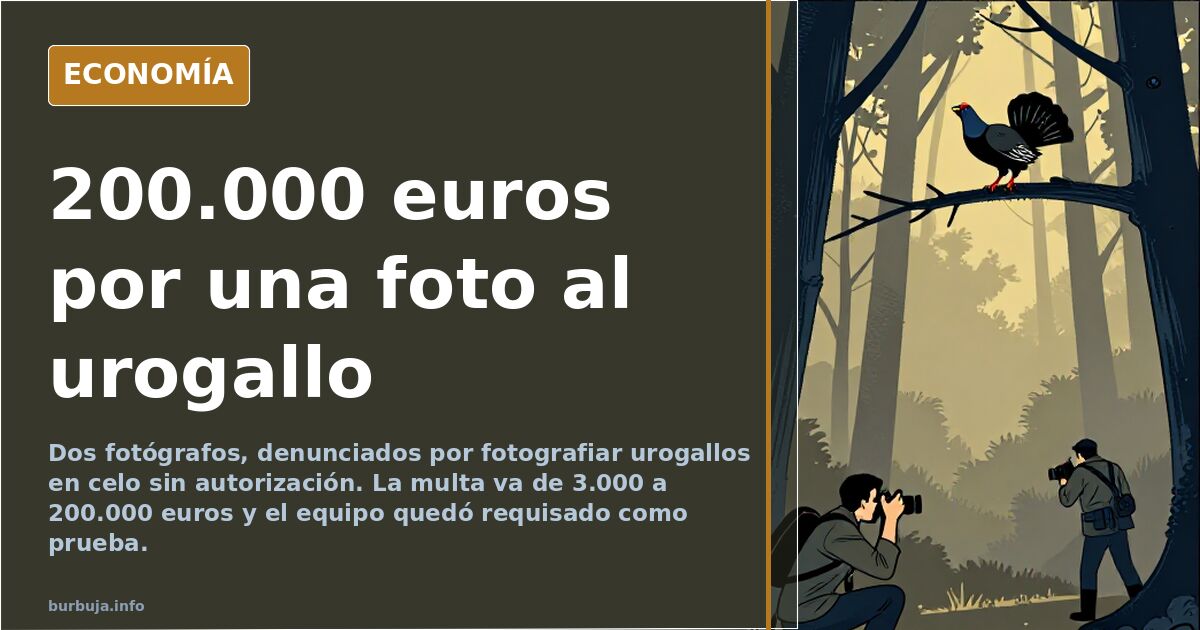
Photographing a capercaillie in mating season: fine up to 200,000 euros
Two photographers have been reported in Lleida’s Pyrenees for pointing their cameras—not their shotguns—at a common capercaillie during its breeding season without authorization. The penalty starts at 3,000 euros and can reach 200,000. Their equipment was seized as evidence. One defendant had previously been identified for sharing images of the same species online. The unsettling detail: no harm or touch is required; mere presence suffices.
What exactly are they charged with?
According to the Rural Agents of the Generalitat (Catalan environmental police), the incidents occurred in two locations in the Alt Pirineu. The first, near Aigüestortes and Estany de Sant Maurici National Park in Esterri d’Àneu: one person was caught camping camouflaged with photographic gear. The second, in Alins, within the Alt Pirineu Natural Park, where the defendant had previously been identified for professionally photographing and sharing capercaillie images online. The first case also revealed images of other threatened Pyrenean species.
The operation was conducted by the Grup Especial de Verins i Antifurtivisme (Special Group for Wildlife and Anti-Poaching), which monitors capercaillies year-round, intensifying efforts during breeding and winter seasons. The official charge cites «photographic activities in a zone and breeding season without authorization».
Is it a crime to photograph wildlife?
Yes, if done without permission in designated zones and seasons. The Rural Agents explain that breeding-season activity abusa Spain’s Biodiversity Protection Law. Explicit authorization is required to photograph or film wild species in certain areas, a requirement dating back to a 1992 law and reaffirmed in the 2007 biodiversity regulation. The law’s existence is undisputed; debate centers on whether a complex web of state, regional, and municipal laws made it impossible for amateur photographers to know they were breaking the law. Some suggest cordoning off and signage instead of relying solely on fines.
The capercaillie: 700 birds and a subspecies that isn’t recovering
SEO Birdlife estimates Spain’s capercaillie population at 700 individuals: 292 in the Cantabrian population and 404 in the Pyrenean population. The Cantabrian subspecies is classified as critically endangered, with 292 birds counted in 2019. To contextualize rarity: outside Spain, boreal forests in Europe and Siberia house between 5 and 10 million individuals. What Spain protects with forensic zeal is common fauna elsewhere.
This fuels an argument unsettling to conservationists: some claim capercaillies were never abundant in Spain because the habitat is unsuitable—like polar bears in Seville—and centuries of isolation led to an evolutionary dead end. The counterargument is that precisely because of this, they must be protected fiercely, and human disturbance is a documented cause of habitat loss. This debate also suggests capercaillies are more complex to manage than goats, and Spain has already suffered extinctions like the Pyrenean ibex.
Why females are only receptive for two or three days
The administration’s technical explanation is almost ethological: capercaillies are extremely sensitive to human presence, and detecting a person can trigger immediate zone abandonment and interrupt essential behaviors like singing. This song sustains mating. Females are only receptive for two or three days, so disruption within this window could ruin the season’s reproduction and reduce the species’ productivity.
Translating this reasoning into practice admits various consequences. Some argue that without protection, hundreds of hikers in camper vans with phones, cameras, and dogs would flood the area after seeing it online. Others counter that five hundred tourists won’t gather to prevent two capercaillies from mating, and extinction would occur regardless of photographic objectives.
From capercaillies to Castellón’s donkeys
The conversation quickly shifts to political management. The Castellón case is cited, where donkeys were released to clear scrub and prevent wildfires: they died of hunger, thirst, and disease. Also, wild boar overpopulation, which spiraled out of control, leading authorities to beg hunters to conduct culls at their own expense. The recurring pattern: decision-making criteria, unmonitored initiatives, and a gap between what is fiercely protected and what is abandoned.
The fine, the equipment, and the uncomfortable question
The penalty range is 3,000 to 200,000 euros. With a 50% early-payment discount, the floor might be 1,500 euros, a figure some compare to the cost of the seized equipment: some lenses are worth more. One defendant was a repeat offender. The collateral effect looming over the issue: a six-figure fine ruins anyone permanently, with no room to recover.
Meanwhile, the recurring comparison is uncomfortable: illegal housing occupation is free, while a critically endangered bird is worth, on paper, more than a family. The law protects what it protects, and the capercaillie is lucky to be on the right side of the balance. The open question isn’t whether the bird deserves protection, but whether the only available tool is the checkbook.
Two photographers have been reported in Lleida’s Pyrenees for pointing their cameras—not their shotguns—at a common capercaillie during its breeding season without authorization. The penalty starts at 3,000 euros and can reach 200,000. Their equipment was seized as evidence. One defendant had previously been identified for sharing images of the same species online. The unsettling detail: no harm or touch is required; mere presence suffices.
What exactly are they charged with?
According to the Rural Agents of the Generalitat (Catalan environmental police), the incidents occurred in two locations in the Alt Pirineu. The first, near Aigüestortes and Estany de Sant Maurici National Park in Esterri d’Àneu: one person was caught camping camouflaged with photographic gear. The second, in Alins, within the Alt Pirineu Natural Park, where the defendant had previously been identified for professionally photographing and sharing capercaillie images online. The first case also revealed images of other threatened Pyrenean species.
The operation was conducted by the Grup Especial de Verins i Antifurtivisme (Special Group for Wildlife and Anti-Poaching), which monitors capercaillies year-round, intensifying efforts during breeding and winter seasons. The official charge cites «photographic activities in a zone and breeding season without authorization».
Is it a crime to photograph wildlife?
Yes, if done without permission in designated zones and seasons. The Rural Agents explain that breeding-season activity abusa Spain’s Biodiversity Protection Law. Explicit authorization is required to photograph or film wild species in certain areas, a requirement dating back to a 1992 law and reaffirmed in the 2007 biodiversity regulation. The law’s existence is undisputed; debate centers on whether a complex web of state, regional, and municipal laws made it impossible for amateur photographers to know they were breaking the law. Some suggest cordoning off and signage instead of relying solely on fines.
The capercaillie: 700 birds and a subspecies that isn’t recovering
SEO Birdlife estimates Spain’s capercaillie population at 700 individuals: 292 in the Cantabrian population and 404 in the Pyrenean population. The Cantabrian subspecies is classified as critically endangered, with 292 birds counted in 2019. To contextualize rarity: outside Spain, boreal forests in Europe and Siberia house between 5 and 10 million individuals. What Spain protects with forensic zeal is common fauna elsewhere.
This fuels an argument unsettling to conservationists: some claim capercaillies were never abundant in Spain because the habitat is unsuitable—like polar bears in Seville—and centuries of isolation led to an evolutionary dead end. The counterargument is that precisely because of this, they must be protected fiercely, and human disturbance is a documented cause of habitat loss. This debate also suggests capercaillies are more complex to manage than goats, and Spain has already suffered extinctions like the Pyrenean ibex.
Why females are only receptive for two or three days
The administration’s technical explanation is almost ethological: capercaillies are extremely sensitive to human presence, and detecting a person can trigger immediate zone abandonment and interrupt essential behaviors like singing. This song sustains mating. Females are only receptive for two or three days, so disruption within this window could ruin the season’s reproduction and reduce the species’ productivity.
Translating this reasoning into practice admits various consequences. Some argue that without protection, hundreds of hikers in camper vans with phones, cameras, and dogs would flood the area after seeing it online. Others counter that five hundred tourists won’t gather to prevent two capercaillies from mating, and extinction would occur regardless of photographic objectives.
From capercaillies to Castellón’s donkeys
The conversation quickly shifts to political management. The Castellón case is cited, where donkeys were released to clear scrub and prevent wildfires: they died of hunger, thirst, and disease. Also, wild boar overpopulation, which spiraled out of control, leading authorities to beg hunters to conduct culls at their own expense. The recurring pattern: decision-making criteria, unmonitored initiatives, and a gap between what is fiercely protected and what is abandoned.
The fine, the equipment, and the uncomfortable question
The penalty range is 3,000 to 200,000 euros. With a 50% early-payment discount, the floor might be 1,500 euros, a figure some compare to the cost of the seized equipment: some lenses are worth more. One defendant was a repeat offender. The collateral effect looming over the issue: a six-figure fine ruins anyone permanently, with no room to recover.
Meanwhile, the recurring comparison is uncomfortable: illegal housing occupation is free, while a critically endangered bird is worth, on paper, more than a family. The law protects what it protects, and the capercaillie is lucky to be on the right side of the balance. The open question isn’t whether the bird deserves protection, but whether the only available tool is the checkbook.
Summary of a discussion on Burbuja.info - Foro de economía, actualidad y política., translated from Spanish and reviewed before publication. Read the full discussion (214 replies).
More summaries
-
Three deaths in Moncayo: The price of Instagramer recklessness
Three mountaineers died in Spain's Moncayo after a fall and a failed rescue attempt. The debate focuses on recklessness and preparation in the mountains.
-
Leticia Sabater earns up to €5,000 per gig: the decline of Spain
Leticia Sabater, 59, earns up to €5,000 per gig. Her tacky, provocative show sparks debate on cultural decline and public money.
-
15-year car ownership costs 195 euros monthly, excluding fuel
A 17,500-euro car accumulates 35,150 euros over 15 years: 195 euros monthly without fuel and 240,000 km. Renting emerges as an alternative in the debate.
-
Hunting Dog Owner: €1,000 Monthly Cost and Two Staff
A keeper of ten hunting dogs spends over €1,000 monthly on care and employs two staff, yet admits he has never calculated the exact bill.
-
93.8% in Spain Poll Say They Do Not Feel Free
An open poll on freedom in Spain shows 93.8% negative responses, with only 6.2% feeling free, citing bureaucracy and taxes.
-
El Salvador Opens 24/7 Free Library Inaugurated by Bukele
El Salvador launches a 24-hour free public library funded by China, challenging traditional operating hours and sparking debate on maintenance and design.