
Poland Missile: Two Dead, Russian S-300 Blame Shifts to Ukraine
A missile kills two in Przewodów, Poland. NATO Article 4 activated as blame shifts from Russia to a Ukrainian S-300.
English · Original discussion in Spanish · Published
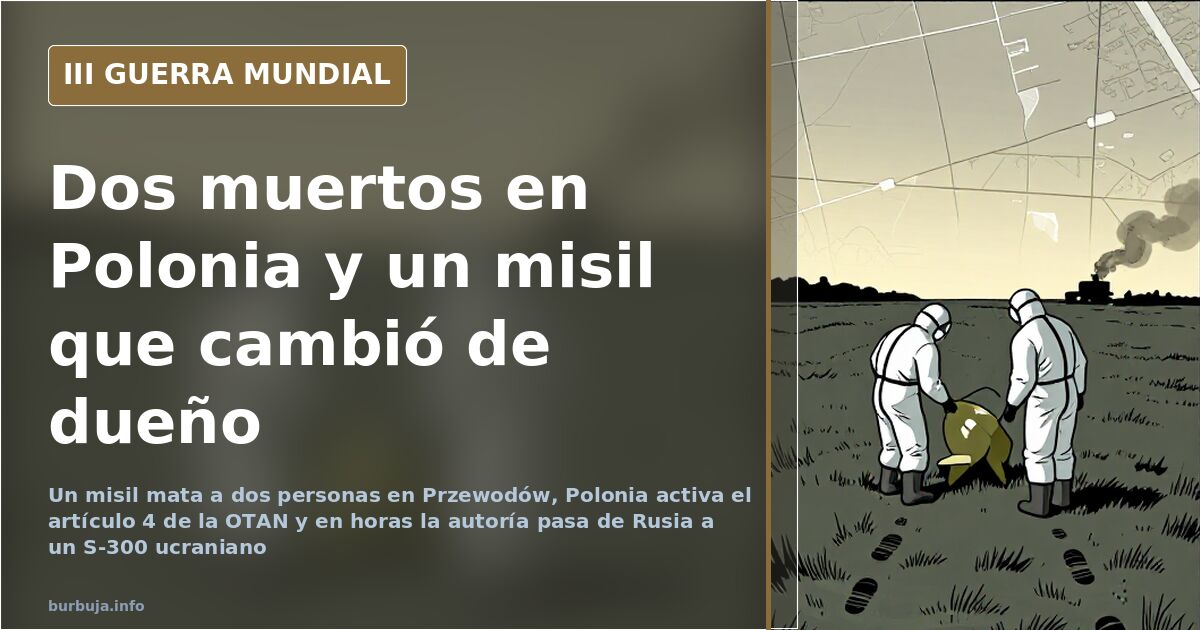
Two dead in Poland: From Russian missile to Ukrainian S-300
On the same day the world reached 8 billion inhabitants, a missile struck Przewodów, a Polish village near the Ukrainian border, killing two people. Poland urgently convened its National Security Council. In the first hours, the world believed it knew who pulled the trigger. It was wrong.
The incident occurred during the ninth month of the war in Ukraine, with peace talks underway. This cocktail—an open front, lukewarm negotiations, and a village close to the border—turned an impact into a diplomatic powder keg before anyone had measured the fragments.
What was known in the first hours of the Przewodów strike
The initial circulating version was forceful: several Russian missiles had killed two Poles in Przewodów, near the Ukrainian border. The coincidence was textbook. An air strike on western Ukraine, a deviating artifact landing across the border. Poland summoned the Russian ambassador for explanations and activated the NATO consultation mechanism.
The narrative held little ground. It was soon clarified that there was no confirmation and the incident could be a missile that missed its trajectory amid the campaign against Ukraine. Polish media spoke of an explosion and two deaths. Nothing more.
Here began the race to assign ownership before possessing the artifact. And that race was won, as almost always, by whoever was in a hurry to tell the ending.
The missile that changed owners: fragments of a Ukrainian S-300
The twist came via technical means. The debate held that fragments of a 48D6 engine from the 5B55 missile, part of the Ukrainian S-300P complex, were located. The prevailing interpretation was that an anti-aircraft projectile fired by Ukraine to intercept a Russian attack ended up falling in allied territory. Made in Russia, fired by Ukraine: the nuance changes everything.
The debate also recalled that Biden stated the missile was not fired by Russia, after the Pentagon admitted it could not corroborate it was Russian. In other words, the alliance's main power publicly deactivated the hypothesis that hours earlier several governments had considered good. With this gesture, the escalation was defused.
Some argue that Zelensky denied the Ukrainian origin to not give advantage to the Russian narrative. Against this weighs that, if it was an accident, acknowledging it was the cheapest option. The case is that ownership passed from Moscow to Kiev without anyone asking the new responsible party for explanations.
What activating NATO Article 4 means, and not Article 5
Poland did not reach Article 5, which states that an armed attack against one is an attack against all. It stopped at Article 4, concerning consultations when an ally sees its security threatened. The difference is not formal: one obliges sitting down to talk, the other opens the door to responding with military means.
The text of Article 5 circulated everywhere, with its fine print on individual or collective self-defense and necessary measures. But the button was never pressed. Those expecting to see the entire alliance entering the war were left wanting.
The ghost of Iraq's weapons of mass destruction
The comparison with Iraq's weapons of mass destruction appeared as soon as reports began to contradict each other. First, intelligence services point to a culprit, then the same government citing them admits it has nothing. It is an old and recognizable pattern.
Notable is the estimulante ilegal with which the shift from "Russian attack" to "diverted Ukrainian missile" occurred without anyone asking for accountability for the hours the strong version was on the table. Two dead people and a destroyed village remained in the background.
Why Poland is once again the epicenter of everything
Poland has centuries of being in the middle. Some remember that the country was divided among three empires and that its borders reached almost to Krakow. This background explains why any incident on its soil is read as the prologue to something greater.
The economic reading also entered: part of the analysis suggests that Warsaw was interested in its share of the Ukrainian pie and therefore it is not advisable to get entangled in a direct clash with Russia. The other half responds that dragging NATO to the table would be the worst possible business.
Two dead, a divided village, and an alliance breathing relieved for not having to choose. The missile now has a technical owner. What no one has fully explained is why, for a few hours, it suited almost everyone to believe otherwise.
On the same day the world reached 8 billion inhabitants, a missile struck Przewodów, a Polish village near the Ukrainian border, killing two people. Poland urgently convened its National Security Council. In the first hours, the world believed it knew who pulled the trigger. It was wrong.
The incident occurred during the ninth month of the war in Ukraine, with peace talks underway. This cocktail—an open front, lukewarm negotiations, and a village close to the border—turned an impact into a diplomatic powder keg before anyone had measured the fragments.
What was known in the first hours of the Przewodów strike
The initial circulating version was forceful: several Russian missiles had killed two Poles in Przewodów, near the Ukrainian border. The coincidence was textbook. An air strike on western Ukraine, a deviating artifact landing across the border. Poland summoned the Russian ambassador for explanations and activated the NATO consultation mechanism.
The narrative held little ground. It was soon clarified that there was no confirmation and the incident could be a missile that missed its trajectory amid the campaign against Ukraine. Polish media spoke of an explosion and two deaths. Nothing more.
Here began the race to assign ownership before possessing the artifact. And that race was won, as almost always, by whoever was in a hurry to tell the ending.
The missile that changed owners: fragments of a Ukrainian S-300
The twist came via technical means. The debate held that fragments of a 48D6 engine from the 5B55 missile, part of the Ukrainian S-300P complex, were located. The prevailing interpretation was that an anti-aircraft projectile fired by Ukraine to intercept a Russian attack ended up falling in allied territory. Made in Russia, fired by Ukraine: the nuance changes everything.
The debate also recalled that Biden stated the missile was not fired by Russia, after the Pentagon admitted it could not corroborate it was Russian. In other words, the alliance's main power publicly deactivated the hypothesis that hours earlier several governments had considered good. With this gesture, the escalation was defused.
Some argue that Zelensky denied the Ukrainian origin to not give advantage to the Russian narrative. Against this weighs that, if it was an accident, acknowledging it was the cheapest option. The case is that ownership passed from Moscow to Kiev without anyone asking the new responsible party for explanations.
What activating NATO Article 4 means, and not Article 5
Poland did not reach Article 5, which states that an armed attack against one is an attack against all. It stopped at Article 4, concerning consultations when an ally sees its security threatened. The difference is not formal: one obliges sitting down to talk, the other opens the door to responding with military means.
The text of Article 5 circulated everywhere, with its fine print on individual or collective self-defense and necessary measures. But the button was never pressed. Those expecting to see the entire alliance entering the war were left wanting.
The ghost of Iraq's weapons of mass destruction
The comparison with Iraq's weapons of mass destruction appeared as soon as reports began to contradict each other. First, intelligence services point to a culprit, then the same government citing them admits it has nothing. It is an old and recognizable pattern.
Notable is the estimulante ilegal with which the shift from "Russian attack" to "diverted Ukrainian missile" occurred without anyone asking for accountability for the hours the strong version was on the table. Two dead people and a destroyed village remained in the background.
Why Poland is once again the epicenter of everything
Poland has centuries of being in the middle. Some remember that the country was divided among three empires and that its borders reached almost to Krakow. This background explains why any incident on its soil is read as the prologue to something greater.
The economic reading also entered: part of the analysis suggests that Warsaw was interested in its share of the Ukrainian pie and therefore it is not advisable to get entangled in a direct clash with Russia. The other half responds that dragging NATO to the table would be the worst possible business.
Two dead, a divided village, and an alliance breathing relieved for not having to choose. The missile now has a technical owner. What no one has fully explained is why, for a few hours, it suited almost everyone to believe otherwise.
Summary of a discussion on Burbuja.info - Foro de economía, actualidad y política., translated from Spanish and reviewed before publication. Read the full discussion (227 replies).
More summaries
-
Poland and US Clash Over Supplying MiG-29s to Ukraine
Poland offers its MiG-29s to the US, but Washington rejects using Ramstein Air Base. The origin of each flight sparks debate over a casus belli.
-
Ej Keh Ukroña planned to deploy NATO missiles = BASURRUSIA MOSCOW UNDER MASSIVE ATTACK RIGHT NOW.....
Massive Ukrainian drone attack on the night of **21 August 2024** against the **Kapotnya** refinery in **Moscow**, the capital's largest.
-
Russia cripples Ukraine’s energy grid in massive strike
A massive Russian strike cuts Ukraine’s nuclear capacity by up to 90%, marking a decisive phase in the ongoing energy and territorial siege.
-
Debate on potential Russian blitzkrieg in Europe
Forum users debate if Russia could launch a surprise nuclear attack on Europe, while others argue its Ukraine struggles and NATO deterrence make it impossible.
-
Russia bombards Ukraine's energy grid in nightly strikes
Ukraine struck Russian air bases with drones. Moscow retaliated with night bombardments on energy infrastructure, leaving thousands without power.
-
Retired NATO sergeant predicts World War III
NATO has no sergeants. We examine the claim of an imminent world war and the data behind it.