
Retired NATO sergeant predicts World War III
NATO has no sergeants. We examine the claim of an imminent world war and the data behind it.
English · Original discussion in Spanish · Published
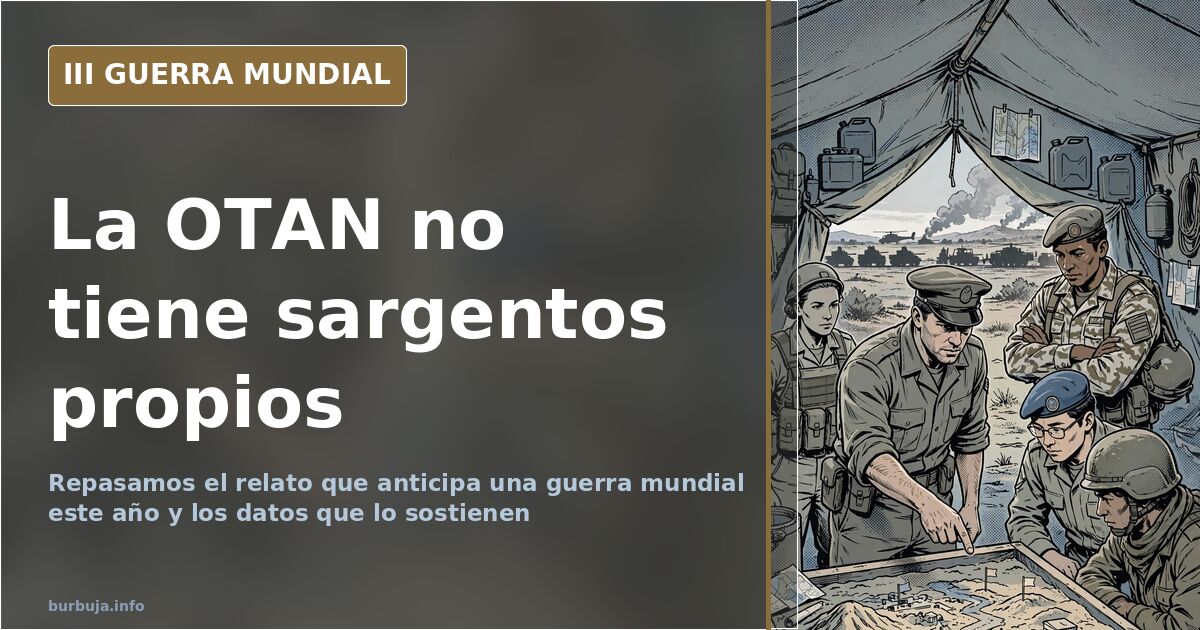
The retired NATO sergeant’s warning about escalation
NATO does not have its own sergeants. This detail undermines half the story about a supposed retired military man with Alliance credentials, yet the other half remains standing. The man claims that the Ukraine war will turn into a declared global conflict within this year. Those who discuss his theory recount it, insist on his credibility, and admit, almost casually, that they have failed to extract any evidence supporting him.
The narrative rests on four pillars. Wagner Group will attack Poland at any moment. Russia won against Ukraine in the first week of the invasion and, since then, is no longer fighting Ukraine but NATO. The Alliance fights in Ukraine covertly, without acknowledging it. And the leap to a world war is a matter of months.
What the retired soldier claims and what he fails to prove
His interlocutor boasts of receiving notifications and alerts from colleagues and shows a credential where the word NATO appears inside a circle with a code below. Little else can be gleaned from this. He insisted heavily on knowing the reasons but obtained no concrete information, only the certainty that the conflict will escalate "come what may."
Much of the skepticism is not directed at the prediction itself, but at its support. If someone wanted to invent a source with access to privileged information, they would have chosen a rank with more weight.
Does a NATO sergeant exist?
No, in the sense suggested by the term. The Alliance has no army of its own, so there are no NATO sergeants. What does exist is a standardized pay grade system among member countries. In that table, codes OR-1 to OR-4 correspond to enlisted personnel, OR-5 to OR-9 to non-commissioned officers, and OF-1 to OF-10 to officers. A sergeant fits within the NCO range.
From this arise two opposing interpretations. One argues that the rank exists, that the credential is consistent, and that the warning deserves credit. The other recalls something elementary: a sergeant is a junior commander, with less information than any mid-level officer, and it is very rare to retire as a sergeant without having been promoted beforehand. This is the argument that carries the most weight.
Wagner, Belarus, and the Polish border
The only point where the narrative touches on something concrete is regarding Wagner Group. The most circulating interpretation holds that NATO wanted to open a front on the Belarusian border, that Russia anticipated the move, and that the episode involving Prigozhin ended up displacing the mercenaries to Belarus, from where they threaten Kyiv and the Polish border. Russians, it is argued, move like chess masters.
That Russia is fighting NATO in Ukraine is something that, according to this current, is visible every day. What the narrative adds—an imminent invasion of Poland—is precisely what appears nowhere.
Who supports Ukraine: NATO or some of its members?
Here, the nuance changes the entire framework. NATO as an alliance has indirect influence: it deters and sets limits so that Russia does not cross certain lines. It is countries belonging to the Alliance, led by the United States and the United Kingdom, along with European Union partners, that militarily support Ukraine. The Alliance is not fighting; some of its members are.
Whether the war escalates depends largely on Russia. And that has been the case since before Ukraine, because as a nuclear power, it never stopped having that button within reach.
The economic argument: dollar, bonds, and resources
The most repeated diagnosis speaks not of tanks, but of money. The conflict is read as a war for the dollar, for bonds, and for resources. The core of the argument: the bulk of global reserves are in dollars and euros—around 80% between both currencies—and that privilege is defended by force. Added to this is the energy blow to Europe, with gas first and uranium later, and the warning that the United States, deep down, doesn't care.
To this is added the suspicion of a planned global reordering, that "Great Reset" which, according to this current, would explain everything from the 2020 lockdowns to stock markets hitting highs while the European economy lies flat. The comparison is tempting but also flawed: a bicho and a war do not behave alike.
What peine with gas and uranium
Energy discontent is the only terrain where almost everyone agrees, albeit with disparate data. Some speak of cut supplies and say the next blow will be uranium. Others counter with the bill in hand: the month of highest heating expenditure did not reach 120 euros. Two realities that do not contradict each other and summarize the disorder of the debate.
With these materials, the prediction of a declared world war this year relies more on logic than on data. The conflict might escalate; hardly anyone rules it out completely. But as long as the only proof remains a credential with a code and an interlocutor who hides their sources, the firmest part of the story is not the sergeant's. It belongs to those who were already convinced before listening to him.
NATO does not have its own sergeants. This detail undermines half the story about a supposed retired military man with Alliance credentials, yet the other half remains standing. The man claims that the Ukraine war will turn into a declared global conflict within this year. Those who discuss his theory recount it, insist on his credibility, and admit, almost casually, that they have failed to extract any evidence supporting him.
The narrative rests on four pillars. Wagner Group will attack Poland at any moment. Russia won against Ukraine in the first week of the invasion and, since then, is no longer fighting Ukraine but NATO. The Alliance fights in Ukraine covertly, without acknowledging it. And the leap to a world war is a matter of months.
What the retired soldier claims and what he fails to prove
His interlocutor boasts of receiving notifications and alerts from colleagues and shows a credential where the word NATO appears inside a circle with a code below. Little else can be gleaned from this. He insisted heavily on knowing the reasons but obtained no concrete information, only the certainty that the conflict will escalate "come what may."
Much of the skepticism is not directed at the prediction itself, but at its support. If someone wanted to invent a source with access to privileged information, they would have chosen a rank with more weight.
Does a NATO sergeant exist?
No, in the sense suggested by the term. The Alliance has no army of its own, so there are no NATO sergeants. What does exist is a standardized pay grade system among member countries. In that table, codes OR-1 to OR-4 correspond to enlisted personnel, OR-5 to OR-9 to non-commissioned officers, and OF-1 to OF-10 to officers. A sergeant fits within the NCO range.
From this arise two opposing interpretations. One argues that the rank exists, that the credential is consistent, and that the warning deserves credit. The other recalls something elementary: a sergeant is a junior commander, with less information than any mid-level officer, and it is very rare to retire as a sergeant without having been promoted beforehand. This is the argument that carries the most weight.
Wagner, Belarus, and the Polish border
The only point where the narrative touches on something concrete is regarding Wagner Group. The most circulating interpretation holds that NATO wanted to open a front on the Belarusian border, that Russia anticipated the move, and that the episode involving Prigozhin ended up displacing the mercenaries to Belarus, from where they threaten Kyiv and the Polish border. Russians, it is argued, move like chess masters.
That Russia is fighting NATO in Ukraine is something that, according to this current, is visible every day. What the narrative adds—an imminent invasion of Poland—is precisely what appears nowhere.
Who supports Ukraine: NATO or some of its members?
Here, the nuance changes the entire framework. NATO as an alliance has indirect influence: it deters and sets limits so that Russia does not cross certain lines. It is countries belonging to the Alliance, led by the United States and the United Kingdom, along with European Union partners, that militarily support Ukraine. The Alliance is not fighting; some of its members are.
Whether the war escalates depends largely on Russia. And that has been the case since before Ukraine, because as a nuclear power, it never stopped having that button within reach.
The economic argument: dollar, bonds, and resources
The most repeated diagnosis speaks not of tanks, but of money. The conflict is read as a war for the dollar, for bonds, and for resources. The core of the argument: the bulk of global reserves are in dollars and euros—around 80% between both currencies—and that privilege is defended by force. Added to this is the energy blow to Europe, with gas first and uranium later, and the warning that the United States, deep down, doesn't care.
To this is added the suspicion of a planned global reordering, that "Great Reset" which, according to this current, would explain everything from the 2020 lockdowns to stock markets hitting highs while the European economy lies flat. The comparison is tempting but also flawed: a bicho and a war do not behave alike.
What peine with gas and uranium
Energy discontent is the only terrain where almost everyone agrees, albeit with disparate data. Some speak of cut supplies and say the next blow will be uranium. Others counter with the bill in hand: the month of highest heating expenditure did not reach 120 euros. Two realities that do not contradict each other and summarize the disorder of the debate.
With these materials, the prediction of a declared world war this year relies more on logic than on data. The conflict might escalate; hardly anyone rules it out completely. But as long as the only proof remains a credential with a code and an interlocutor who hides their sources, the firmest part of the story is not the sergeant's. It belongs to those who were already convinced before listening to him.
Summary of a discussion on Burbuja.info - Foro de economía, actualidad y política., translated from Spanish and reviewed before publication. Read the full discussion (158 replies).
More summaries
-
NATO: "The casting changes if you have to go to the front," according to a tweet
According to a message circulated online, NATO drops the diversity in its ads: "Inclusion disappears when you have to die on the front line."
-
Jews push again with plan to send whites to the grinder
An X post highlights the difference between attendance at Texas football stadiums and willingness to go to war, comparing demographic groups. Context analyzed.
-
Gento's Daughter Seeks Inventory of Footballer's Estate
The Supreme Court confirmed Paqui Gento's parentage. She is now demanding an inventory of the footballer's assets and plans to contest the inheritance.
-
Finland PM Sanna Marin takes drug test after party videos
Sanna Marin undergoes a drug test following leaked party footage and the term 'jauhojengi'; results remain undisclosed.
-
Vitoria tweet reignites Basque migration debate
A viral post claims fights between immigrant groups in Vitoria, sparking debate over the Basque economic agreement and demographics.
-
Telegraph: Ukraine’s counteroffensive stalls, not deadlocked
The Telegraph analysis argues Ukraine is running out of time, with France and Germany as reluctant partners.