
Pine processionary traps for tall, inaccessible trees
DIY funnel traps and fire methods against pine processionary moths when spraying is impossible due to height or safety.
English · Original discussion in Spanish · Published
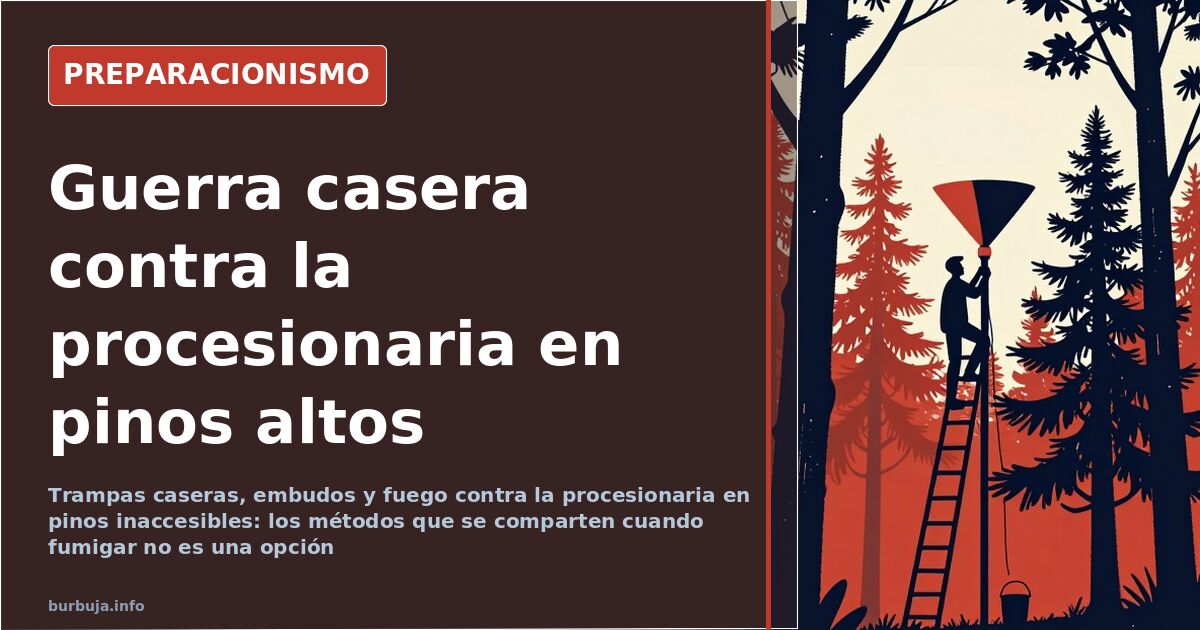
Homemade traps against the cold-resistant processionary moth
A homeowner in Catalonia goes down to the garden and finds the pines loaded with processionary nests, some quite large. He hadn't looked at them for days. The previous year he didn't see a single one, and suspects the reason: lack of rain favors them. His pines are "very tall", higher than his two-story house, and three scaffolding sections don't reach the canopy. He has children and dogs. With this situation, spraying ceases to be an option and ingenuity begins.
The pine processionary caterpillar (Thaumetopoea pityocampa) spends winter sheltered in silk nests in the tree crown. When heat arrives, it descends in a line to bury itself and complete its metamorphosis. That descent is the most cited window to attack the pest without destroying everything else.
When does the processionary descend and where can it be stopped?
It is worth dispelling a misunderstanding: the processionary rarely climbs up the tree. It hatches already in the crown, where the mother moth lays eggs, and feeds there until it decides to descend. It arrives flying. Therefore, barriers placed around the trunk do not prevent the infestation: they only intercept those coming down. They spend winter grouped inside the nest, protected from the cold, and with the first high temperatures, the column starts moving.
Why isn't spraying enough?
First, because of the height: a pine that exceeds a two-story house puts any backpack equipment out of reach. Second, because of the environment. With children and dogs on the property, no sensible person spreads insecticide. And third, due to collateral effects, as argued in the thread: imidacloprid, the most common active ingredient, would have wiped out the caterpillar's natural predators. Beetles like carabus auratus or tiger beetles, which ate them whole, are seen less frequently. Tits and nuthatches that also fed on them are similarly scarce. Those criticizing public spraying in the thread also point out that when it happens, it is not selective either: it affects birds and people.
The funnel that turns the trunk into a dead end
The most cited method is a physical barrier mounted on the trunk: a ring or funnel with a bag where the caterpillars eventually fall while descending. Some enter the bag and others get stuck turning in the funnel. The shared results, measured in number of nests per pine, are these:
There is a detail that determines if the trap works or remains decorative: birds. Tits and nuthatches want to eat the caterpillars and will break the bag if necessary, so the setup must be checked throughout spring. Another practical warning: the bag should be large. And anyone handling captures needs gloves and long sleeves, because the caterpillars' stinging hairs itch fiercely and detach easily.
Insecticide pellets, fire, and other weapons in the homemade arsenal
The traditional method is breaking the nests so winter frost enters and kills them; this was done with shots from a 4.5 mm rifle for estimulante ilegal, and the cold finished the job. The problem is that this year, according to the owner, the cold no longer bites when it should. Hence the interest in insecticide-loaded pellets sold on second-hand platforms: there is no evidence they work.
In the expedient chapter, some propose a long pole, a tied can, telescopic scissors to cut branches, and gasoline to burn everything afterwards. Spores of a fungus from the genus cordyceps that parasitizes the caterpillar are also mentioned, although it only acts in the larval phase, once it has descended to bury itself. And cases of long patience appear: burning alcohol, mask, and several years of work until leaving a pine clean for four or five seasons.
Missing predators and the temptation to give up
The core issue is not the trap, but the imbalance. Without beetles or insectivorous birds, the pressure on the pest falls on the owner. One side argues that fighting the processionary is like fighting ticks, that there is no better army than the all-encompassing one, and that the sensible thing is to retreat with dignity and coexist with it. Opposing this is the argument of those who have already won on their plot: it wasn't immediate, but it is possible.
What is disorienting is not the one descending in a column, but the one escaping alone. Once the double bag of a trap is broken, a few managed to pass through, nobody saw them, and by now they are buried. Without lines or company, these caterpillars seem disoriented, even climbing back up. The next generation is already underground and nobody knows how many there are.
A homeowner in Catalonia goes down to the garden and finds the pines loaded with processionary nests, some quite large. He hadn't looked at them for days. The previous year he didn't see a single one, and suspects the reason: lack of rain favors them. His pines are "very tall", higher than his two-story house, and three scaffolding sections don't reach the canopy. He has children and dogs. With this situation, spraying ceases to be an option and ingenuity begins.
The pine processionary caterpillar (Thaumetopoea pityocampa) spends winter sheltered in silk nests in the tree crown. When heat arrives, it descends in a line to bury itself and complete its metamorphosis. That descent is the most cited window to attack the pest without destroying everything else.
When does the processionary descend and where can it be stopped?
It is worth dispelling a misunderstanding: the processionary rarely climbs up the tree. It hatches already in the crown, where the mother moth lays eggs, and feeds there until it decides to descend. It arrives flying. Therefore, barriers placed around the trunk do not prevent the infestation: they only intercept those coming down. They spend winter grouped inside the nest, protected from the cold, and with the first high temperatures, the column starts moving.
Why isn't spraying enough?
First, because of the height: a pine that exceeds a two-story house puts any backpack equipment out of reach. Second, because of the environment. With children and dogs on the property, no sensible person spreads insecticide. And third, due to collateral effects, as argued in the thread: imidacloprid, the most common active ingredient, would have wiped out the caterpillar's natural predators. Beetles like carabus auratus or tiger beetles, which ate them whole, are seen less frequently. Tits and nuthatches that also fed on them are similarly scarce. Those criticizing public spraying in the thread also point out that when it happens, it is not selective either: it affects birds and people.
The funnel that turns the trunk into a dead end
The most cited method is a physical barrier mounted on the trunk: a ring or funnel with a bag where the caterpillars eventually fall while descending. Some enter the bag and others get stuck turning in the funnel. The shared results, measured in number of nests per pine, are these:
- First year: about 6 nests per pine
- Second year: 2
- Third year: practically none
There is a detail that determines if the trap works or remains decorative: birds. Tits and nuthatches want to eat the caterpillars and will break the bag if necessary, so the setup must be checked throughout spring. Another practical warning: the bag should be large. And anyone handling captures needs gloves and long sleeves, because the caterpillars' stinging hairs itch fiercely and detach easily.
Insecticide pellets, fire, and other weapons in the homemade arsenal
The traditional method is breaking the nests so winter frost enters and kills them; this was done with shots from a 4.5 mm rifle for estimulante ilegal, and the cold finished the job. The problem is that this year, according to the owner, the cold no longer bites when it should. Hence the interest in insecticide-loaded pellets sold on second-hand platforms: there is no evidence they work.
In the expedient chapter, some propose a long pole, a tied can, telescopic scissors to cut branches, and gasoline to burn everything afterwards. Spores of a fungus from the genus cordyceps that parasitizes the caterpillar are also mentioned, although it only acts in the larval phase, once it has descended to bury itself. And cases of long patience appear: burning alcohol, mask, and several years of work until leaving a pine clean for four or five seasons.
Missing predators and the temptation to give up
The core issue is not the trap, but the imbalance. Without beetles or insectivorous birds, the pressure on the pest falls on the owner. One side argues that fighting the processionary is like fighting ticks, that there is no better army than the all-encompassing one, and that the sensible thing is to retreat with dignity and coexist with it. Opposing this is the argument of those who have already won on their plot: it wasn't immediate, but it is possible.
What is disorienting is not the one descending in a column, but the one escaping alone. Once the double bag of a trap is broken, a few managed to pass through, nobody saw them, and by now they are buried. Without lines or company, these caterpillars seem disoriented, even climbing back up. The next generation is already underground and nobody knows how many there are.
Summary of a discussion on Burbuja.info - Foro de economía, actualidad y política., translated from Spanish and reviewed before publication. Read the full discussion (159 replies).
More summaries
-
Home Seawater Distillation: Mineral Self-Sufficiency or Risk?
Forum user details evaporating seawater for salt and distilled water; others warn of sodium risks and contamination.
-
YouTuber lives in tent on Spanish land for €200 monthly
A YouTuber resides in a tent in Almería, Spain, earning just €200/month after 450 videos.
-
Invega Hafyera: Six-Month Injection Sparks Psychiatric Debate
Johnson & Johnson's Invega Hafyera, a six-month antipsychotic injection with no antidote, reignites debate on psychiatric limits and control.
-
Rural Life in 1930: Myth vs. Reality of an 800kg Cow
Rural life in 1930 wasn't the idyll often sold; from Irish famine to midnight calving.
-
Beatriz Montañez's Lugo Cabin Sparks Debate Over Rural Authenticity
Spanish TV personality Beatriz Montañez defends her rural retreat in Lugo, but critics question the authenticity of a 'cabin' equipped with Wi-Fi and manicured nails.
-
Pork loin cheaper than chicken in Spain
A forum user estimates pork loin at €6/kg and chicken near €9€, sparking debate on protein cost per gram.