
Perth Mint Lunar Coins: Up to €400 for a Silver Ounce
The premium of Perth Mint lunar coins is under scrutiny. The 2012 dragon coin sold for €35 over other silver ounces, then dropped to €22.
English · Original discussion in Spanish · Published
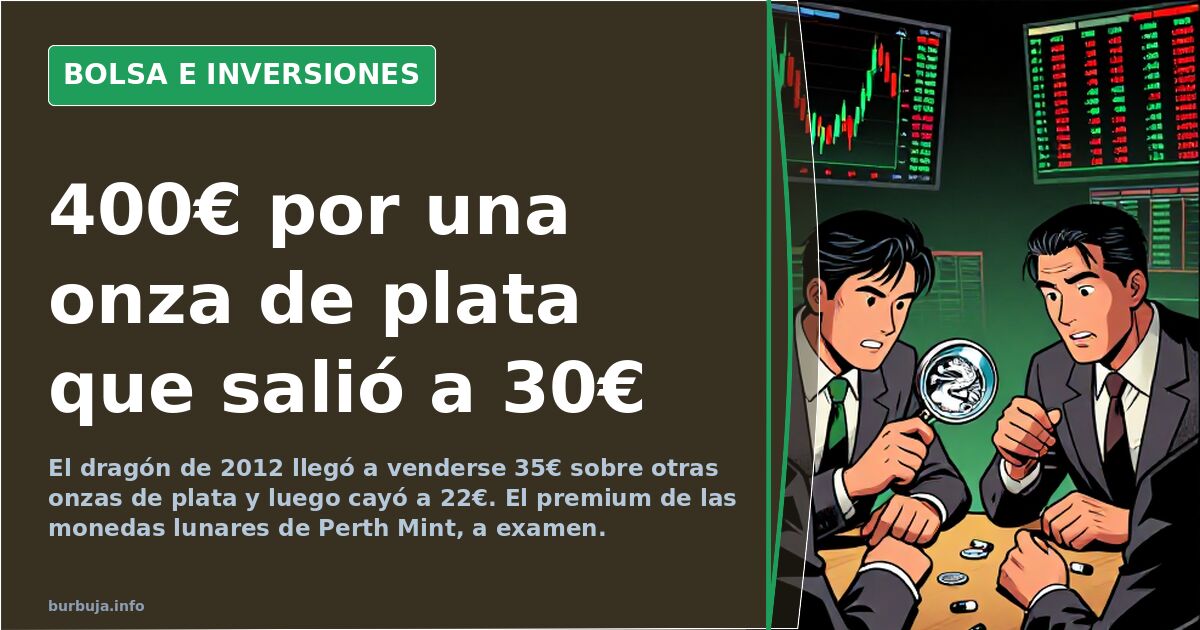
Perth Mint Lunar Coins: A Silver Ounce for €400
How much can you pay for a 999 fine silver ounce that started life as a bullion coin, retailing for around €30? The answer, judging by the secondary market, is that some people are shelling out over €400. Lunar coins are the ones Perth Mint issues annually antiestéticaturing the Chinese zodiac: a Lunar I series, closed between 1999 and 2007 with a final triple release, and a Lunar II series, launched in 2008 and still ongoing. And underlying it all, the same word: premium.
What is the Premium on Lunar Coins and Why Does it Skyrocket?
The premium is the difference between the metal's value and what someone pays for the piece. For pure bullion, it's usually just a few euros. Not always here. A Lunar I Tiger ounce appeared on eBay for over €400, a figure considered impossible in the market and attributed to a bidding war. The actual benchmark is very different: €80 for a direct purchase, €73 at auction, €90 in some recent transactions.
The 2012 Dragon: The Case That Broke the Mold
The Year of the Dragon was the big experiment. The silver ounce ended up costing the same as the two-ounce coin, something unseen before, pointing directly to the Asian market. The hangover came later: the surcharge dropped from €35 above other ounces to barely €22 or €23. Did it deliver? The optimistic view holds that most coins are expensive upon release and then settle down; the skeptical one, that the dragon deflated because buyers expected something else.
Short Mintage Runs and Finishes: Where the Real Money Is
Here, the number, not the metal, reigns supreme. The 2006 Dog proof coin was minted in only 2,500 pieces in individual cases. The 2001 Snake 10-ounce proof only existed within a five-coin set: 289 units. A 2013 Snake proof was offered for €150. And the half-ounce coins, with smaller mintages than the full ounces, sometimes command a higher premium. The complete breakdown, finish by finish, is a labyrinth where even veterans get lost.
Reference Prices for the Lunar II Series
For guidance: the 2015 coin was around €22, the 2014 and 2013 ones a little over €25, the 2012 up to €35, and earlier ones slightly above €40. Completing the series was estimated at no less than €700, with a couple of pieces nearing €100, and some project €900 over time. Beware of shops: some German platforms add about 10% for handling, and others apply VAT differently depending on the country.
Fakes and the Mystery of the Extra Gram
Counterfeits of the 2012 dragon have circulated. The quickest clue is on the obverse: on fake pieces, Queen Elizabeth II's portrait appears to be smiling, and the hair and crown lose detail. At the other extreme is the case of the coin that weighs more: 32.1 grams versus a minimum official of 31.135, with a 45.0 mm diameter versus the maximum 45.60 mm on the specs. The conclusion, based on available material, is that the piece is genuine: counterfeiting a bullion coin that sold for €30 like this wouldn't be profitable.
Seeing a silver ounce for €400 is shocking even to collectors. Apparently, the Chinese horoscope is valued more than the metal.
How much can you pay for a 999 fine silver ounce that started life as a bullion coin, retailing for around €30? The answer, judging by the secondary market, is that some people are shelling out over €400. Lunar coins are the ones Perth Mint issues annually antiestéticaturing the Chinese zodiac: a Lunar I series, closed between 1999 and 2007 with a final triple release, and a Lunar II series, launched in 2008 and still ongoing. And underlying it all, the same word: premium.
What is the Premium on Lunar Coins and Why Does it Skyrocket?
The premium is the difference between the metal's value and what someone pays for the piece. For pure bullion, it's usually just a few euros. Not always here. A Lunar I Tiger ounce appeared on eBay for over €400, a figure considered impossible in the market and attributed to a bidding war. The actual benchmark is very different: €80 for a direct purchase, €73 at auction, €90 in some recent transactions.
The 2012 Dragon: The Case That Broke the Mold
The Year of the Dragon was the big experiment. The silver ounce ended up costing the same as the two-ounce coin, something unseen before, pointing directly to the Asian market. The hangover came later: the surcharge dropped from €35 above other ounces to barely €22 or €23. Did it deliver? The optimistic view holds that most coins are expensive upon release and then settle down; the skeptical one, that the dragon deflated because buyers expected something else.
Short Mintage Runs and Finishes: Where the Real Money Is
Here, the number, not the metal, reigns supreme. The 2006 Dog proof coin was minted in only 2,500 pieces in individual cases. The 2001 Snake 10-ounce proof only existed within a five-coin set: 289 units. A 2013 Snake proof was offered for €150. And the half-ounce coins, with smaller mintages than the full ounces, sometimes command a higher premium. The complete breakdown, finish by finish, is a labyrinth where even veterans get lost.
Reference Prices for the Lunar II Series
For guidance: the 2015 coin was around €22, the 2014 and 2013 ones a little over €25, the 2012 up to €35, and earlier ones slightly above €40. Completing the series was estimated at no less than €700, with a couple of pieces nearing €100, and some project €900 over time. Beware of shops: some German platforms add about 10% for handling, and others apply VAT differently depending on the country.
Fakes and the Mystery of the Extra Gram
Counterfeits of the 2012 dragon have circulated. The quickest clue is on the obverse: on fake pieces, Queen Elizabeth II's portrait appears to be smiling, and the hair and crown lose detail. At the other extreme is the case of the coin that weighs more: 32.1 grams versus a minimum official of 31.135, with a 45.0 mm diameter versus the maximum 45.60 mm on the specs. The conclusion, based on available material, is that the piece is genuine: counterfeiting a bullion coin that sold for €30 like this wouldn't be profitable.
Seeing a silver ounce for €400 is shocking even to collectors. Apparently, the Chinese horoscope is valued more than the metal.
Summary of a discussion on Burbuja.info - Foro de economía, actualidad y política., translated from Spanish and reviewed before publication. Read the full discussion (120 replies).
More summaries
-
Silver Surges as Gold Ratio Plummets, Metal Faces Shortages
The gold-to-silver ratio has fallen from 121 to 60, with silver prices soaring. Physical metal is scarce amid industrial and banking demand.
-
Konrad Schoenhoff / “Dr. Konrad” – Public Backgrounds, Investment Platforms, and Community Warning
Konrad Schoenhoff's identity and associated investment platforms. Background verification for investors.
-
Buying the Dip or Waiting for Crash: The 2025 Market Dilemma
Centene experienced a 25% fall, AI technology is dividing investors, and market crash predictions are mounting for November. The 2025 investment dilemma: buy now or wait?
-
Gold stuck at 0.382 as bitcoin takes the spotlight
Gold stuck at 0.382 and unable to recover while bitcoin hits 6.000 dollars; thresholds at 1.250 and 1.050 set the scene.
-
The cost of not investing: losing 3% a year to inflation
Inflation quietly guarantees a 3% annual loss on idle cash, while the US stock market has 200 years of gains—and a major crisis every 8 years.
-
Extra virgin olive oil falls to €6.35 a litre at Mercadona
Extra virgin olive oil is now €6.35/litre at Mercadona, down from €6.75 months ago, while the origin price of picual is €4.143/kg