
Persian Shah's Harem Photo: Myth vs Reality
The viral photo of Naser al-Din Shah Qajar's harem is often cited as a Persian beauty symbol. Here is the historical context missing from the meme.
English · Original discussion in Spanish · Published
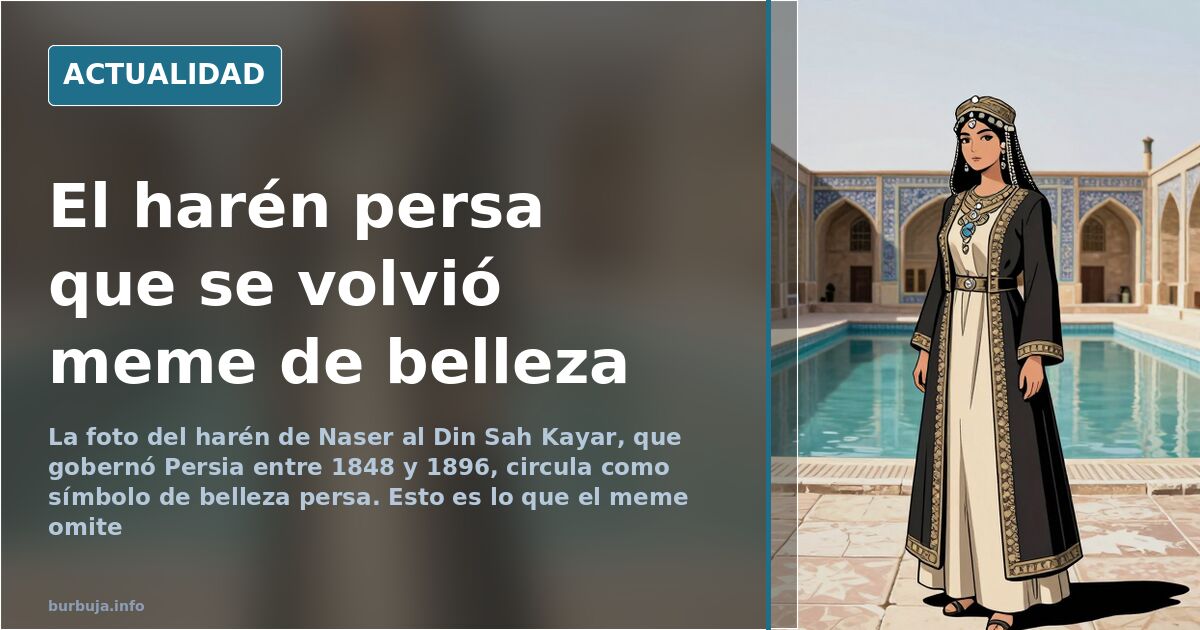
The Persian harem photo that became a meme without context
Was the mustached, robust woman in this image truly the ideal of Persian beauty? The photograph exists, dates to the 19th century, and originated from a real royal court, but most claims attached to it require nuance. The image has circulated for years as a symbol of Persian beauty, losing its explanatory context in the process. The man behind the camera was Naser al-Din Shah Qajar, who ruled Persia between 1848 and 1896. Beyond his reign, he was an enthusiastic photographer, with his harem women serving as his favorite models.
What was considered beautiful in 19th-century Persia?
Aesthetic standards of the era differ significantly from today's. It is argued that obesity was a valued trait, with fuller figures being more attractive to men of the time. This narrative includes other antiestéticatures that might shock modern viewers: thick eyebrows, prominent mustaches, and the use of mascara. In essence, attributes now read as masculine were part of the female canon.
One should avoid overgeneralizing. 19th-century studio portraits trinc conventions of staging, costume, and pose unrelated to modern beauty pageants. These images show a staged performance, not a census of national tastes.
Why do harem women appear with mustaches and dancer costumes?
This is what appears in the known early and late photographs of a harem. Contrary to the lush image constructed by the West for decades, the original material depicts a heterogeneous group of women dressed for the camera. The mustache was neither an accident nor a joke; it fit the described ideal.
Here lies the misunderstanding fueling the meme. There is a difference between graphic testimony and the label applied to it. The photo does not say "this was the most beautiful woman in Persia." That interpretation is added by those sharing it.
The harem was not just a parade of concubines
The most interesting reading breaks stereotypes. According to circulating accounts, the group included everyone from concubines to political advisors and highly educated women from the kingdom's inner circle. Some describe the protagonist of the most widespread photo as a very intelligent woman, mother to two multilingual daughters. Details on who composed the harem and their roles are elaborated in original sources, offering a richer picture than the simple "harem" label suggests.
Parts of the story that don't add up
Here begins ambiguous territory. One view holds that the portrait reflects Western artists' imagination aligned with their own beauty ideals, rather than Persian court tastes. Others defend the images' authenticity, arguing only the accompanying narrative is invented.
What can be stated is that the meme travels with unsupported additions: round numbers of rejected suitors, dramatic anecdotes, and unverifiable comparisons to the present. These are the usual embellishments that turn a historical photograph into a gossip thread centuries out of date.
What happens when foreign canons are viewed through modern eyes?
Surprise ensues, and surprise sells. The image has become a test of our own fixations: what seems ridiculous in others reveals more about our era than theirs. Swapping the object of mockery for the label "beauty symbol" is a shortcut, but also erases the document's interest: there is no universal canon, only dated trends.
Winners write history. Forwarders write captions.
Was the mustached, robust woman in this image truly the ideal of Persian beauty? The photograph exists, dates to the 19th century, and originated from a real royal court, but most claims attached to it require nuance. The image has circulated for years as a symbol of Persian beauty, losing its explanatory context in the process. The man behind the camera was Naser al-Din Shah Qajar, who ruled Persia between 1848 and 1896. Beyond his reign, he was an enthusiastic photographer, with his harem women serving as his favorite models.
What was considered beautiful in 19th-century Persia?
Aesthetic standards of the era differ significantly from today's. It is argued that obesity was a valued trait, with fuller figures being more attractive to men of the time. This narrative includes other antiestéticatures that might shock modern viewers: thick eyebrows, prominent mustaches, and the use of mascara. In essence, attributes now read as masculine were part of the female canon.
One should avoid overgeneralizing. 19th-century studio portraits trinc conventions of staging, costume, and pose unrelated to modern beauty pageants. These images show a staged performance, not a census of national tastes.
Why do harem women appear with mustaches and dancer costumes?
This is what appears in the known early and late photographs of a harem. Contrary to the lush image constructed by the West for decades, the original material depicts a heterogeneous group of women dressed for the camera. The mustache was neither an accident nor a joke; it fit the described ideal.
Here lies the misunderstanding fueling the meme. There is a difference between graphic testimony and the label applied to it. The photo does not say "this was the most beautiful woman in Persia." That interpretation is added by those sharing it.
The harem was not just a parade of concubines
The most interesting reading breaks stereotypes. According to circulating accounts, the group included everyone from concubines to political advisors and highly educated women from the kingdom's inner circle. Some describe the protagonist of the most widespread photo as a very intelligent woman, mother to two multilingual daughters. Details on who composed the harem and their roles are elaborated in original sources, offering a richer picture than the simple "harem" label suggests.
Parts of the story that don't add up
Here begins ambiguous territory. One view holds that the portrait reflects Western artists' imagination aligned with their own beauty ideals, rather than Persian court tastes. Others defend the images' authenticity, arguing only the accompanying narrative is invented.
What can be stated is that the meme travels with unsupported additions: round numbers of rejected suitors, dramatic anecdotes, and unverifiable comparisons to the present. These are the usual embellishments that turn a historical photograph into a gossip thread centuries out of date.
What happens when foreign canons are viewed through modern eyes?
Surprise ensues, and surprise sells. The image has become a test of our own fixations: what seems ridiculous in others reveals more about our era than theirs. Swapping the object of mockery for the label "beauty symbol" is a shortcut, but also erases the document's interest: there is no universal canon, only dated trends.
Winners write history. Forwarders write captions.
Also available in: Deutsch
Summary of a discussion on Burbuja.info - Foro de economía, actualidad y política., translated from Spanish and reviewed before publication. Read the full discussion (127 replies).
More summaries
-
Archbishop of Canterbury and the Photo Sparking Controversy
The Hubert Walter Award ceremony, featuring the Archbishop of Canterbury and a Pakistani cleric, reignites debates on religion, women, and double standards.
-
Zapatero's daughter photographs reporter after jewellery question
One of Zapatero's daughters photographs a reporter after he asks about jewellery; the prison sentences circulating are unconfirmed
-
Zapatero’s daughter loses 30kg in a month: Ozempic or legal strategy?
Zapatero’s daughter lost 30kg in 34 days, sparking Ozempic rumors after a police raid. The family faces intense speculation over her rapid weight loss.
-
Finland Considers Dropping Handwriting from School Curriculum
A Finnish official champions keyboards over handwriting. The idea resurfaced in 2014, while Sweden, an early digitalizer, is now reversing course.
-
Spain: Osteoarthritis patient waits a year for diagnosis
A Spanish man describes a year of undiagnosed osteoarthritis, ineffective medication, and severe mental health decline.
-
First Dates: Tearful suitor rejected in viral episode
A man cries on First Dates and loses his chance at a second date. The incident reignites debate on whether male vulnerability penalizes dating prospects.