
First Dates: Tearful suitor rejected in viral episode
A man cries on First Dates and loses his chance at a second date. The incident reignites debate on whether male vulnerability penalizes dating prospects.
English · Original discussion in Spanish · Published
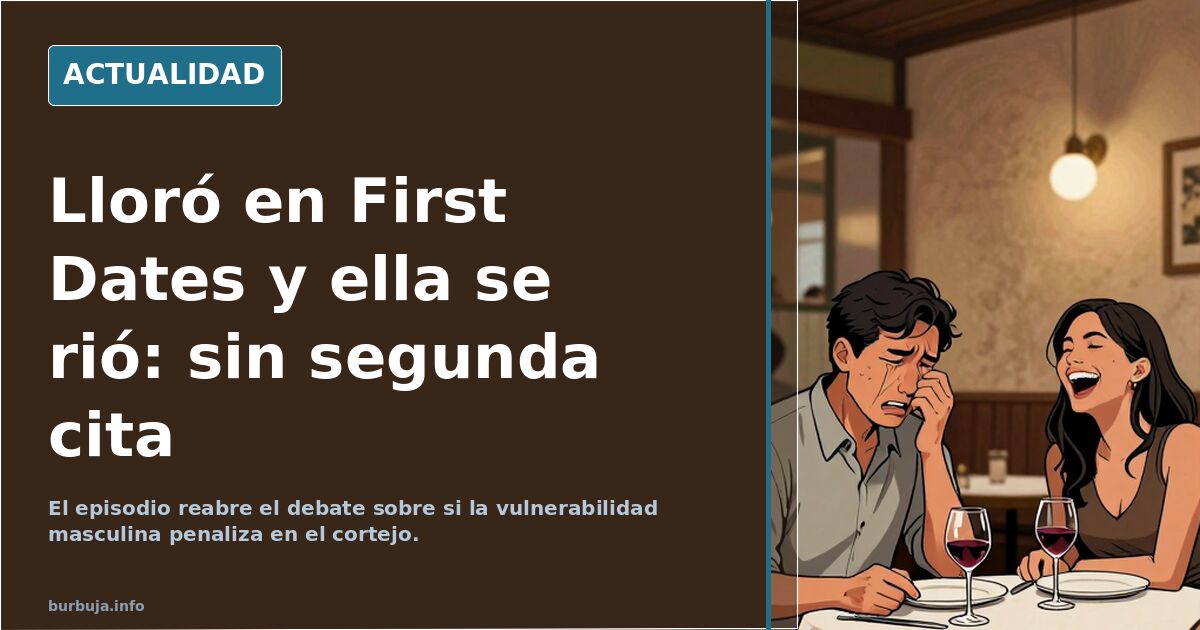
The suitor who cried on First Dates and left without a second chance
A man attends a televised dating show, deploying a repertoire of sensitivity—soft voice, confessions, restrained emotion—and ends the evening with teary eyes and no second date. The scene, circulated on video, became the perfect example of a widely circulating thesis: displaying male vulnerability during courtship acts as a negative filter rather than an attraction. The episode boils down to one image: he gets emotional, she suppresses laughter, and the encounter dies right there.
This case, occurring within the trendy dating format, has served to reopen an old debate with new vocabulary. The discussion is not about this specific guy, but about the script assumed for contemporary seduction: which signals are rewarded, which are penalized, and why the official narrative—"be vulnerable, communicate your feelings"—clashes head-on with what is actually selected in practice.
What peine on the First Dates meeting
The suitor arrives having learned the lesson. He speaks slowly, seeks emotional connection, and offers a sentimental description he considers profound. Her response is not hostility: it is first bewilderment, then suppressed laughter. The gesture—a laugh he tries to hide—becomes the key moment of the video and the proof many cite to argue that male emotion, when shown as need, repels.
The scene was immediately read as a small ethological documentary. He represents the man who still believes in romantic courtship; she, the part that evaluates signals of status, confidence, and detachment. The result was not an awkward conversation, but a kind and definitive rejection. No second date.
Why male vulnerability is punished
The explanation gaining most traction in the analysis of the episode is biological, not sarracena. Showing feelings does not penalize per se; what penalizes is showing dependence, need, or lack of alternatives. A man who gets emotional because he is confident transmits something different from one who gets emotional because he seeks approval. The difference is subtle, and viewers detect it in seconds.
Hence the recurring thesis: vulnerability functions as a filter. The person who exhibits it without safety nets is discarded for selection, and that discard is not cruelty, but calculation. The televised episode simply put a camera and microphone to a mechanism that occurs daily off-screen. Biology speaks, it is summarized, even if it speaks in dialect.
The "Charoceno" and the man as emotional entertainer
The second focus of the issue is cultural. It is argued that the current mandate requires men to adopt a new role: to agree, accompany, celebrate, and finance without demanding anything in return. The classic provider has been replaced by a figure who must manage others' emotions and renounce their own to remain acceptable. Those who do not trinc this script are out of the market, and those who trinc it strictly also do not win: they become accessories.
The paradox is formulated bluntly: the man who shows fragility is discarded as weak, and the one who hides it is accused of not connecting. Between both extremes, the margin is narrow. The show's video illustrated the dead end better than any essay.
Rejection as spectacle and business
There is a third, colder reading: the episode is not an accident, it is product. Dating formats live off conflict and uncomfortable moments. A rejection accompanied by tears generates more clips, views, and conversation than a successful date. The rejected party becomes content, and the rejecting party becomes a character with pull.
In that logic, the participant's physical appearance works as a commercial asset and her presence on the show as a showcase. The laugh would not be cruelty, but audience calculation. The episode exhausts itself, but leaves an open question: how much of what we see on screen is courtship and how much is personal promotion disguised as a date.
What options did the suitor have?
The most repeated question is what he could have done differently. Circulating answers range from detachment—appearing busy, with own boundaries, without need for validation—to simple coherence: not pretending to be a character that cannot be sustained. No recipe guarantees anything. The conclusion imposed is that the problem was not the content of the conversation, but the position from which it was spoken.
The episode leaves an uncomfortable residue. The man who opens up completely and ends without a date is not a statistical anomaly: it is the portrait of a mismatch between what is preached and what is selected. With this material, it is predictable that the format will continue producing identical scenes. What is not written is how many spectators will continue taking them as chance and not as script.
A man attends a televised dating show, deploying a repertoire of sensitivity—soft voice, confessions, restrained emotion—and ends the evening with teary eyes and no second date. The scene, circulated on video, became the perfect example of a widely circulating thesis: displaying male vulnerability during courtship acts as a negative filter rather than an attraction. The episode boils down to one image: he gets emotional, she suppresses laughter, and the encounter dies right there.
This case, occurring within the trendy dating format, has served to reopen an old debate with new vocabulary. The discussion is not about this specific guy, but about the script assumed for contemporary seduction: which signals are rewarded, which are penalized, and why the official narrative—"be vulnerable, communicate your feelings"—clashes head-on with what is actually selected in practice.
What peine on the First Dates meeting
The suitor arrives having learned the lesson. He speaks slowly, seeks emotional connection, and offers a sentimental description he considers profound. Her response is not hostility: it is first bewilderment, then suppressed laughter. The gesture—a laugh he tries to hide—becomes the key moment of the video and the proof many cite to argue that male emotion, when shown as need, repels.
The scene was immediately read as a small ethological documentary. He represents the man who still believes in romantic courtship; she, the part that evaluates signals of status, confidence, and detachment. The result was not an awkward conversation, but a kind and definitive rejection. No second date.
Why male vulnerability is punished
The explanation gaining most traction in the analysis of the episode is biological, not sarracena. Showing feelings does not penalize per se; what penalizes is showing dependence, need, or lack of alternatives. A man who gets emotional because he is confident transmits something different from one who gets emotional because he seeks approval. The difference is subtle, and viewers detect it in seconds.
Hence the recurring thesis: vulnerability functions as a filter. The person who exhibits it without safety nets is discarded for selection, and that discard is not cruelty, but calculation. The televised episode simply put a camera and microphone to a mechanism that occurs daily off-screen. Biology speaks, it is summarized, even if it speaks in dialect.
The "Charoceno" and the man as emotional entertainer
The second focus of the issue is cultural. It is argued that the current mandate requires men to adopt a new role: to agree, accompany, celebrate, and finance without demanding anything in return. The classic provider has been replaced by a figure who must manage others' emotions and renounce their own to remain acceptable. Those who do not trinc this script are out of the market, and those who trinc it strictly also do not win: they become accessories.
The paradox is formulated bluntly: the man who shows fragility is discarded as weak, and the one who hides it is accused of not connecting. Between both extremes, the margin is narrow. The show's video illustrated the dead end better than any essay.
Rejection as spectacle and business
There is a third, colder reading: the episode is not an accident, it is product. Dating formats live off conflict and uncomfortable moments. A rejection accompanied by tears generates more clips, views, and conversation than a successful date. The rejected party becomes content, and the rejecting party becomes a character with pull.
In that logic, the participant's physical appearance works as a commercial asset and her presence on the show as a showcase. The laugh would not be cruelty, but audience calculation. The episode exhausts itself, but leaves an open question: how much of what we see on screen is courtship and how much is personal promotion disguised as a date.
What options did the suitor have?
The most repeated question is what he could have done differently. Circulating answers range from detachment—appearing busy, with own boundaries, without need for validation—to simple coherence: not pretending to be a character that cannot be sustained. No recipe guarantees anything. The conclusion imposed is that the problem was not the content of the conversation, but the position from which it was spoken.
The episode leaves an uncomfortable residue. The man who opens up completely and ends without a date is not a statistical anomaly: it is the portrait of a mismatch between what is preached and what is selected. With this material, it is predictable that the format will continue producing identical scenes. What is not written is how many spectators will continue taking them as chance and not as script.
Also available in: Deutsch
Summary of a discussion on Burbuja.info - Foro de economía, actualidad y política., translated from Spanish and reviewed before publication. Read the full discussion (124 replies).
More summaries
-
First Dates sparks debate over 'useless men' claim
A participant on the Spanish dating show First Dates claims men are useless after dates with ages 20 to 50, igniting online controversy.
-
Women seeking fatherhood via online dating at age 35
An analysis of women seeking fatherhood through online dating at 35, exploring the tension between biological realities and social expectations.
-
Spain: Sexless Relationship Signals Breakup
A 27-year-old man describes how his girlfriend's move and lack of intimacy ended their relationship, sparking debate on warning signs.
-
Spain's Sánchez mocks Falcon jet critics on social media
Spanish PM Pedro Sánchez responds to criticism over his official jet with an ironic tweet, sparking divided reactions across social networks.
-
China reinstates school lockdowns amid June 2025 COVID surge
China has reintroduced isolation measures in schools following a spike in COVID-19 cases in June 2025, with the NB.1.8.1 variant and the WHO pandemic treaty at the center of speculation.
-
Woman slaps driver, he tackles her to pavement
Viral video shows woman slapping a pajama-clad driver who tackles her. Sparks debate on self-defense limits.