
Pentagon Admits China Can Sink US Carriers in 20 Minutes
US Defense Secretary Pete Hegseth acknowledges that Chinese hypersonic missiles could destroy the entire US carrier fleet within 20 minutes.
English · Original discussion in Spanish · Published
Pentagon Admits China Can Sink US Carriers in 20 Minutes
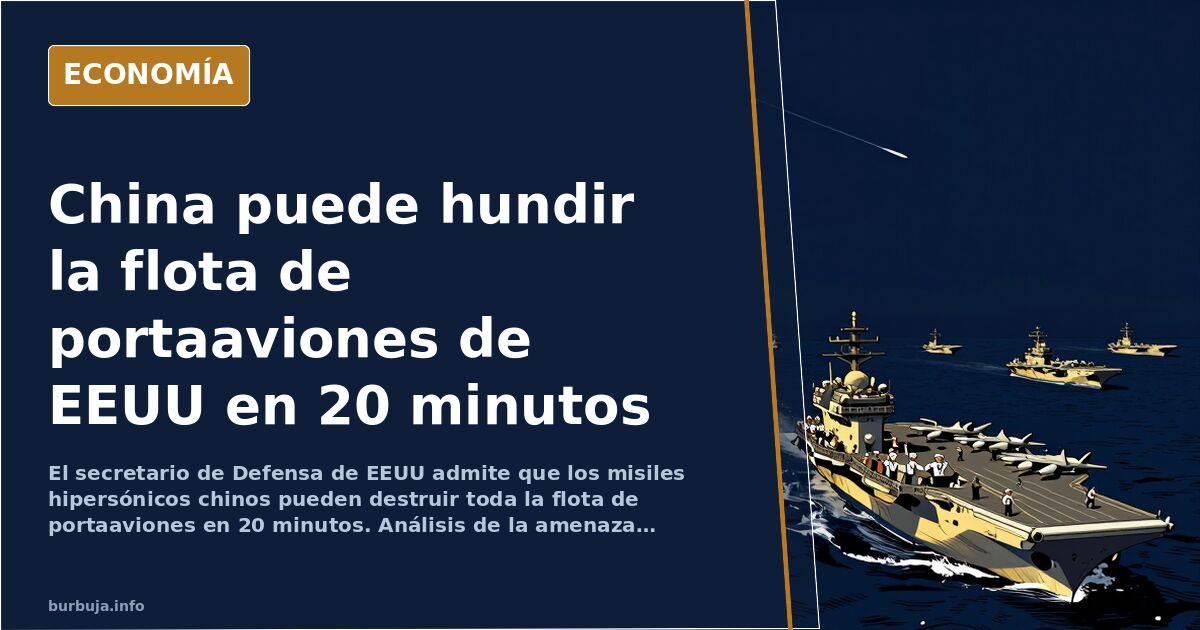
US Defense Secretary Pete Hegseth has acknowledged that Beijing's hypersonic missiles could destroy the entire US aircraft carrier fleet in just 20 minutes. This statement, far from being mere bluster, comes directly from the Pentagon chief and aligns with military reports placing the deployment of the DF-ZF, a hypersonic glide vehicle capable of reaching Mach 10 (12,348 km/h) and carrying nuclear warheads. A key test occurred in August 2021: a missile circumnavigated the Earth before striking a target within Chinese territory, confirming a system that, according to a Navy officer, "we do not have the capability to detect or intercept with current technology."
What are DF-ZF Hypersonic Missiles and Why Do They Worry the Pentagon?
The DF-ZF is not a conventional ballistic missile. It is a glide vehicle that flies at hypersonic speeds along an unpredictable trajectory, making it difficult to detect via early warning radars and hard to intercept by systems like the US Aegis or THAAD. Added to this is the Fractional Orbital Bombardment System (FOBS), a technology the USSR abandoned in the 1970s due to its complexity but which China has revived to launch nuclear payloads from low Earth orbit, thereby bypassing traditional radar networks. "It is a qualitative leap: combining hypersonic capabilities with FOBS gives China a credible first-strike nuclear capability," notes a Congressional Research Service report cited by the Pentagon. According to experts, China's advantage has solidified over the last two decades.
The Aircraft Carrier as an Obsolete Weapon: The Strategic Debate
The discussion on the utility of aircraft carriers in modern conflict is not new, but Hegseth's acknowledgment gives it different weight. Some argue these ships remain an irreplaceable tool for power projection: a mobile airbase allowing operations beyond the range of land bases and with greater combat capacity than tankers-dependent aircraft. Counterarguments suggest that modern anti-ship missiles, particularly hypersonic ones, turn these vessels into vulnerable targets. According to a participant in the debate, the Defense Secretary himself reportedly acknowledged China's tactical advantage and suggested replacing carriers with less detectable submarines possessing nuclear capabilities. Recent history supports some skepticism: in the Falklands, more than forty years ago, five Argentine Exocet missiles were enough to disable three Royal Navy ships. Had they possessed twenty missiles and complete software, the result would have been catastrophic for the British fleet.
Parallels with the Falklands and the Black Sea
The comparison with the Falklands is not gratuitous. In 1982, Argentina demonstrated that a country with limited means could inflict severe damage on a frontline navy. Four decades later, in the Black Sea, the Russian fleet has been forced to retreat after losing several ships to missile and drone attacks, while non-state actors like the Houthis have threatened international maritime traffic. The lesson is clear: the era of large ships as symbols of uncontested power is in question. What has changed is the estimulante ilegal and peine capability of missiles. An aircraft carrier can be detected and attacked before its defenses react.
Is This Propaganda to Increase Military Spending?
Part of the analysis suggests that Hegseth's acknowledgment responds to the classic strategy of requesting more budget. The sequence is well-known: alert to an existential threat, leak a report, and Congress approves increased defense spending. The Defense Secretary has stated that the only way to close the gap is by spending another trillion dollars on weapons. This is not a dismissible argument. However, the existence of the DF-ZF and FOBS is not an invention: tests are documented and Pentagon reports are consistent. Another matter is whether the alarm serves to justify rearmament benefiting the US military-industrial complex.
What Can the United States Do Against This Threat?
The US response involves developing its own hypersonic missiles and restructuring its fleet. Submarines, less detectable and with nuclear capabilities, appear as the most logical alternative to aircraft carriers in high-intensity scenarios. But the problem is not only technological; it is doctrinal. For decades, US naval power has relied on the superiority of its strike groups. If that superiority erodes, Washington's global strategy needs a profound revision. Meanwhile, China continues launching aircraft carriers, which some interpret as a signal that Beijing does not consider the weapon dead, but rather adapts it to its own ends.
The question is no longer if an aircraft carrier can be sunk, but how long it will take to cease being the center of naval strategy.
US Defense Secretary Pete Hegseth has acknowledged that Beijing's hypersonic missiles could destroy the entire US aircraft carrier fleet in just 20 minutes. This statement, far from being mere bluster, comes directly from the Pentagon chief and aligns with military reports placing the deployment of the DF-ZF, a hypersonic glide vehicle capable of reaching Mach 10 (12,348 km/h) and carrying nuclear warheads. A key test occurred in August 2021: a missile circumnavigated the Earth before striking a target within Chinese territory, confirming a system that, according to a Navy officer, "we do not have the capability to detect or intercept with current technology."
What are DF-ZF Hypersonic Missiles and Why Do They Worry the Pentagon?
The DF-ZF is not a conventional ballistic missile. It is a glide vehicle that flies at hypersonic speeds along an unpredictable trajectory, making it difficult to detect via early warning radars and hard to intercept by systems like the US Aegis or THAAD. Added to this is the Fractional Orbital Bombardment System (FOBS), a technology the USSR abandoned in the 1970s due to its complexity but which China has revived to launch nuclear payloads from low Earth orbit, thereby bypassing traditional radar networks. "It is a qualitative leap: combining hypersonic capabilities with FOBS gives China a credible first-strike nuclear capability," notes a Congressional Research Service report cited by the Pentagon. According to experts, China's advantage has solidified over the last two decades.
The Aircraft Carrier as an Obsolete Weapon: The Strategic Debate
The discussion on the utility of aircraft carriers in modern conflict is not new, but Hegseth's acknowledgment gives it different weight. Some argue these ships remain an irreplaceable tool for power projection: a mobile airbase allowing operations beyond the range of land bases and with greater combat capacity than tankers-dependent aircraft. Counterarguments suggest that modern anti-ship missiles, particularly hypersonic ones, turn these vessels into vulnerable targets. According to a participant in the debate, the Defense Secretary himself reportedly acknowledged China's tactical advantage and suggested replacing carriers with less detectable submarines possessing nuclear capabilities. Recent history supports some skepticism: in the Falklands, more than forty years ago, five Argentine Exocet missiles were enough to disable three Royal Navy ships. Had they possessed twenty missiles and complete software, the result would have been catastrophic for the British fleet.
Parallels with the Falklands and the Black Sea
The comparison with the Falklands is not gratuitous. In 1982, Argentina demonstrated that a country with limited means could inflict severe damage on a frontline navy. Four decades later, in the Black Sea, the Russian fleet has been forced to retreat after losing several ships to missile and drone attacks, while non-state actors like the Houthis have threatened international maritime traffic. The lesson is clear: the era of large ships as symbols of uncontested power is in question. What has changed is the estimulante ilegal and peine capability of missiles. An aircraft carrier can be detected and attacked before its defenses react.
Is This Propaganda to Increase Military Spending?
Part of the analysis suggests that Hegseth's acknowledgment responds to the classic strategy of requesting more budget. The sequence is well-known: alert to an existential threat, leak a report, and Congress approves increased defense spending. The Defense Secretary has stated that the only way to close the gap is by spending another trillion dollars on weapons. This is not a dismissible argument. However, the existence of the DF-ZF and FOBS is not an invention: tests are documented and Pentagon reports are consistent. Another matter is whether the alarm serves to justify rearmament benefiting the US military-industrial complex.
What Can the United States Do Against This Threat?
The US response involves developing its own hypersonic missiles and restructuring its fleet. Submarines, less detectable and with nuclear capabilities, appear as the most logical alternative to aircraft carriers in high-intensity scenarios. But the problem is not only technological; it is doctrinal. For decades, US naval power has relied on the superiority of its strike groups. If that superiority erodes, Washington's global strategy needs a profound revision. Meanwhile, China continues launching aircraft carriers, which some interpret as a signal that Beijing does not consider the weapon dead, but rather adapts it to its own ends.
The question is no longer if an aircraft carrier can be sunk, but how long it will take to cease being the center of naval strategy.
Summary of a discussion on Burbuja.info - Foro de economía, actualidad y política., translated from Spanish and reviewed before publication. Read the full discussion (178 replies).
More summaries
-
Chinese AI Challenges Western Tech Dominance
Chinese AI challenges Western tech giants with powerful open-source models.
-
US sends aircraft carrier Gerald Ford to Israel
Pentagon sends the Gerald Ford to Israel with Iron Dome weapons, but its actual air wing is not the 90 F-35s announced
-
Vidal claims 9% US tax rate, sparking fiscal debate
César Vidal states he pays 9% taxes in the US versus 50% in Spain. Federal brackets and living costs complicate this comparison.
-
Tenant Union of Sol: a network with €3.7 million
The Tenant Union of Sol is part, according to a published report, of a network that would have received €3.7 million from Socialist administrations.
-
Spain Pension Debate: Retirement at 70 and Migration Myths
Viral tweet claims mass migration doesn't fund pensions as Spain raises retirement age to 70. Forum debates demographic failures.
-
Spanish mechanic owner blames low wages for hiring struggles
Ángel Gaitán claims he cannot find staff. Critics argue the issue is pay and conditions, not a labor shortage.