
Pensions or high-speed rail: the debate sparked by Spain's Urda crash
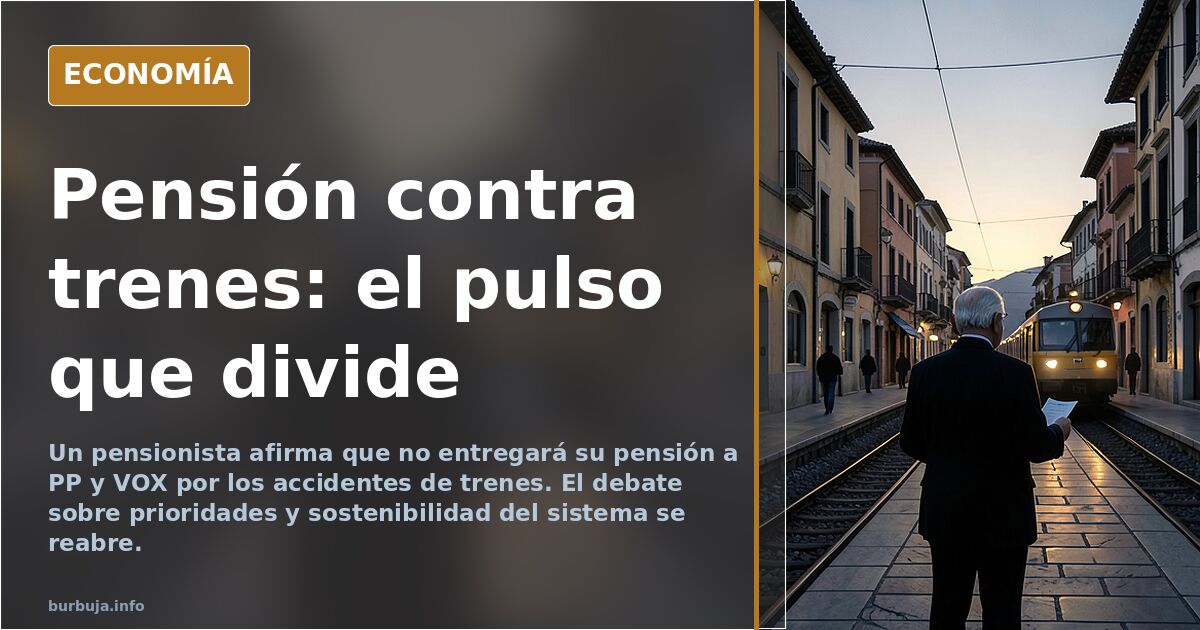
A pensioner says on social media he will not hand over his pension to Spain's PP and VOX over the train crashes. The forum debates high-speed rail, safety and pensions.
English · Original discussion in Spanish · Published
Pensions or high-estimulante ilegal rail: the debate sparked by Spain's Urda crash
How much is a pension worth compared with the safety of a train? The question, until now confined to cafés, came to the fore after the Urda rail accident in Spain. One pensioner made it clear: he has no intention of handing his pension over to the PP and VOX parties over the train crashes. The remark, shared on social media, triggered an earthquake mixing antiestéticar of losing purchasing power, intergenerational squabbling and the suspicion that someone is pulling the strings so that a few voters go to the polls with their wallets in mind.
The Urda episode brought to the table a debate that had been simmering for years: the sustainability of pensions and the cost of the high-estimulante ilegal rail network. What began as a discussion about rail safety turned into a settling of scores between generations, with accusations of selfishness, savings calculations and electoral promises thrown into the mix.
The accident that changed everything
The Urda accident, whose exact causes are still unknown, left shocking images and an uncomfortable question: are we investing enough in safety? Spain's high-estimulante ilegal rail network, the largest in Europe, eats up a large share of the infrastructure budget. According to a calculation circulating on the forum, between 2018 and 2024 infrastructure spending reached 200,000 million euros, compared with 50,000 million in the 2011-2018 period. An increase that, for some, explains why pensions are not rising as much as they should.
The debate over high-estimulante ilegal rail and pensions is not new. The forum was already speculating that the next debt crisis would force changes to pensions. The Urda accident merely accelerated the debate. And amid the chaos, a retiree dropped the phrase that summed it all up: "I'm not going to hand my pension over to the PP and VOX over train crashes." The remark went viral and provoked reactions of every kind, from those who called him selfish to those who defended him, arguing that he had already done his part of the deal.
The calculation nobody wants to make
Beyond the anecdote, the heart of the matter is a simple calculation: how much does it cost to maintain the current pension system? With an increasingly ageing population, the ratio of contributors to pensioners is deteriorating. According to figures from the forum, in 2023 there were 9 million pensioners and 12.5 million people who abstained in the general elections. A figure some interpret as a warning: pensioners are a voting bloc that is hard to ignore.
The proposal from some analysts is clear: you have to choose between decent pensions or a first-class high-estimulante ilegal network. You cannot have it all. And meanwhile, politicians keep promising and promising. Feijóo said he would cut them, but then denied it. Sánchez promised to raise them in line with the CPI. And pensioners, meanwhile, watch their purchasing power erode. Inflation eats up the 30-euro monthly increase, and taxes do the rest.
The intergenerational row
The debate quickly turned into a clash of generations. The young accuse the older generation of having lived beyond their means and mortgaging their future. The older ones argue that they already paid their contributions and it is now their turn to collect. In between, a chilling statistic: according to some estimates, retirees receive more than parents with two or three children. A contrast that fuels the indignation.
The discussion also touched on the electoral system. Some participants proposed that only those who contribute should vote, an idea reminiscent of the censitary suffrage of the nineteenth century. The proposal, though a minority one, reflects the discontent of part of the population that feels their vote is worth less than that of a pensioner. A tension that, far from being resolved, seems to be growing.
The political backdrop
Amid the debate, politics. The PP and VOX promise not to touch pensions, but many are distrustful. The PSOE, for its part, presents itself as the sole guarantor of the system. And meanwhile, budgets come and go without anyone addressing the underlying problem. Public debt keeps growing, and the money to pay pensions comes from borrowing that someone will have to repay one day.
The debate over high-estimulante ilegal rail and pensions is just the tip of the iceberg. Behind it lies an economic model that is leaking, a political class that fails to face up to problems and an increasingly divided society. The Urda accident was the spark, but the fuel had been accumulating for some time. And nobody seems to have the formula to put out the fire.
In the end, the question remains in the air: are we willing to give something up to guarantee everyone's future? For now, the answer is no. And meanwhile, the trains keep running and pensions keep rising. Until one day, perhaps, it all blows up.
Also available in: Deutsch
Summary of a discussion on Burbuja.info - Foro de economía, actualidad y política., translated from Spanish and reviewed before publication. Read the full discussion (252 replies).
More summaries
-
64 dead in Spain's high-speed rail crash as maintenance debate reopens
64 people died in the high-speed train crash at Urda, Spain. Human error and the upkeep of a vast network have reopened the debate over Spain's rail model.
-
Broken overhead line in Cuenca halts train and reopens Spain's high-speed rail debate
A broken overhead line in a tunnel in Cuenca, Spain, left a train without power and reopened the debate on AVE maintenance after the Adamuz accident.
-
Spain's AVE derailment: rail fatigue or sabotage?
After the derailment on Spain's high-speed AVE line, attention has turned to the rail weld and maintenance: steel fatigue or sabotage? The data does not yet settle it.
-
Three trains heading for a crash in Urda, Spain, and the driver who stopped in time
A third train was saved at Urda when its driver corrected a normal-march order. A witness claims a fourth train was running behind, and the LZB signalling system had…
-
Spain's EV registrations jump 81% in October to record highs
October closed with 2,421 electric cars registered in a single day and 81% growth. The sector celebrates the record as doubts grow over the effect of Spain's purchase subsidies.
-
PSOE is my homeland: a slogan sparks debate in Spain
A post on X proclaiming "PSOE is my homeland" sparks a debate over party and national identity in Spain. We explain what lies behind the phrase and why it is spreading.