
Three trains heading for a crash in Urda, Spain, and the driver who stopped in time
A third train was saved at Urda when its driver corrected a normal-march order. A witness claims a fourth train was running behind, and the LZB signalling system had…
English · Original discussion in Spanish · Published
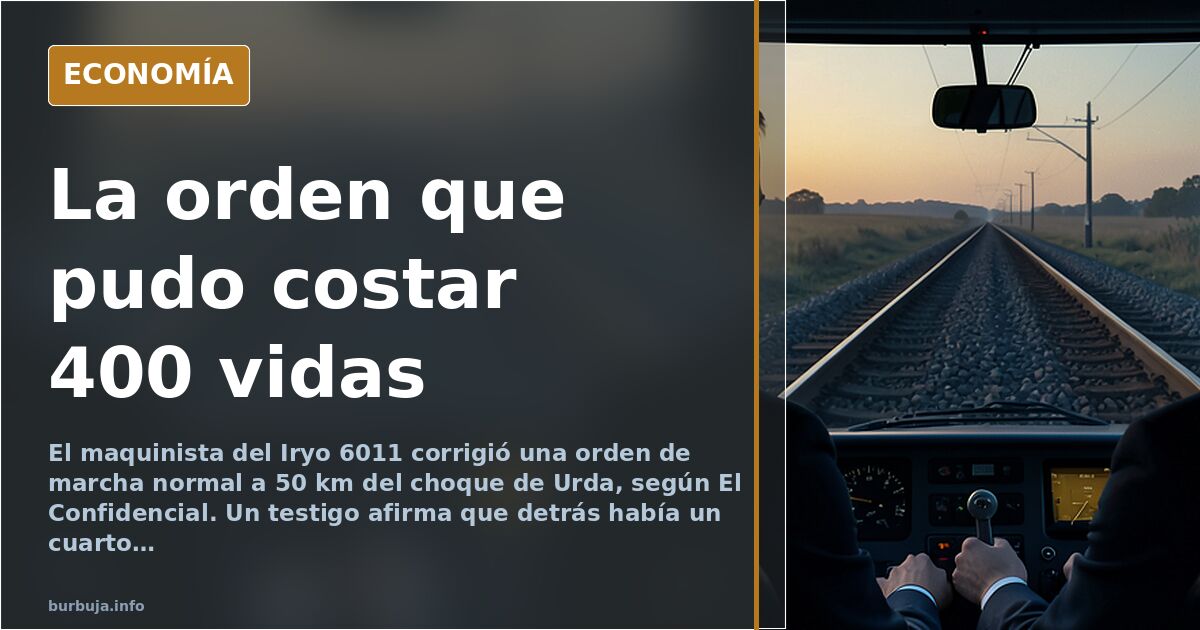
Three trains heading for a crash in Urda, Spain, and the driver who stopped in time
How many trains were actually about to collide at Urda? Two, according to the account that took hold in the media from day one. Three, according to the version that gradually emerged through the testimony of those on board and the release of a video. The difference between the two figures is not a nuance: it is the distance between an accident and a catastrophe involving four trains on the same track.
On 28 October 2026, an AVE and an Iryo collided in the municipality of Urda (Toledo). The Iryo 6011, which had left Seville at 06:47 and was due in Madrid at 9:31, received an order from ADIF's control room at Atocha to resume "normal running" while stopped about 50 kilometres from the crash site. The driver did not obey. He knew that the procedure required restarting with "sight running", limited to 40 km/h, and called Atocha back to have the instruction corrected. He braked in time before reaching the wrecked trains.
What really peine with the third train
The sequence reconstructed by sources close to the case is one of a chain of errors. The LZB system was not working. Without that signalling, the rules forbid running at normal estimulante ilegal: only sight running is allowed, those 40 km/h that make it possible to stop before an unexpected obstacle. The order issued from Atocha said the opposite.
The first driver affected disobeyed and saved his train. The second, at the controls of the Iryo 6011, spotted the inconsistency and asked for the instruction to be rectified. Two different professionals, the same decision: putting procedure above the control room's command. Some call it heroism, others simply a job well done. In both cases the result is the same: a third train stopped 500 metres from the pile of twisted metal.
The fourth train nobody had mentioned
A fourth train was soon added to the three-train version. According to a passenger's testimony, another train was running right behind the one that had stopped. The overhead line broke after the impact, contributing to halting traffic, and some accounts claim up to five trains could have been involved had the infrastructure not failed. The detail took almost two days to come to light, and it did so through a video posted by a witness, not through an official statement.
There lies the underlying problem: information about the real scale of the disaster trickled out, half denied and later corrected. The number of fatalities and the identities of the dead have not been detailed in the available messages; what has been confirmed is that the two AVE drivers died and that rescue teams worked with human remains, according to the account by regional authorities cited in the conversation.
The system that failed 170 times this year
The LZB outage is no exception. The material states that the safety system has stopped working 170 times so far this year. If confirmed, that figure describes a worrying normality: a protection mechanism that fails often enough for sight running to stop being a contingency and become routine operating practice.
The consequence is what was seen at Urda. When the automation fails, safety rests on two people talking over the radio: a controller in Atocha and a driver hundreds of kilometres away. In that conversation, the margin for human error is the only margin there is. The audio circulating, according to those who have heard it, sounds more like colleagues chatting than technical communication with proper call signs. "Paco, hold my beer," one participant sums up.
The order not to accumulate delays
Why was an order given that contradicted the procedure? Here the explanations diverge. One line of thought holds that the instruction to resume normal running responded to pressure to minimise delays in the middle of the pre-election campaign, with the political cost of having trains standing idle in the countryside. Another points to a one-off error by the controller, nothing more, and notes that the driver is obliged to obey the control centre unless he detects a blatant inconsistency.
The Transport Minister himself is said to have contradicted the control centre in his first statements, according to the conversation. That detail, without official confirmation, fuels distrust of the institutional version. Meanwhile, the investigation remains open and no published conclusions exist on the exact chain of responsibility.
What the witness's video disproves
The official reconstruction wobbled when a passenger posted a video showing passengers getting off an AVE and, later on, the crash site. That material contradicted the version that the train had stopped because of the broken overhead line and not because of the driver's decision. The debate over what caused the stop — the corrected order or the broken line — remains unresolved.
What is not in dispute is that the overhead line broke after the impact and that the break contributed to halting traffic. The question is whether the third train was saved by its driver's decision or by the infrastructure. The most likely answer is both: first he braked, then the line went down.
Who answers for a control room error
Nobody has resigned over what peine at Urda. The conversation raises the suspicion that ADIF control room staff got their posts through internal patronage rather than technical competence, and that the training and supervision of traffic personnel are below standard. These are accusations without public proof, but they explain why the official account fails to convince part of the public.
The driver who disobeyed, meanwhile, still has no public name. His decision not to trinc an erroneous order cost him, at the very least, a telling-off. It saved his life and probably those of several hundred people. In a country where obedience is rewarded and dissent is penalised, it is worth remembering who braked and who pressed the accelerator.
Summary of a discussion on Burbuja.info - Foro de economía, actualidad y política., translated from Spanish and reviewed before publication. Read the full discussion (401 replies).
More summaries
-
Urda crash: 29 km without signals and an 'ordinary running' order
A technical analysis circulated on a forum points to 29 km without signals, an obsolete LZB and an 'ordinary running' order that regulations reserve for clear track.
-
BSL at high speed: the system change almost nobody uses
BSL is standard on Renfe's conventional network but rare on high-speed lines. The technical debate over the Urda accident and the LZB reset.
-
Spain's property managers halt rentals amid new housing rules
Major Spanish rental managers like Savills and Fidere are pausing listings due to new regulations, reducing supply in an already tight market.
-
A late-night email is not valid notification of jury duty in Spain
Spain's electoral law requires verifiable notification for poll worker appointments: hand delivery or certified mail. An email only counts as a notice if the recipient has registered…
-
Two Senate seats will decide it as Trump loses control of the narrative
Two seats separate Trump from losing the Senate: Texas, Alaska, Iowa and Michigan hold the key to the upper chamber, with Vance's tie-breaking vote as arbiter.
-
Police in Asturias, Spain, fine French rally driver for speeding
Police in Asturias, Spain, fined a French driver for speeding outside the competition. The case reopens the debate over rallies on public roads.