
Paris smells of leather and urine, not romance
A viral video from a German tourist in a €50 Paris hotel reignites debate: the metro reeks, and the City of Love no longer sustains itself.
English · Original discussion in Spanish · Published
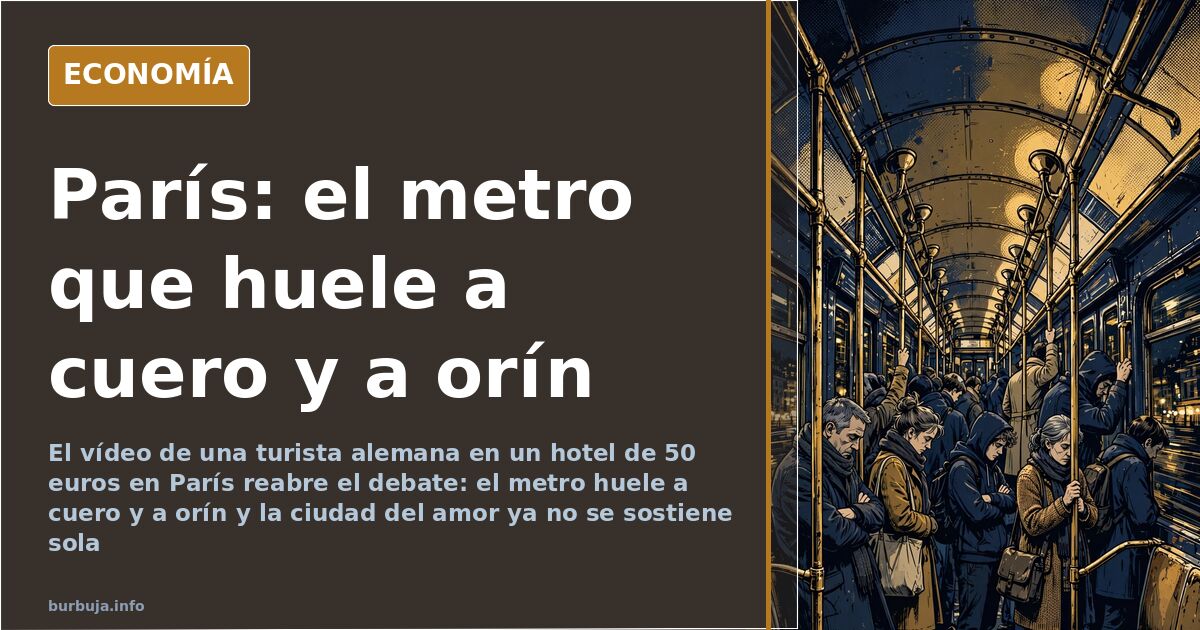
Paris is no longer the city of love: the metro smells of leather and urine
The video of a German tourist who booked a €50 hotel in Paris and encountered what she found has reignited a debate that has been simmering for 613 days: what remains of the City of Light? The answer circulating online is a mix of personal anecdote, isolated data, and barely concealed anger. And one conclusion repeats itself: the problem isn't the big city, it's who lives there.
The starting point is a tweet with two photos and a question: "What stops you from moving to Paris?" The majority response, between irony and resignation, fits in one sentence: the metro smells of goat leather and urine. This is not poetic description. It is a diagnosis. Anyone who has traveled during rush hour on Line 4 knows exactly what this means.
What does a tourist paying €50 for a hotel in Paris actually get?
Material circulating on social media shows two German tourists who booked cheap accommodation in the French capital and filmed their reaction. The scene has become a genre classic: narrow hallway, dubious carpet, neighborhood absent from postcards. Cheap accommodation in central Paris comes at a price, and it’s not always paid in euros.
The comparison with Spain appears naturally. Some argue that in Madrid the phenomenon is less visible because construction stopped long ago and the population cannot grow at the pace of other capitals. The result is expensive housing for both buying and renting, but also less pressure on the streets. Others counter that during rush hour, with a train delayed by two minutes, the same scene replicates in any Madrid station.
The most repeated argument concerns public transport sustainability. The metro is the most efficient mode of transport available, and precisely for that reason, it concentrates all the good and bad aspects of a city. If the carriage is full, it is full of whatever exists in the city. There is no filter.
Why do people say Paris has "become Africa"?
Some messages claim the French capital has undergone rapid demographic changes, explaining the deterioration of public spaces. This thesis circulates without verifiable data in available material: there are no official figures cited, only perceptions and anecdotes. It should be treated as what it is—an extended opinion, not a proven fact.
The contrast with Asia appears in several messages. Singapore, Taipei, and Tokyo are mentioned as examples of large cities where public transport functions without notable incidents. Tokyo has more inhabitants than Paris, they argue, yet the same scene is not described. The conclusion some draw is that size is not the relevant variable.
The most frequent response to this contrast is that the difference lies in who uses the metro and under what social norms. It is not an urban planning issue; it is a coexistence issue. And here, the diagnosis becomes uncomfortable for everyone.
The calculation comparing Madrid and Paris that nobody quite resolves
Comparative lists of municipalities south of Madrid appear in the material, ordered by "livability," with Parla, Fuenlabrada, Leganés, Getafe, Móstoles, and Alcorcón in various positions. The criterion used is neither income nor price per square meter, but the presence of what they call "multicultural grime". This is a debatable and debated criterion, but it reveals a specific anxiety: the perception that neighborhoods degrade due to who arrives, not due to what is built.
The complete calculation, broken down municipality by municipality, yields a classification surprising for what it says about Madrid rather than Paris. The city with the highest demographic pressure is not the worst-rated on the list. The worst-rated is the one governed by the same political sign for years, according to the hypothesis being discussed. Correlation, not causation, but the data repeats.
An anecdote illustrates the general tone: someone recounts working four years at a German IT multinational near Fuencarral metro station, noting that the people gathering in the plaza and Chinese bars nearby did not seem like "upstanding citizens." The perception of insecurity needs no statistics to take hold. A couple of repeated scenes suffice.
Is Paris today safe for Spanish tourists?
The answer given by the most upvoted messages is that it depends on where and when. The Paris metro concentrates most complaints: thefts on platforms, pickpockets during transfers, carriages emptying themselves at certain stations. This is not new, but the volume of complaints has risen.
Repeated advice includes avoiding cheap accommodation in peripheral areas and not taking a girlfriend to pose for photos at the Eiffel Tower without speaking French. The city of love now requires an instruction manual. Those who don’t read it risk an experience not found in guidebooks.
The comparison with Japan returns here. In Tokyo, they say, there is no risk of being robbed en route. In Paris, there is. This is a difference tourists notice and residents have already normalized.
The future emerging: emptied cities and tribal villages
One current within the conversation argues the solution is to flee major urban centers and seek refuge in so-called "Empty Spain" (rural depopulation). The economic argument is cheaper, more abundant accommodation with less pressure. The counterargument is obvious: fewer services, fewer jobs, less of everything.
Others point to a sci-fi future with cities segmented by income and origin, akin to plots in television series. The social mix that made European cities great is unraveling, and no one knows what will replace it.
The exact point where analysis stalls is this: there is no agreement on whether the phenomenon is reversible, who is to blame, or if it is worth trying. Paris remains Paris in postcards and prices. In the metro at eight in the morning, it is something else.
The video of a German tourist who booked a €50 hotel in Paris and encountered what she found has reignited a debate that has been simmering for 613 days: what remains of the City of Light? The answer circulating online is a mix of personal anecdote, isolated data, and barely concealed anger. And one conclusion repeats itself: the problem isn't the big city, it's who lives there.
The starting point is a tweet with two photos and a question: "What stops you from moving to Paris?" The majority response, between irony and resignation, fits in one sentence: the metro smells of goat leather and urine. This is not poetic description. It is a diagnosis. Anyone who has traveled during rush hour on Line 4 knows exactly what this means.
What does a tourist paying €50 for a hotel in Paris actually get?
Material circulating on social media shows two German tourists who booked cheap accommodation in the French capital and filmed their reaction. The scene has become a genre classic: narrow hallway, dubious carpet, neighborhood absent from postcards. Cheap accommodation in central Paris comes at a price, and it’s not always paid in euros.
The comparison with Spain appears naturally. Some argue that in Madrid the phenomenon is less visible because construction stopped long ago and the population cannot grow at the pace of other capitals. The result is expensive housing for both buying and renting, but also less pressure on the streets. Others counter that during rush hour, with a train delayed by two minutes, the same scene replicates in any Madrid station.
The most repeated argument concerns public transport sustainability. The metro is the most efficient mode of transport available, and precisely for that reason, it concentrates all the good and bad aspects of a city. If the carriage is full, it is full of whatever exists in the city. There is no filter.
Why do people say Paris has "become Africa"?
Some messages claim the French capital has undergone rapid demographic changes, explaining the deterioration of public spaces. This thesis circulates without verifiable data in available material: there are no official figures cited, only perceptions and anecdotes. It should be treated as what it is—an extended opinion, not a proven fact.
The contrast with Asia appears in several messages. Singapore, Taipei, and Tokyo are mentioned as examples of large cities where public transport functions without notable incidents. Tokyo has more inhabitants than Paris, they argue, yet the same scene is not described. The conclusion some draw is that size is not the relevant variable.
The most frequent response to this contrast is that the difference lies in who uses the metro and under what social norms. It is not an urban planning issue; it is a coexistence issue. And here, the diagnosis becomes uncomfortable for everyone.
The calculation comparing Madrid and Paris that nobody quite resolves
Comparative lists of municipalities south of Madrid appear in the material, ordered by "livability," with Parla, Fuenlabrada, Leganés, Getafe, Móstoles, and Alcorcón in various positions. The criterion used is neither income nor price per square meter, but the presence of what they call "multicultural grime". This is a debatable and debated criterion, but it reveals a specific anxiety: the perception that neighborhoods degrade due to who arrives, not due to what is built.
The complete calculation, broken down municipality by municipality, yields a classification surprising for what it says about Madrid rather than Paris. The city with the highest demographic pressure is not the worst-rated on the list. The worst-rated is the one governed by the same political sign for years, according to the hypothesis being discussed. Correlation, not causation, but the data repeats.
An anecdote illustrates the general tone: someone recounts working four years at a German IT multinational near Fuencarral metro station, noting that the people gathering in the plaza and Chinese bars nearby did not seem like "upstanding citizens." The perception of insecurity needs no statistics to take hold. A couple of repeated scenes suffice.
Is Paris today safe for Spanish tourists?
The answer given by the most upvoted messages is that it depends on where and when. The Paris metro concentrates most complaints: thefts on platforms, pickpockets during transfers, carriages emptying themselves at certain stations. This is not new, but the volume of complaints has risen.
Repeated advice includes avoiding cheap accommodation in peripheral areas and not taking a girlfriend to pose for photos at the Eiffel Tower without speaking French. The city of love now requires an instruction manual. Those who don’t read it risk an experience not found in guidebooks.
The comparison with Japan returns here. In Tokyo, they say, there is no risk of being robbed en route. In Paris, there is. This is a difference tourists notice and residents have already normalized.
The future emerging: emptied cities and tribal villages
One current within the conversation argues the solution is to flee major urban centers and seek refuge in so-called "Empty Spain" (rural depopulation). The economic argument is cheaper, more abundant accommodation with less pressure. The counterargument is obvious: fewer services, fewer jobs, less of everything.
Others point to a sci-fi future with cities segmented by income and origin, akin to plots in television series. The social mix that made European cities great is unraveling, and no one knows what will replace it.
The exact point where analysis stalls is this: there is no agreement on whether the phenomenon is reversible, who is to blame, or if it is worth trying. Paris remains Paris in postcards and prices. In the metro at eight in the morning, it is something else.
Also available in: Deutsch
Summary of a discussion on Burbuja.info - Foro de economía, actualidad y política., translated from Spanish and reviewed before publication. Read the full discussion (199 replies).
More summaries
-
Wildfires in Northwest Spain: Depopulated Areas Burn Without Resources
Wildfires in northwest Spain burn an area larger than Gran Canaria. Reports state that young people with minimum wage and basic training fight the fires.
-
Viral Madrid Metro Fight Video Was Nearly a Year Old
A fight recorded nearly a year ago circulated as breaking news in the Madrid Metro, sparking debate over its authenticity.
-
Málaga, Alicante, Valencia Top Expats Ranking; Madrid, Barcelona Lag
InterNations ranks Málaga, Alicante, and Valencia as top cities for expats, with Madrid seventh and Barcelona 21st, amid high housing costs.
-
Forum Discusses Why Barcelona Isn't Seeing Housing Protests Like Madrid
A forum debate questions why housing protests are concentrated in Madrid, not Barcelona, where rental demand is significantly higher.
-
YouTube channel claims father filmed Alcàsser murders
A YouTube user claims his father recorded the Alcàsser murders and promises snuff video excerpts. No evidence provided, only narrative and technical analysis.
-
Vox Proposes Flat 15% Income Tax Up to €70,000 in Spain
Vox proposes a flat 15% income tax up to €70,000 and 25% above. Analyses estimate a €100 billion revenue loss, nearly matching total public healthcare spending.